
Bimolecular Elimination
There is yet another elimination mechanism: bimolecular elimination (E2). Watch it in motion:
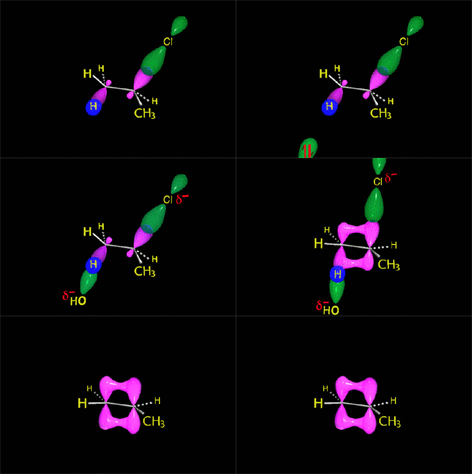
Bimolecular elimination (E2) takes place without reactive intermediates, through a single TS in which the base removes the proton at the same time as the leaving group departs. The two involved carbons change hybridization from sp3 to sp2.
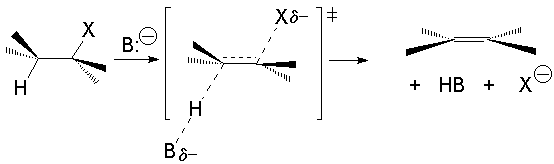
E2 kinetics depends on both the halide and the base/nucleophile and is therefore second order: the E2 reaction is bimolecular.
The E2 reaction proceeds with a fixed stereochemistry: the leaving group and the hydrogen on the adjacent carbon must be in an ANTIPERIPLANAR arrangement.
The following experimental data prove the existence of the E2 mechanism and of its strict stereochemical requirements:

The meso isomer of 2,3-dibromobutane exclusively gives the E olefin by elimination of HBr, whereas either of the other two diastereomers, (R,R) or (S,S) or their racemic mixture gives the Z olefin. Would this STEREOSPECIFICITY be possible if the mechanism weren't E2?
On the other hand, is there any way to explain the different elimination rate displayed by the cis and trans isomers of 1-bromo-4-tert-butylcyclohexane other than by an E2 mechanism?
In order to do that, consider which chair conformer is the most populated in each isomer's equilibrium...
Which of the two bears the H and Br in ANTIPERIPLANAR arrangement?
