Nitration of benzene
This is our reference reaction: the nitration of benzene with a mixture of nitric and sulfuric acids under given conditions, which will be identical in all cases. Therefore, the variations observed relative to benzene will be due only to the substituent already present in each substituted benzene.
We will discuss three aspects of the data in the table:
1) Electron density
In benzene there is a certain excess of electron density (in red) evenly distributed over the carbon atoms, compensated by the electron density deficit of the peripheral hydrogens (in blue).
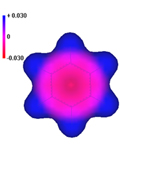
In benzene the carbon atoms are susceptible to electrophilic attack because they have an excess of electron density.
2) Reaction rate relative to benzene
Benzene is the reference: its relative rate is krel = 1.
3) Direction of substitution
The six positions of benzene are equivalent, so only one product, nitrobenzene, is obtained.