Nitration of toluene
1) Electron density
The methyl group slightly increases the electron density of the ring. The methyl's sp3 orbitals have lower s character than the ring sp2 carbons and are thus slightly less electronegative. The ring carbons are able to feebly withdraw electron charge from the methyl group.
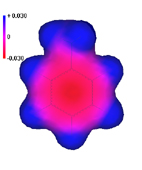
2) Relative rate to benzene
Toluene reacts 25 times faster than benzene, which experimentally proves that a methyl group delivers a small but sizeable amount of electron charge to the ring, slightly lowering the activation energy as compared to benzene.
3) Substitution direction
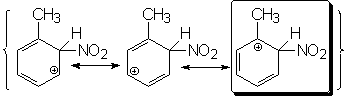
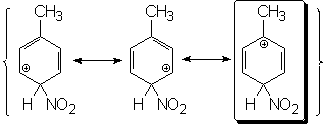
Substitution mainly takes place at the ortho and para positions. Accordingly, the benzenonium ions corresponding to these positions must be less unstable than the meta one. Their resonance forms give us the answer.
Ortho substitution
Para substitution
Meta substitution
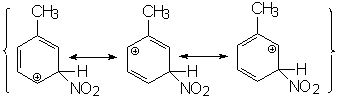
The meta case is the only one where the positive charge cannot be located at the carbon bearing the methyl group and thus cannot be further delocalized and stabilized.
The energy diagram of toluene nitration is qualitatively similar to that of phenol and the explanation is identical.
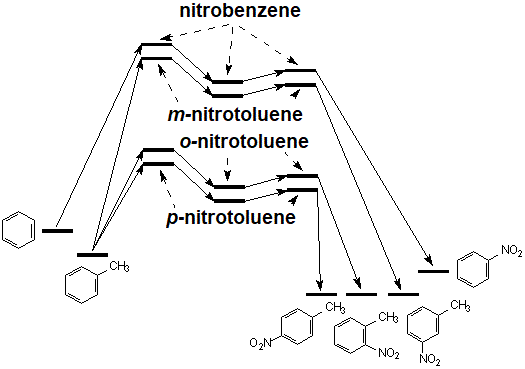
The ortho:para isomer ratio is in this case 58:38, which equals 1:1.3 after removing the statistical factor. The ortho and para pathways are closer in energy than in the case of phenol.