Nitration of trifluoromethylbenzene
1) Electron density
The CF3 group withdraws a substantial amount of electron density from the ring due to the extreme electronegativity of the three fluorine atoms. The ortho and para positions are the most affected.
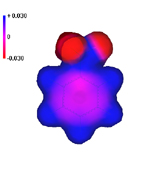
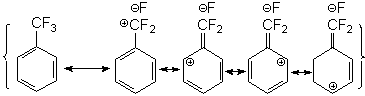
The hyperconjugative resonance forms won't have a high contribution to the resonance hybrid but they allow us to explain why the ortho and para positions bear the lowest electron density.
2) Relative reaction rate
Trifluoromethylbenzene reacts much more slowly (about 30,000 times) than benzene. That's experimental proof of the heavy electron withdrawing ability of this group. The benzenonium ion is much less stable when the CF3 group is attached to it.
3) Substitution direction
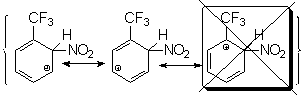
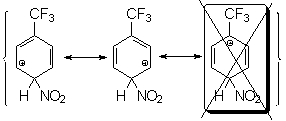
Substitution takes place almost exclusively at the meta position. Accordingly, the benzenonium ions corresponding to ortho and para substitution are in this case way more unstable than the meta one. The resonance forms give us the clue as usual.
Ortho substitution
Para substitution
Meta substitution
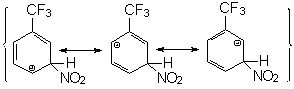
The positive charge of the benzenonium intermediate delocalizes throughout ortho and para positions relative to the site of attack. It is very unfavorable for the charge to lie on the carbon bearing the electronegative CF3 group. This doesn't happen in the meta case and hence this is the least unstable intermediate.
The reaction energy diagram is not comparable to those of phenol, toluene or even benzyl chloride.
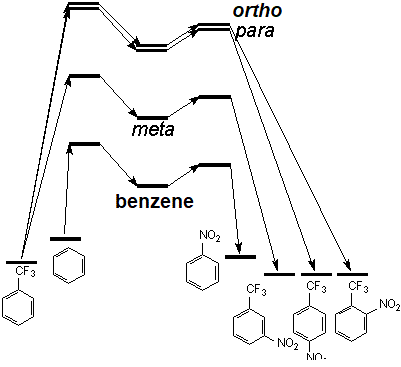
Trifluoromethylbenzene reacts much more slowly than benzene and hence its pathways should be higher in energy than benzene's. Of the three possible orientations, the meta one must follow the lowest energy pathway because that's the major product.