Nitration of chlorobenzene
1) Electron density
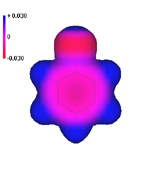
The highest electron density is located at the chlorine atom but the ring density is not very different to benzene's.
2) Relative reaction rate
Chlorobenzene reacts more slowly than benzene, but not dramatically (about 30 times). Chlorine is a slight deactivator of the SEAr.
3) Substitution direction
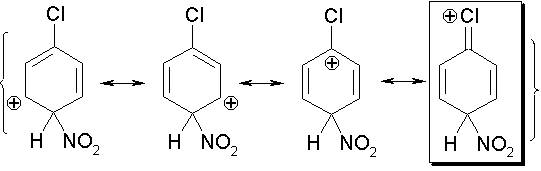
Chlorine happens to be an ortho-para director in spite of being a deactivator. All chlorobenzenonium ions are more unstable than benzenonium, but the orientation pattern tells us that the least unstable chlorobenzenonium ions are the ortho and para ones. Why's that? The resonance structures have to be able to explain that.
Ortho substitution
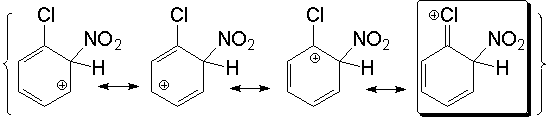
Para substitution
Meta substitution
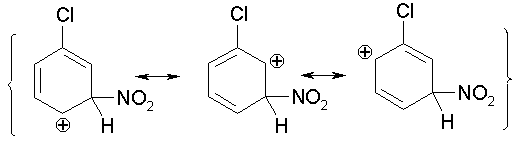
The fact that ortho and para orientations are preferred must mean that the chlorine comes along with a positive charge on the carbon it is attached to. Although highly electronegative, it has lone electron pairs to share in order to stabilize the positive charge. This is a situation similar to that of phenol with the difference that an OH activates and a Cl deactivates the SEAr. It seems that the Cl steals electron density from the aromatic ring but, once the SEAr is on its way, Cl contributes to the stabilization of the positive charge.
The energy diagram as compared to benzene's is as follows:
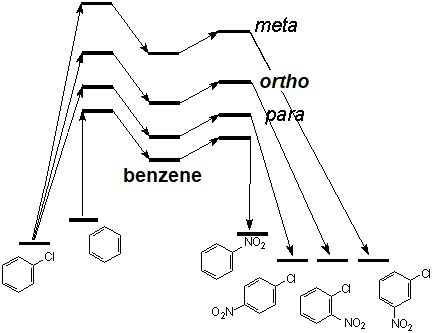
Chlorobenzene reacts somewhat more slowly than benzene. Therefore, all the three possible pathways should be higher in energy than that of benzene, yet the ortho and para pathways should lie lower than the meta one. The ortho:para ratio is 30:70 or 1:4.7 after the statistical correction. There should then be a sizeable gap between the para and ortho pathways.