Nitration of nitrobenzene
1) Electron density
The NO2 group withdraws a high amount of electron density from the ring due to the high electronegativity of its constituting atoms.
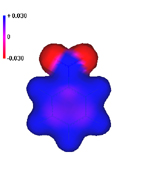
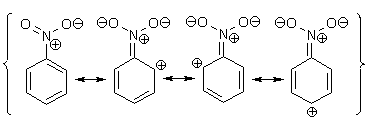
The aromatic ring appears to be almost depleted of electron density save at the meta positions. These are the likely sites where the SEAr would take place. The resonance forms suggest that the ortho and para positions are devoid of electron density.
2) Relative reaction rate
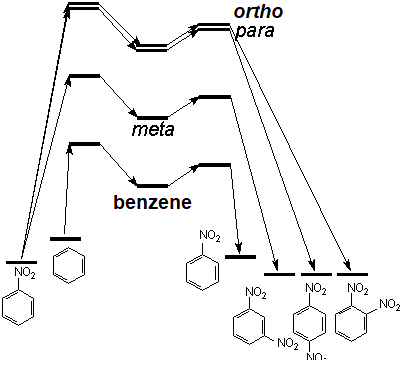
Nitrobenzene reacts 16 million times slower than benzene. A second SEAr on nitrobenzene is actually impractical.
3) Substitution direction
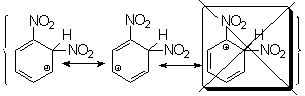
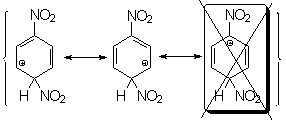
As our previous study predicted, the SEAr on nitrobenzene occurs almost exclusively at the meta position. The resonance forms of the nitrobenzenonium ion are very self-explanatory.
Ortho substitution
Para substitution
Meta substitution
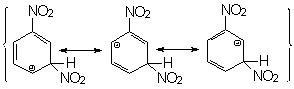
The worst possible situation is when the carbon attached to the nitro group sustains a positive charge. That happens in one resonance form of the ortho and para orientations, but not in the meta one. Substitution at meta is difficult, but at ortho and para it is almost impossible.
The energy diagram is very similar to that of trifluoromethylbenzene.