Nitration of trimethylammoniumbenzene
1) Electron density
The NMe3 group with a positive formal charge heavily diminishes the electron density of the ring due to the high electronegativity of a positively charged nitrogen.
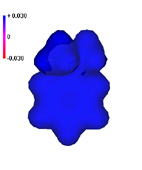
Unlike nitrobenzene where the NO2 group withdraws electron density by resonance effect, the NMe3 cannot resonate with the ring because it has a complete octet. Despite that, its high electronegativity makes it strongly withdraw electron density by inductive effect.
2) Relative reaction rate
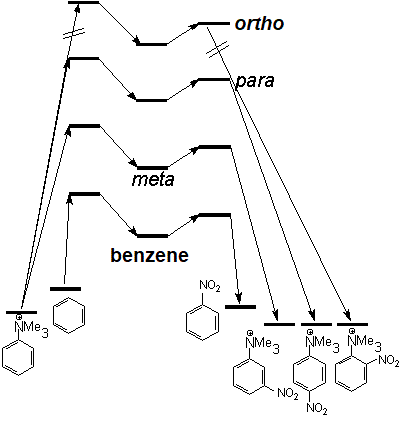
Trimethylammoniumbenzene reacts even slower than nitrobenzene. It reacts about 83 million times more slowly than benzene. The NMe3 group completely deactivates the ring to which it is attached and a new SEAr is totally impractical. Never attempt an SEAr on an ammoniumbenzene derivative of any kind!
3) Substitution direction
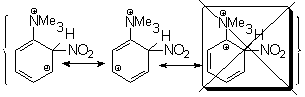
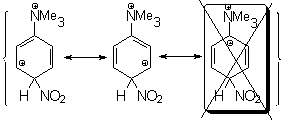
After an extremely long reaction time, substitution mainly ends up at the meta position. The explanation is clearly given by the resonance forms of the benzenonium intermediate.
Ortho substitution
Para substitution
Meta substitution
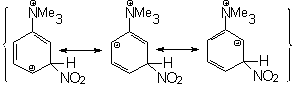
Like nitrobenzene the worst possible situation is when the carbon attached to the NMe3 group sustains a positive charge. That happens in one resonance form of the ortho and para orientations, but not in the meta one. Substitution at meta is quite difficult, at para extremely hard and at ortho simply impossible because of the added steric hindrance.
The energy diagram is qualitatively similar to nitrobenzene's but with the ortho pathway at an insurmountable height.