Nitration of benzoic acid
1) Electron density
The COOH group withdraws electron charge by resonance effect. Its capacity is a tad higher than that of the halogens by inductive effect but with a notable difference: the remaining electron density in the ring ends up concentrated at the meta positions.
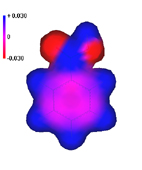
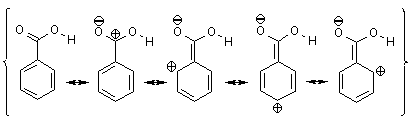
The resonance forms indicate that the COOH group places positive charges on the ortho and para positions, something that didn't occur with the halogens that only acted through their inductive effect. Therefore, COOH and halogens seem to have the same deactivating effect but the induced orientation of the SEAr is different.
2) Relative reaction rate
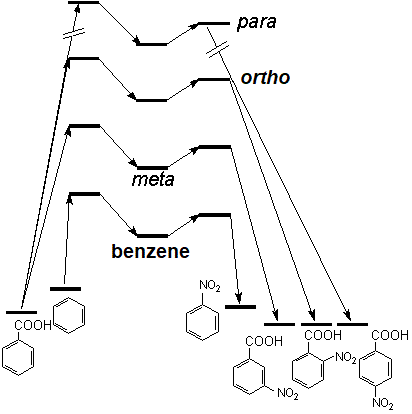
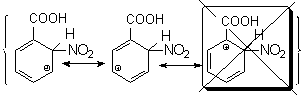
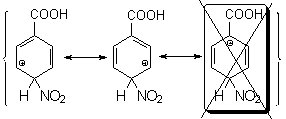
Benzoic acid reacts 250 times slower than benzene showing that a COOH group deactivates the ring towards an SEAr but not heavily. The benzenonium intermediate is less stable when a COOH is attached to it and accordingly this group raises the activation energy of the process. Let's have a look at the resonance forms.
Ortho substitution
Para substitution
Meta substitution
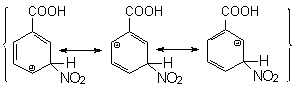
As we have already seen in various previous cases (nitrobenzene for example) the worst possible situation is when the carbon attached to the COOH group sustains a positive charge. That happens in one resonance form of the ortho and para orientations, but not in the meta one. In this case the meta derivative is the major product, but notice that no para isomer is obtained. The COOH is a group that can establish strong hydrogen bonding with the incoming reactants, thus giving the ortho position a good chance to react.
The energy diagram must place the para pathway at an insurmountable height and the other two, meta and ortho, above that of benzene.