Chandrasekhara Venkata Raman (1888-1970)
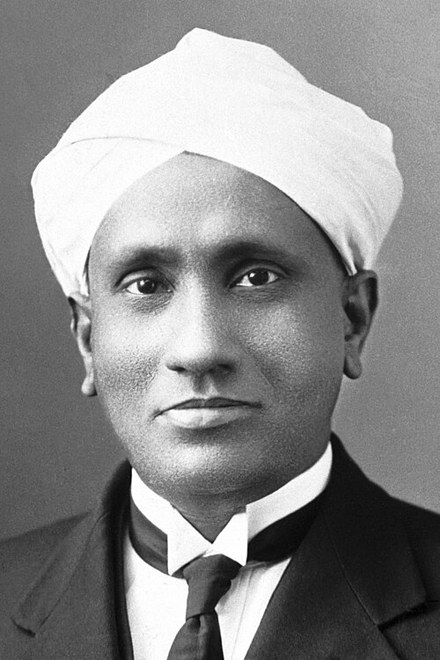
Indian physicist born in Tiruchirappalli, in southern India. He studied at Presidency College, Madras, and since a scientific career was not easy to pursue in his country at the time, he started work as a civil servant in the finance department in Calcutta. In his spare time he did research at the Indian Association for the Cultivation of Science, mainly in acoustics and optics. In 1917 he became professor of physics at the University of Calcutta.
Intrigued by the blue colour of the sea, he began to study how liquids scatter light. In 1928, with his collaborator K. S. Krishnan, he observed that a small part of the scattered light changed colour, and attributed it to the energy exchanged between the light and the vibrations of the molecules: the Raman effect. They detected it with filtered sunlight, a spectroscope and great patience, without lasers.
He received the 1930 Nobel Prize in Physics, the first awarded to an Asian scientist in a scientific discipline. He later directed the Indian Institute of Science in Bangalore and founded the Raman Research Institute. In India, 28 February, the anniversary of his discovery, is celebrated as National Science Day.
More information: en.wikipedia.org