
Infrared radiation and molecular vibrations
The bonds in a molecule are not rigid: they vibrate all the time, stretching and bending like springs. Infrared radiation has just the right energy to excite those vibrations, and each type of bond absorbs at a characteristic frequency, which depends on the mass of the atoms and on the strength of the bond.
The infrared region of the spectrum
Infrared (IR) radiation lies between visible light and microwaves (see Electromagnetic radiation and spectroscopies). For organic chemistry the important part is the mid-infrared, with wavelengths from 2.5 to 25 µm.
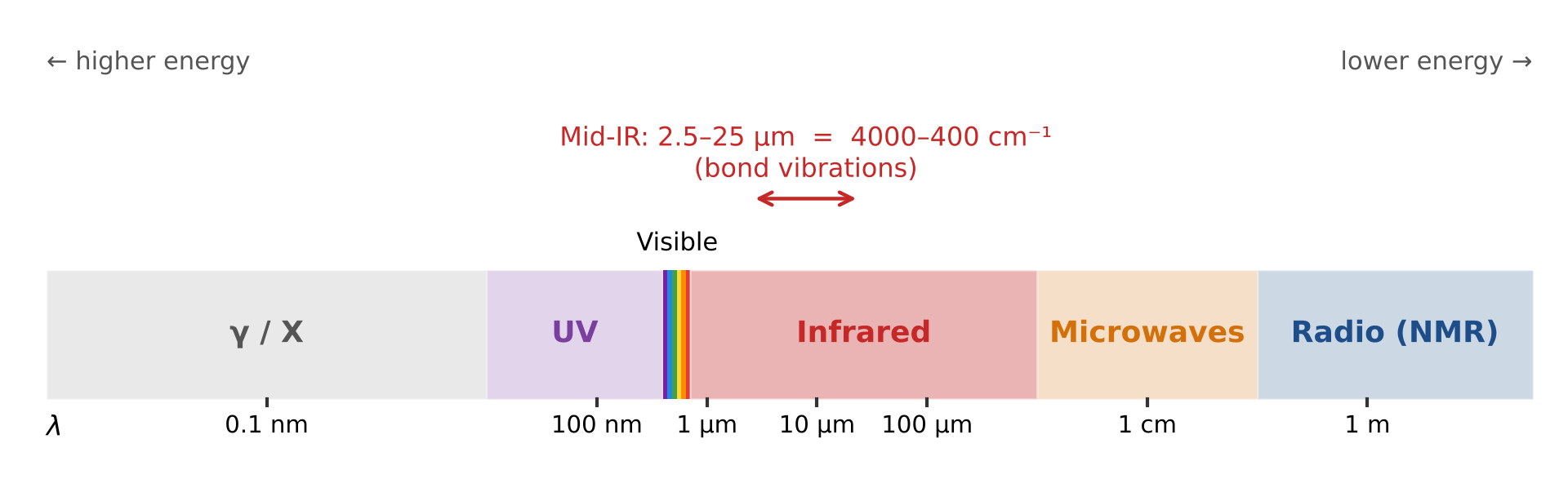
IR spectroscopy does not use the wavelength but the wavenumber, ν̃ = 1/λ, expressed in cm−1, which is proportional to the frequency and to the energy:
E = h·c·ν̃
Thus 2.5 µm = 2.5·10−4 cm corresponds to 4000 cm−1, and 25 µm to 400 cm−1. Multiplying by Avogadro's constant, 1 cm−1 is equivalent to 0.01196 kJ/mol: mid-IR radiation carries between 4.8 and 48 kJ/mol, much less than the energy of a C–C bond (about 350 kJ/mol). It does not break bonds; it only makes them vibrate with greater amplitude.
The bond as a spring
To a first approximation, a bond between two atoms behaves like a spring joining two masses: a harmonic oscillator. According to Hooke's law, its vibrational wavenumber is:
ν̃ = (1/2πc)·√(k/μ), with μ = m1·m2/(m1 + m2)
where k is the force constant of the bond (its stiffness) and μ the reduced mass of the two atoms. Two rules follow from this formula, and they explain almost the whole spectrum:
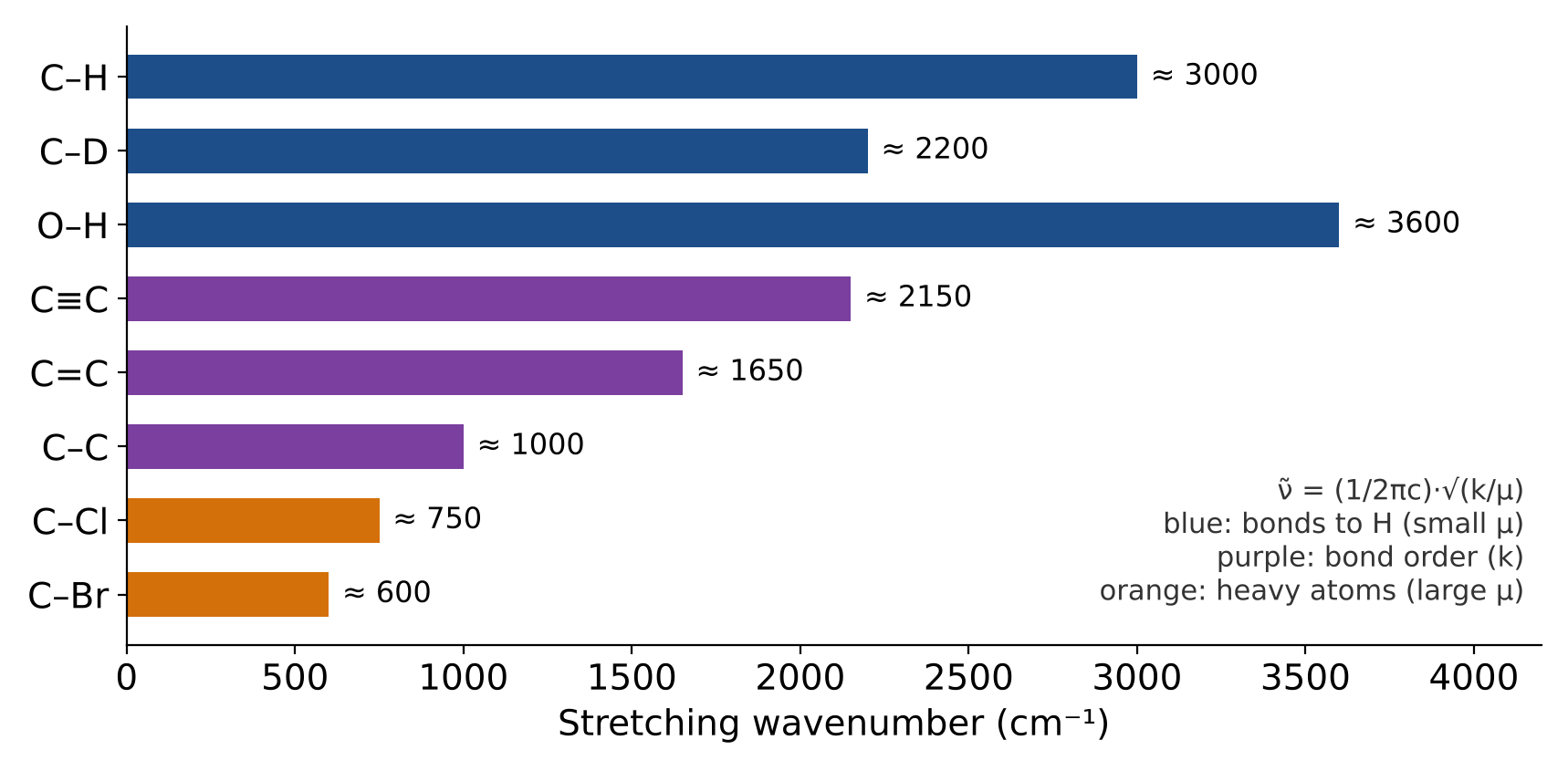
- The lighter the atoms, the higher the wavenumber. Bonds to hydrogen (C–H, O–H, N–H) vibrate above 2800 cm−1, whereas bonds to heavy atoms (C–Cl, C–Br) vibrate below 800 cm−1. Replacing H by deuterium almost doubles the reduced mass, and the C–H stretch moves from about 3000 to about 2200 cm−1.
- The stronger the bond, the higher the wavenumber. A triple bond is stiffer than a double bond, which in turn is stiffer than a single bond: C≡C absorbs around 2150 cm−1, C=C around 1650 and C–C around 1000.
Quantum mechanics adds that vibrational energy is quantized: the oscillator can only be in the levels v = 0, 1, 2… At room temperature almost all molecules are in the ground level, and the strong band of the spectrum corresponds to the jump v = 0 → 1 (the fundamental band). The jump 0 → 2 gives a weak overtone at almost twice the wavenumber.
Vibrational modes
A molecule of N atoms has 3N degrees of freedom, of which three are translations and three are rotations (two if the molecule is linear). That leaves 3N − 6 normal modes of vibration (3N − 5 for linear molecules). Water, for example, has three: the symmetric stretch (3657 cm−1 in the gas phase), the asymmetric stretch (3756) and the bend (1595).
The models below show the three modes of water, exaggerated and in very slow motion. The yellow arrows show how each atom moves; you can rotate the molecules with the mouse.
All three modes change the dipole moment of water, so all three absorb in the IR. Notice that the much lighter hydrogen atoms move far more than the oxygen: the centre of mass of the molecule does not move.
Vibrations fall into two broad types:
- Stretching changes bond lengths. It can be symmetric or asymmetric.
- Bending changes bond angles. It takes less energy than stretching, so it appears at lower wavenumbers. In a CH2 group, scissoring, rocking, wagging and twisting can be distinguished.
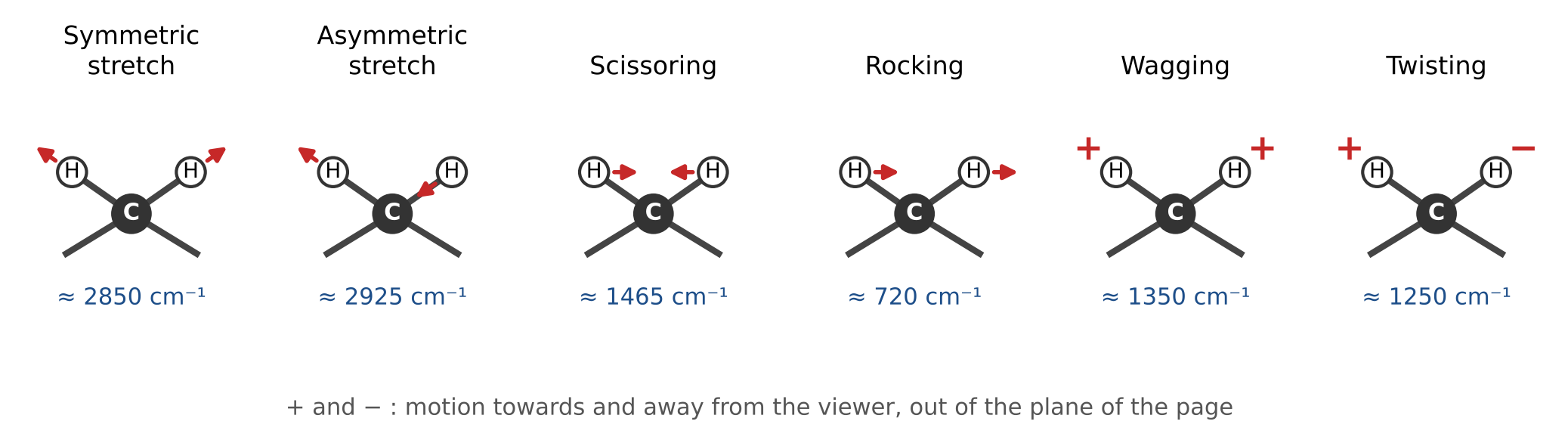
Although a medium-sized organic molecule has hundreds of normal modes, many of them are concentrated in one bond or one group of atoms and hardly depend on the rest of the molecule. That is why each functional group has its own characteristic bands, which is what makes IR spectroscopy useful.
The selection rule: the dipole moment
Not every vibration absorbs infrared radiation. For a vibration to interact with the electric field of the radiation, it must change the dipole moment of the molecule. The larger that change, the more intense the band.
- Very polar bonds, such as C=O, O–H or C–O, give strong bands. The carbonyl band is usually the strongest in the spectrum.
- Weakly polar bonds, such as C=C or C≡C, give weak bands. In a symmetric alkene or alkyne, such as trans-but-2-ene or but-2-yne, stretching the multiple bond does not change the dipole moment and the band does not appear.
- Homonuclear diatomic molecules (N2, O2) do not absorb in the IR. That is why air is transparent in this region, except for water vapour and CO2, which are the greenhouse gases.
Raman spectroscopy
Raman spectroscopy also measures molecular vibrations, but by scattering of light rather than by absorption. The sample is illuminated with a monochromatic laser of frequency ν0, in the visible or near infrared, and the light leaving in other directions is analysed. Almost all of it has the same frequency as the laser (Rayleigh scattering), but a very small fraction, of the order of one part in ten million, leaves with a slightly lower or higher frequency: this is Raman scattering, discovered in 1928 by the Indian physicist C. V. Raman.
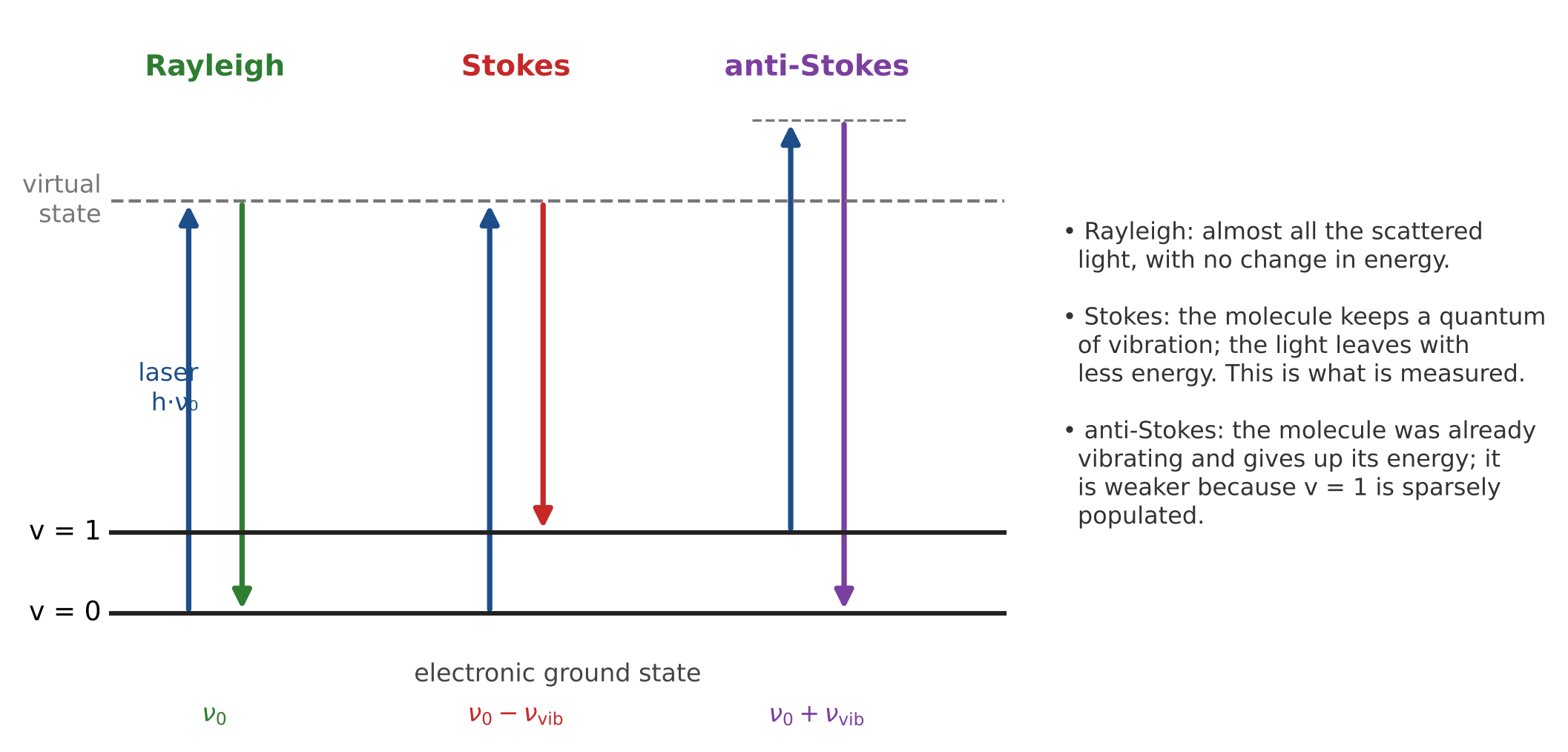
The difference between the frequency of the laser and that of the scattered light equals the frequency of a vibration of the molecule. The Raman spectrum is therefore plotted against the Raman shift, in cm−1, and its bands appear at the same positions as in the IR. What changes is the selection rule: a vibration is Raman active if it changes the polarizability of the molecule, that is, how easily the electric field of the light distorts its electron cloud.
Carbon dioxide illustrates this very well. Its two C=O bonds are polar, but the molecule is linear and symmetrical and has no dipole moment:
- In the symmetric stretch, the two oxygens move away and back at the same time: the dipole moment stays zero and the vibration does not absorb in the IR, but the electron cloud stretches and shrinks, the polarizability changes and the band appears in the Raman spectrum.
- In the asymmetric stretch and the bend, the molecule loses its symmetry and an oscillating dipole appears: both absorb in the IR. These are the bands that make CO2 a greenhouse gas.
This is an example of the rule of mutual exclusion: in molecules with a centre of symmetry, vibrations that are IR active are Raman inactive, and vice versa. In other molecules many vibrations are active in both techniques, but with very different intensities:
| Infrared | Raman | |
|---|---|---|
| What is measured | absorption of IR radiation | scattering of laser light |
| Selection rule | change in dipole moment | change in polarizability |
| Strong bands | polar bonds: C=O, O–H, N–H, C–O | weakly polar, symmetrical bonds: C=C, C≡C, S–S, aromatic rings |
| Water and glass | absorb strongly: unusable as solvent or container | give weak bands: aqueous solutions can be measured in glass tubes |
| Main problem | sample preparation | fluorescence of the sample or of impurities can swamp the spectrum |
Raman needs no sample preparation: the laser is simply focused on the sample, even through a glass bottle or with a microscope on an area a few microns across. It is used to distinguish drug polymorphs, to identify pigments in works of art without touching them, to analyse minerals (Raman spectrometers travel on the rovers exploring Mars) and to recognise drugs and explosives with portable instruments. When the molecule is adsorbed on a nanostructured gold or silver surface, the signal is multiplied millions of times (SERS, surface-enhanced Raman scattering), and minute amounts can be detected.