Robert Burns Woodward (1917-1979)
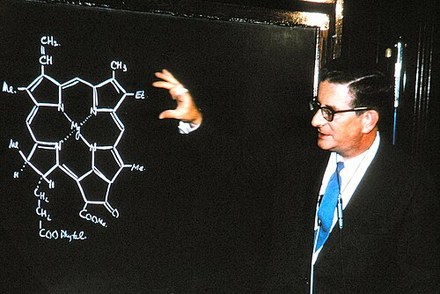
American chemist born in Boston. He entered the Massachusetts Institute of Technology (MIT) at 16 and obtained his doctorate at 20. He spent his whole career at Harvard University.
He was the great master of twentieth-century organic synthesis: among other compounds he synthesized quinine (with William Doering, 1944), cholesterol, cortisone, strychnine (1954), reserpine, chlorophyll (1960) and, with Albert Eschenmoser and nearly a hundred co-workers, vitamin B12 (1972). In 1941 and 1942 he published the empirical rules for predicting the UV absorption of dienes and enones, among the first systematic applications of spectroscopy to structure determination, and in 1961 he took part in formulating the octant rule.
He received the 1965 Nobel Prize in Chemistry for his outstanding achievements in the art of organic synthesis. With Roald Hoffmann he formulated the rules of conservation of orbital symmetry (the Woodward–Hoffmann rules), for which Hoffmann received the 1981 Nobel Prize, two years after Woodward's death.
More information: en.wikipedia.org