
Conjugation and the Woodward–Fieser rules
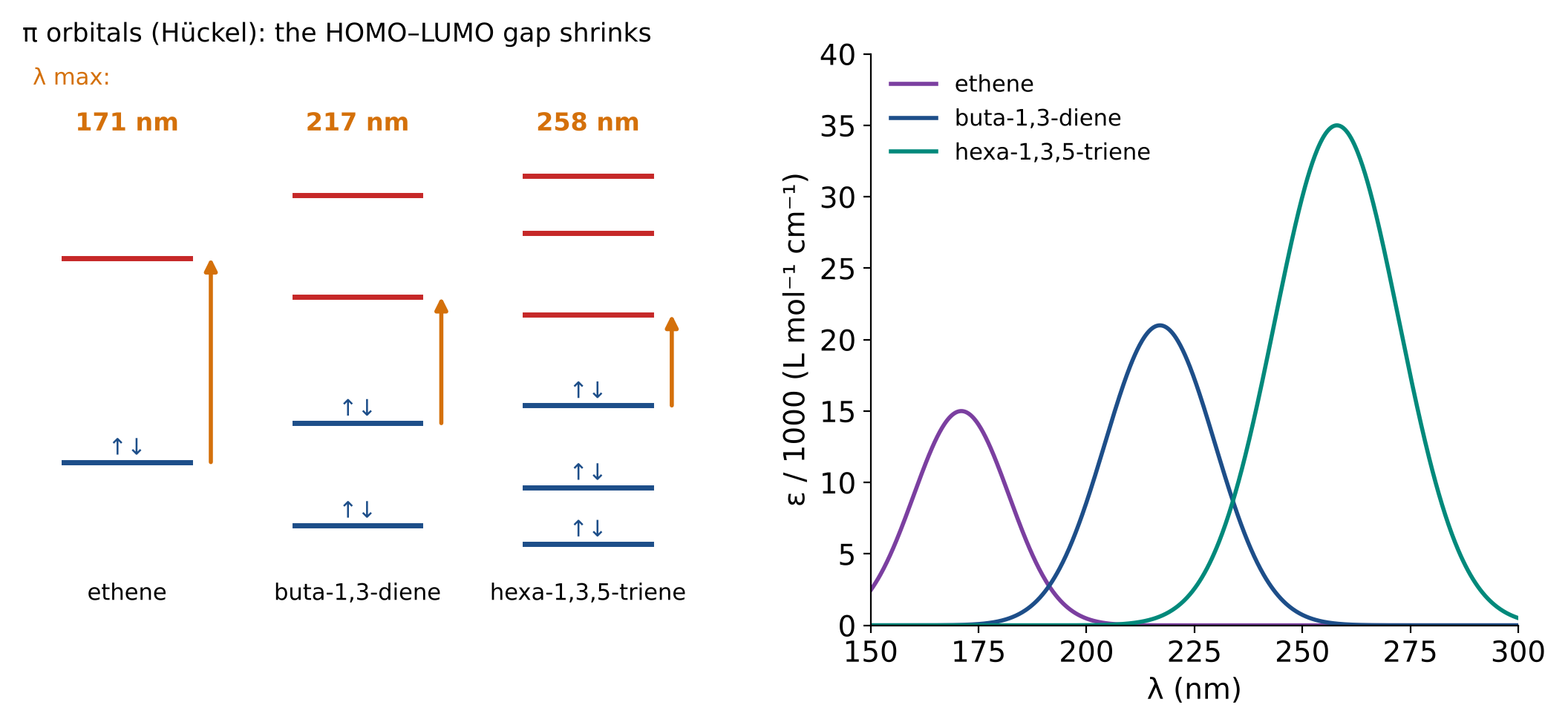
The most useful information in a UV-visible spectrum is the extent of conjugation. Each extra conjugated double bond shifts the π→π* band about 30 nm to the red. With enough double bonds, the absorption reaches the visible and the compound is coloured. The Woodward–Fieser rules predict λmax of dienes and enones to within a few nanometres.
Why conjugation shifts the absorption
When the p orbitals of a conjugated system combine, as many π orbitals form as there are atoms in the system. The more orbitals there are, the closer together their levels lie, and the gap between the highest occupied orbital (HOMO) and the lowest empty one (LUMO) narrows. The π→π* transition needs less energy, that is, radiation of longer wavelength. The band also becomes more intense.
Conjugation requires the p orbitals to be parallel. If steric hindrance twists the system out of the plane, conjugation is reduced and the band moves back to the blue and loses intensity. UV is thus a test of geometry: cis-stilbene, which cannot be planar, absorbs at shorter wavelength and with lower intensity than the trans isomer.
Compare them in 3D. In trans-stilbene (λmax 295 nm, ε ≈ 29,000) the two rings and the double bond can lie almost in the same plane; in the cis isomer (λmax 280 nm, ε ≈ 10,500), the ortho hydrogens of the two rings would clash, and the rings twist out of the plane of the double bond:
Woodward–Fieser rules for dienes
Robert B. Woodward, in 1941, and later Louis and Mary Fieser, found that λmax of a conjugated diene can be calculated by adding increments to a base value:
| Dienes (in ethanol or hexane) | nm |
|---|---|
| Base value: acyclic or heteroannular diene (the two double bonds in different rings) | 214 |
| Base value: homoannular diene (both double bonds in the same ring) | 253 |
| Each double bond extending the conjugation | +30 |
| Each alkyl substituent or ring residue | +5 |
| Each exocyclic double bond | +5 |
| OR / SR / Cl or Br / NR2 | +6 / +30 / +5 / +60 |
| OCOR | 0 |
A double bond is exocyclic to a ring when one of its carbons belongs to the ring and the other does not. A ring residue is any C–C single bond of the skeleton that leaves a diene carbon and is not part of the diene.
Example: cholesta-3,5-diene. The diene C3=C4–C5=C6 is heteroannular (C3=C4 in ring A and C5=C6 in ring B): base 214. Ring residues: C2 on C3, C10 on C5 and C7 on C6, 3 · 5 = 15. The C5=C6 double bond is exocyclic to ring A: +5. Total: 234 nm; observed 235 nm.
Example: ergosterol. The diene C5=C6–C7=C8 lies in ring B (homoannular): base 253. Ring residues: C4 and C10 on C5, C9 and C14 on C8, 4 · 5 = 20. Two exocyclic double bonds (C5=C6 to ring A and C7=C8 to ring C): +10. Total: 283 nm; observed 282 nm.
Woodward–Fieser rules for enones
| α,β-Unsaturated carbonyl compounds (in ethanol) | nm |
|---|---|
| Base value: acyclic or six-membered-ring ketone | 215 |
| Base value: five-membered-ring ketone / aldehyde / acid or ester | 202 / 210 / 195 |
| Each double bond extending the conjugation | +30 |
| Homoannular component (diene within one ring) | +39 |
| Alkyl or ring residue at α / β / γ and beyond | +10 / +12 / +18 |
| Exocyclic double bond | +5 |
| OH at α / β; OCH3 at α / β | +35 / +30; +35 / +30 |
| Cl at α / β; Br at α / β | +15 / +12; +25 / +30 |
| Solvent correction: water / methanol / chloroform / hexane | −8 / 0 / +1 / +11 |
The solvent correction is subtracted from the calculated value for comparison with the observed one: in hexane, the band appears about 11 nm below the value calculated for ethanol.
Example: mesityl oxide, (CH3)2C=CH–CO–CH3. Base 215; two β methyls, 2 · 12 = 24. Total: 239 nm; observed 237 nm.
Example: testosterone (T13) or cholest-4-en-3-one. The C3=O, C4=C5 enone is in a six-membered ring: base 215. C4 (α) carries no substituents; C5 (β) carries two ring residues, C6 and C10: 2 · 12 = 24. The C4=C5 double bond is exocyclic to ring B: +5. Total: 244 nm; observed 241 nm, with ε ≈ 16,000.
The rules are empirical and work well for unstrained, undistorted dienes and enones. Today, when needed, the spectrum is calculated by quantum methods (TD-DFT), but the rules remain a quick way to check whether a proposed structure is compatible with the spectrum.
Colour
A compound is coloured when it absorbs part of the visible light (roughly 400 to 750 nm). The colour we see is the complementary colour of the one absorbed: the rest of the light reaching the eye.
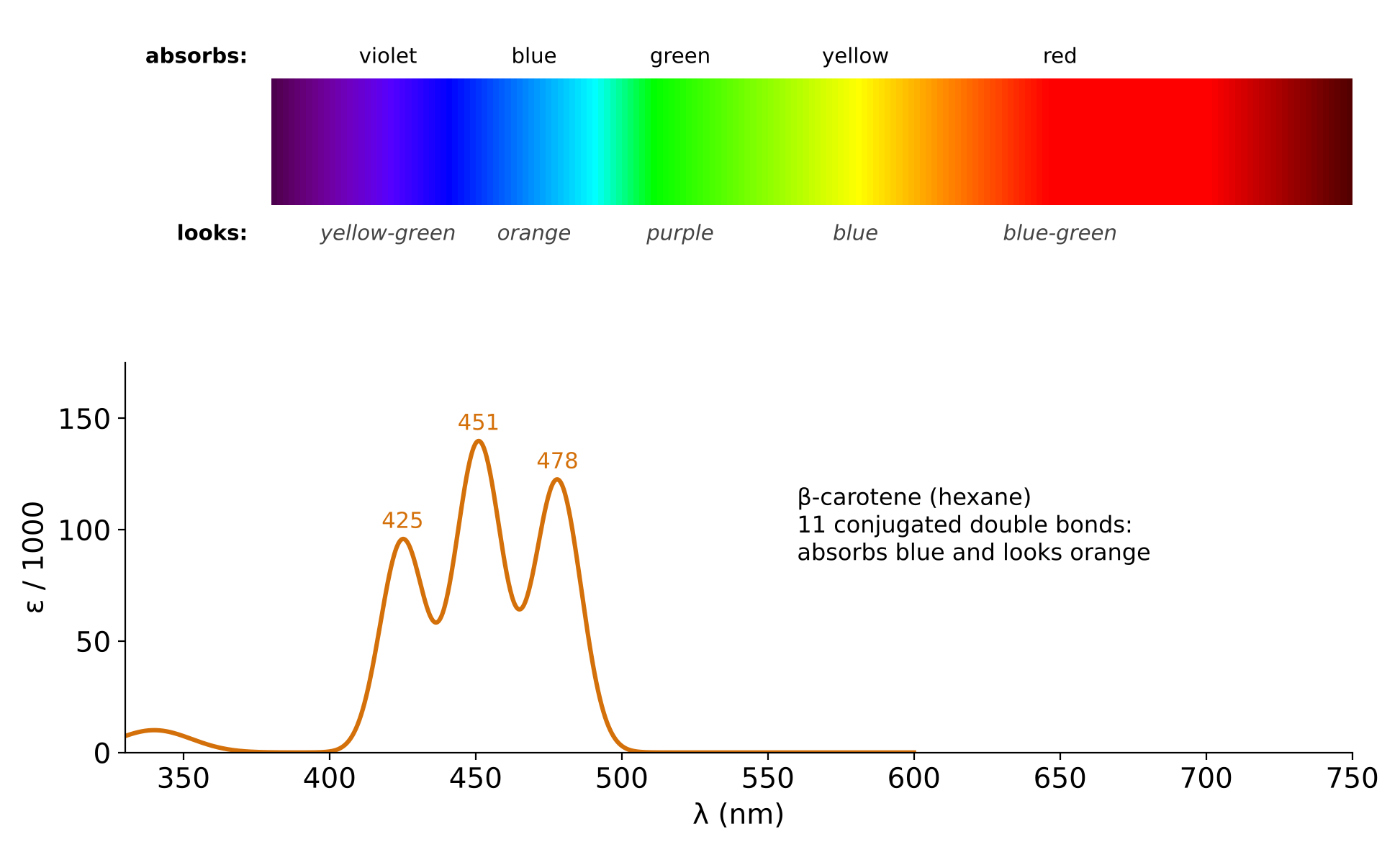
A polyene needs about eight conjugated double bonds to absorb in the visible. β-Carotene, with eleven, absorbs at 451 and 478 nm with ε ≈ 140,000, and gives carrots their colour. Lycopene from tomatoes, with eleven conjugated double bonds and two isolated ones, is red. Synthetic dyes manage to absorb in the visible with shorter systems thanks to electron-donor and electron-acceptor groups at the ends of the conjugation, as in azo dyes (Ar–N=N–Ar) and in acid-base indicators, which change colour when their conjugation changes with pH.
In both, the long all-trans chain is almost planar, as befits a conjugated system. In β-carotene, the end rings twist somewhat relative to the chain because their methyls clash with it, and conjugation with the ring double bonds is less effective:

