
NMR determination of a complex structure
In a large molecule with many saturated carbons, the 1H spectrum is a mass of overlapping signals between 1 and 2.5 ppm, and the strategy of following couplings from one end soon gets stuck. A reliable starting point is needed. In many natural products it is provided by the methyl groups: their singlets are intense and isolated and, in the HMBC, they point to all the carbons around them.
 ▶ A complex structure (in Spanish)
An example: testosterone
Testosterone, C19H28O2 (exact mass 288.2089), has (38 + 2 − 28)/2 = 6 degrees of unsaturation: the four rings of the steroid skeleton, the C=C double bond and the carbonyl of an enone. Its NMR data in CDCl3 are as follows:
| Position | δC (type) | δH | Position | δC (type) | δH |
|---|---|---|---|---|---|
| 1 | 35.7 (CH2) | 1.7; 2.0 | 11 | 20.6 (CH2) | 1.4–1.6 |
| 2 | 33.9 (CH2) | 2.3–2.4 | 12 | 36.4 (CH2) | 1.1; 1.9 |
| 3 | 199.6 (C) | — | 13 | 42.8 (C) | — |
| 4 | 123.8 (CH) | 5.73 (s) | 14 | 50.5 (CH) | 0.9–1.0 |
| 5 | 171.2 (C) | — | 15 | 23.3 (CH2) | 1.3; 1.6 |
| 6 | 32.8 (CH2) | 2.3–2.4 | 16 | 30.4 (CH2) | 1.5; 2.1 |
| 7 | 31.5 (CH2) | 1.0; 1.8 | 17 | 81.6 (CH) | 3.65 (t, 8.6 Hz) |
| 8 | 35.8 (CH) | 1.6 | 18 | 11.0 (CH3) | 0.80 (s) |
| 9 | 53.9 (CH) | 0.9–1.0 | 19 | 17.4 (CH3) | 1.19 (s) |
| 10 | 38.6 (C) | — | OH | — | ≈ 1.5 (broad) |
The shifts of the CH2 and CH hydrogens are approximate: their signals overlap so much that they can only be read in the HSQC.
The signals that can be read
Only four signals in the 1H spectrum are isolated: olefinic H4 (5.73 ppm, a singlet, because C3 and C5 carry no hydrogens), H17 (3.65 ppm, on the carbon bonded to the OH, at 81.6 ppm) and the two methyl groups (1.19 and 0.80 ppm). The other 19 hydrogens bonded to carbon form a broad envelope between 0.9 and 2.5 ppm. In the 13C spectrum, however, the 19 signals are almost all separate, and the edited HSQC classifies them: 4 carbons without hydrogens (199.6, 171.2, 42.8 and 38.6), 5 CH, 8 CH2 and 2 CH3.
Methyl groups as anchors
A methyl group bonded to a quaternary carbon correlates in the HMBC with that carbon (two bonds away) and with the other three carbons bonded to it (three bonds away). A single experiment thus gives the complete environment of each quaternary carbon:
- CH3 at 1.19 ppm → 38.6 (C), 35.7 (CH2), 53.9 (CH) and 171.2 ppm (C). One of its neighbours is the olefinic carbon of the enone (171.2): this is methyl C19, on C10, bonded to C1, C5 and C9.
- CH3 at 0.80 ppm → 42.8 (C), 36.4 (CH2), 50.5 (CH) and 81.6 ppm (CH). One of its neighbours is the carbon bonded to the OH (81.6): this is methyl C18, on C13, bonded to C12, C14 and C17.
With eight carbons already assigned, the HSQC gives the hydrogens of each one, and from them COSY or TOCSY lets us walk around the rings: from H17 we reach the two H16, and from them H15 and H14; from the H1 we reach the H2. H4 completes ring A: in the HMBC it correlates with C2, C6 and C10. The remaining carbons (C6, C7, C8, C11) are assigned from their correlations with hydrogens already known.
Stereochemistry
The skeleton of natural steroids has a fixed stereochemistry, which NMR confirms. The two methyl groups, axial and on the same face of the molecule (β), show NOE with each other and with nearby axial β hydrogens, such as H8. H17 is an apparent triplet with J = 8.6 Hz: it couples to both H16 with similar constants, and its NOE with H14 shows that it is on the α face, opposite methyl C18, which leaves the OH in the β position.
This strategy applies to many families of natural products with methyl groups on quaternary carbons, such as terpenes and steroids. When there are no methyl groups, the starting point can be any isolated signal: an olefinic hydrogen, an OCH3, a CH bonded to oxygen.
More videos
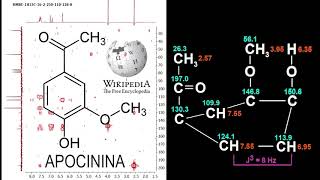 ▶ APOCININA (in Spanish)
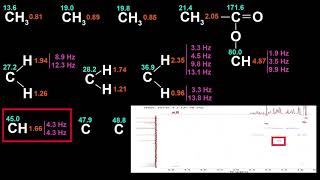 ▶ ACETATO DE BORNILO: RMN 1D y 2D (in Spanish)
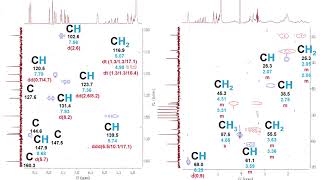 ▶ SULFATO de QUININA (in Spanish)
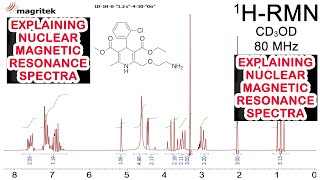 ▶ HIGH PRESSURE!!! AMLODIPINE
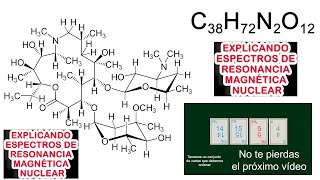 ▶ BIG BOY !!! AZITROMICINA (in Spanish)
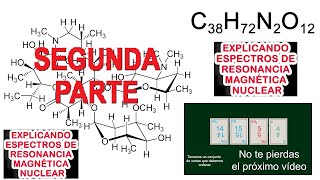 ▶ BIG BIG BOY !!! AZITROMICINA (parte 2) (in Spanish)
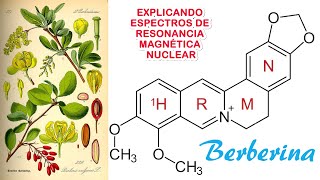 ▶ ¡¡¡MUY FÁCIL!!! BERBERINA (in Spanish)
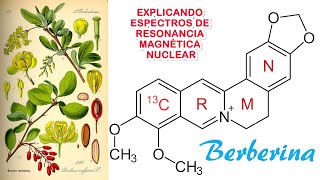 ▶ ¡¡¡REFÁCIL!!! BERBERINA(2) (in Spanish)
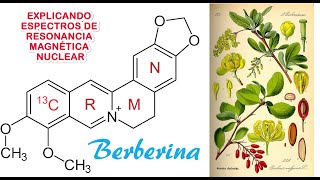 ▶ ¡¡¡ TODO RESUELTO !!! BERBERINA(3) (in Spanish)