
Fluconazole
Fluconazole is an antifungal drug of the triazole family. Its structure is simple, but its spectra bring together several instructive situations: a symmetry that reduces the number of signals, diastereotopic hydrogens, couplings to fluorine and a hydrogen that exchanges with the solvent. All the spectra were recorded on an 80 MHz benchtop spectrometer, in a 5:1 mixture of CDCl3 and CD3OD, because fluconazole is poorly soluble in chloroform.
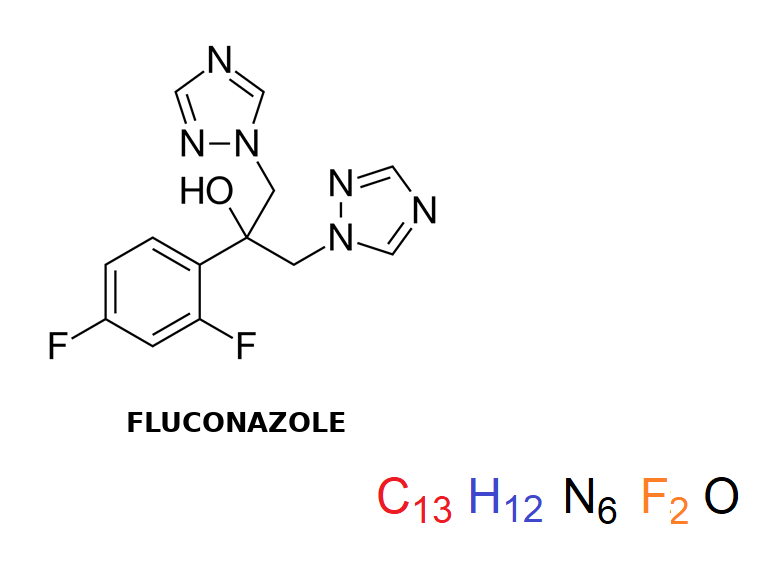
The formula has (2·13 + 2 + 6 − 12 − 2)/2 = 10 degrees of unsaturation: 4 from the benzene ring and 3 from each triazole (the ring and two double bonds). In the numbering used here, the triazole hydrogens are H3 and H5, and those of the benzene ring, H3′, H5′ and H6′.
Symmetry
The carbon bearing the OH is bonded to two identical groups, the two CH2-triazole groups. The molecule has a mirror plane that exchanges them: they are enantiotopic and give the same signals. That is why there are only two triazole signals (2H each) and a single carbon signal for both CH2 groups. However, the two hydrogens of each CH2 are not exchanged by any symmetry operation: they are diastereotopic and have different chemical shifts (T7).
1H spectrum
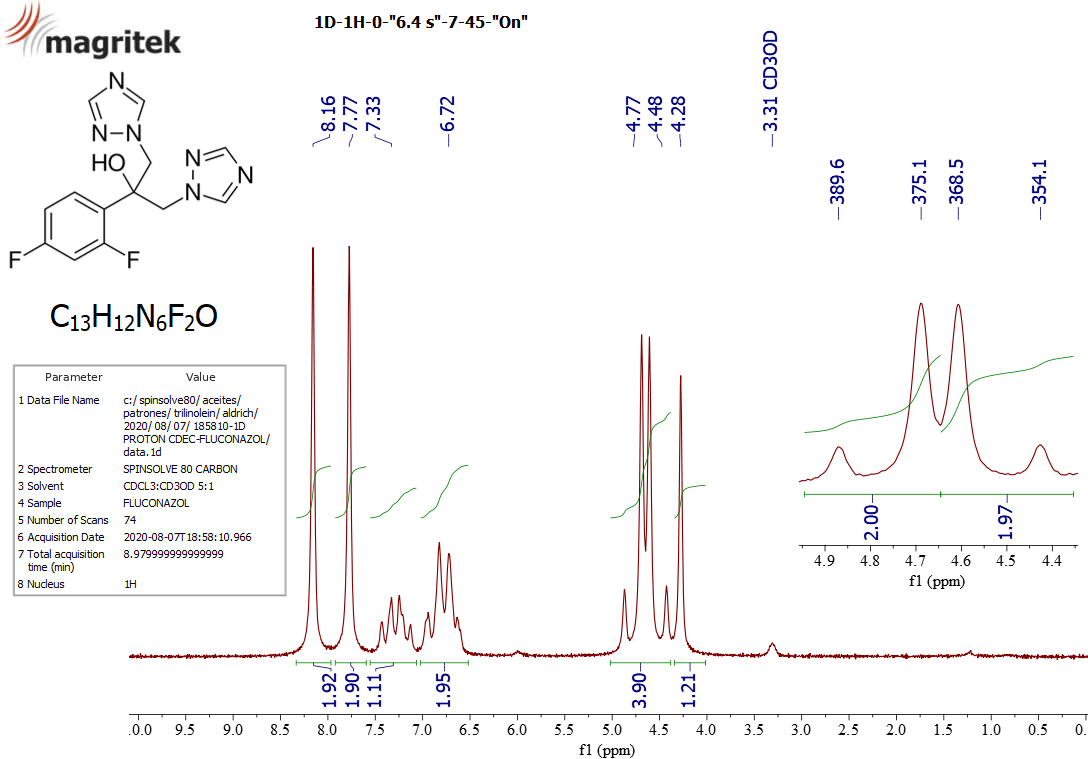
| δ (ppm) | Integral | Shape | Assignment |
|---|---|---|---|
| 8.16 | 2H | s | Triazole H5 |
| 7.77 | 2H | s | Triazole H3 |
| 7.33 | 1H | m | H6′ |
| 6.72 | 2H | m | H3′ and H5′ |
| 4.74 and 4.55 | 4H | AB system, J = 14.5 Hz | CH2N (diastereotopic hydrogens) |
| 4.28 | — | broad s | Exchanging solvent OH |
| 3.31 | — | m | Residual CHD2OD |
The aromatic hydrogens give complicated multiplets because, besides coupling to each other, they couple to both fluorines (T9). The CH2 groups form an AB system with a strong roof effect: its four lines are at 389.6, 375.1, 368.5 and 354.1 Hz. The coupling constant is the spacing between lines 1 and 2 (or 3 and 4), 14.5 Hz, a typical geminal value. The frequency difference is Δν = √[(ν1 − ν4)(ν2 − ν3)] = √(35.5 · 6.6) ≈ 15.3 Hz, only 0.19 ppm at 80 MHz; since Δν is almost equal to J, the spectrum is second-order (T7).
The OH hydrogen does not appear as a signal of its own: it exchanges with the deuterium of CD3OD, and its hydrogen joins the solvent OH signal (4.28 ppm), which also includes water.
 ▶ 1H spectrum (in Spanish)
13C spectrum
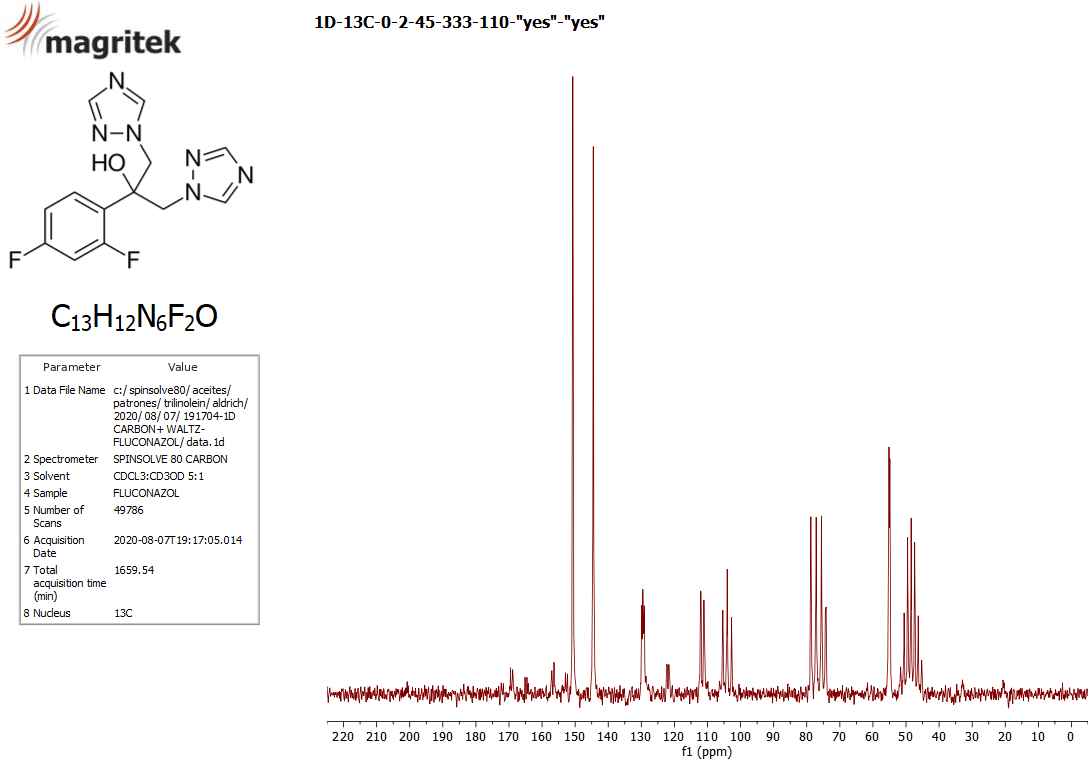
The two triazole carbons give the strongest signals, at 151 (C3) and 145 ppm (C5). The benzene carbons appear as multiplets because decoupling removes the couplings to 1H but not to 19F: C6′ at 129 ppm, C1′ at 122 ppm, C5′ at 111 ppm (dd) and C3′ at 104 ppm (t, because it lies between the two fluorines and couples to both with 2J ≈ 26 Hz). The CH2 gives the signal at 56 ppm.
The two carbons bonded to fluorine, C2′ (≈ 160 ppm) and C4′ (≈ 164 ppm), are hard to see. Their 1JCF, about 250 Hz, amounts to 12.4 ppm at 20 MHz, so each is spread into a doublet of doublets whose lines lie 6 ppm on either side of its shift: these are the four weak signals between 154 and 170 ppm. Being quaternary, they also relax slowly and receive no NOE. The quaternary carbon bonded to the OH (≈ 74 ppm) is weak too and sits next to the CDCl3 triplet; it is easier to locate in the HMBC.
 ▶ 13C spectrum (in Spanish)
HSQC and HMBC
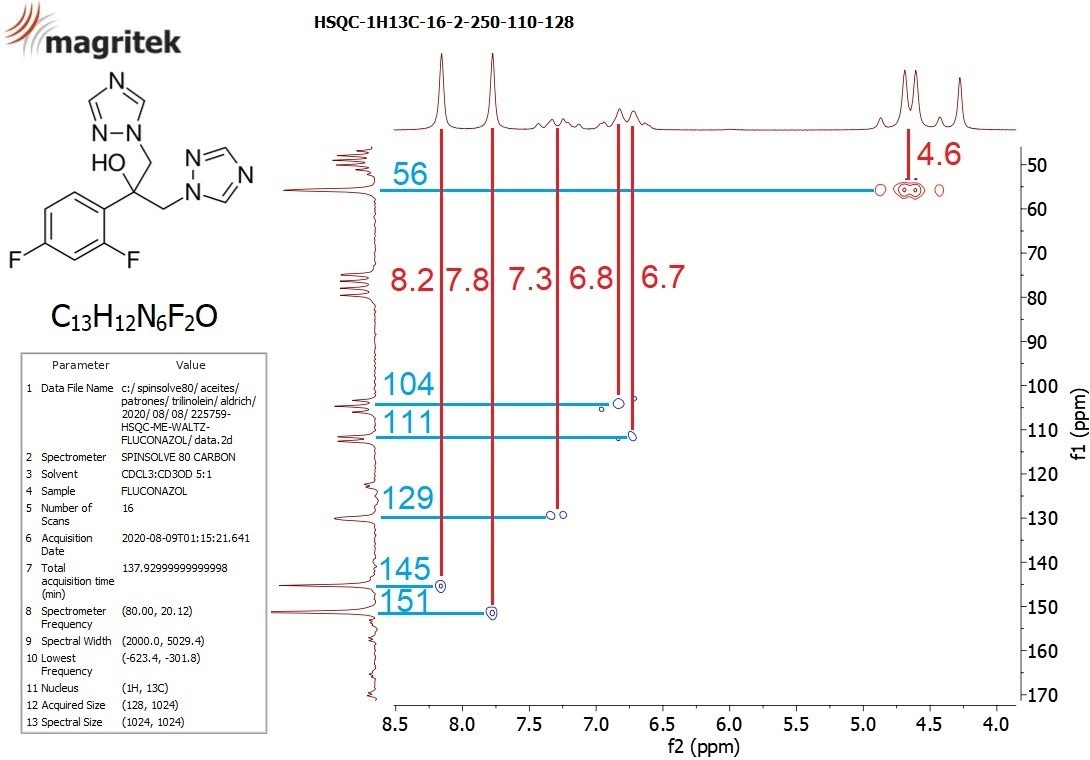
The HSQC confirms the assignments: CH2 (56/4.6), C3′ (104/6.7), C5′ (111/6.8), C6′ (129/7.3), C5 (145/8.2) and C3 (151/7.8). The hydrogen at 8.2 ppm is bonded to the 145 ppm carbon, and the one at 7.8 ppm to the 151 ppm carbon.
 ▶ HSQC (in Spanish)
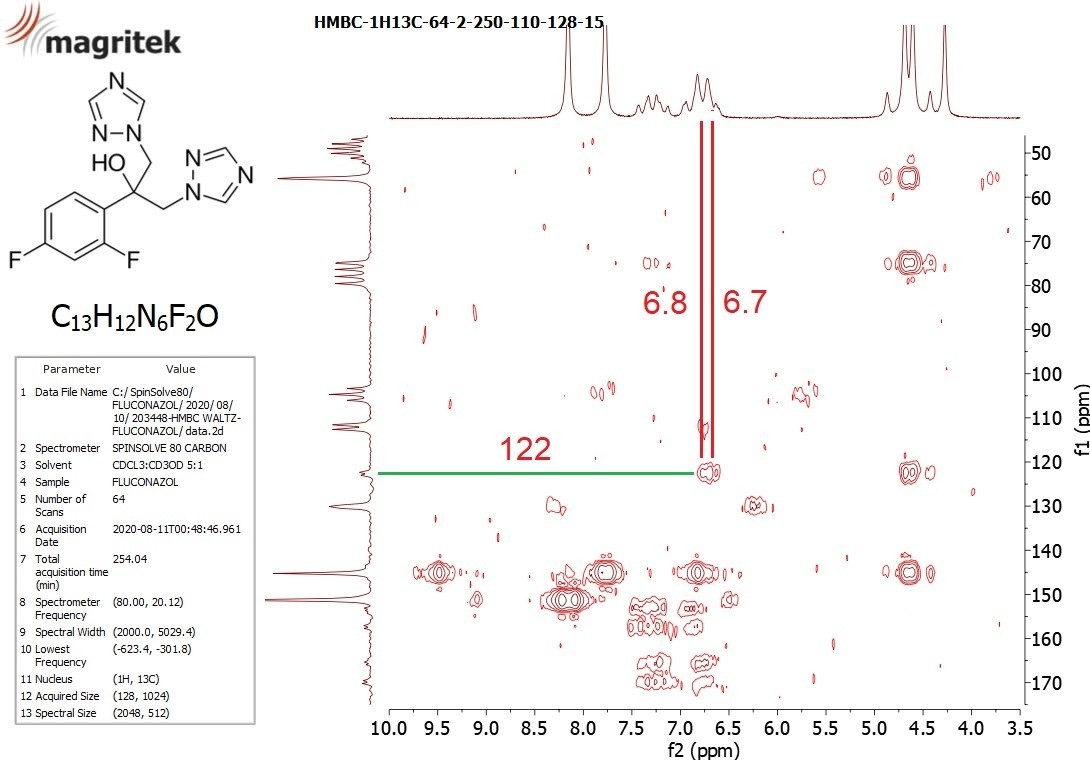
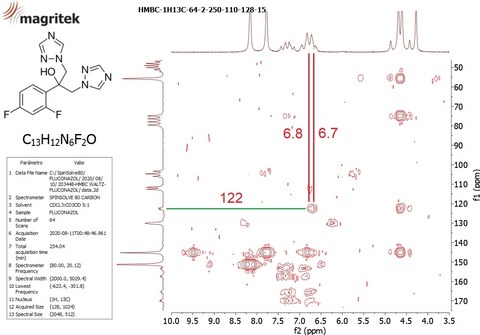
The HMBC locates the quaternary carbons. H3′ and H5′ (6.7–6.8 ppm) correlate with C1′ (122 ppm). The CH2 hydrogens (4.6 ppm) correlate with the OH-bearing carbon (≈ 74 ppm), with C1′ (122 ppm) and with triazole C5 (145 ppm, three bonds away through N1): the CH2 links the central carbon to the triazole N1. The pairs of spots placed symmetrically on either side of a strong signal, such as those at 145 ppm at 9.5 and 6.8 ppm, are not long-range correlations but remnants of the one-bond correlations that the experiment's filter has not removed completely.
 ▶ HMBC (in Spanish)
19F spectrum
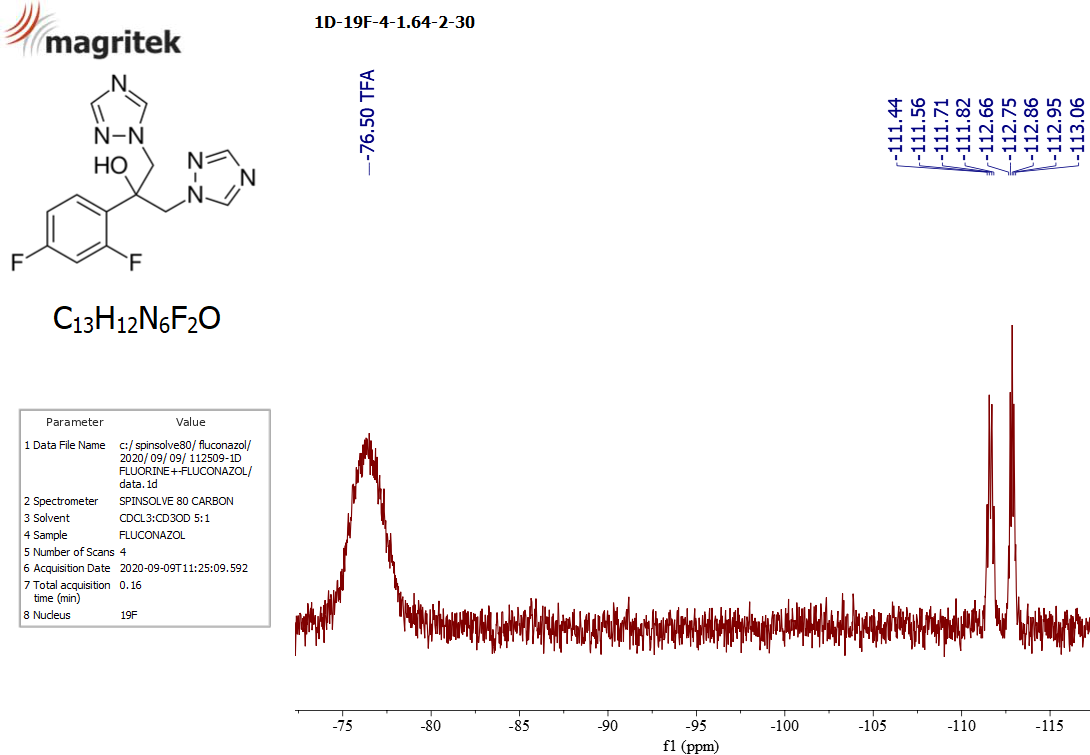
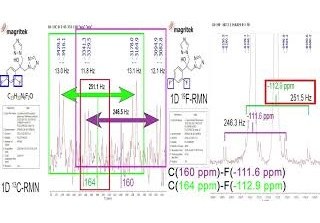
The two fluorines give two multiplets, at −111.6 and −112.9 ppm, split by couplings to the ring hydrogens and to each other. 19F has 100 % abundance and a sensitivity close to that of 1H, so a few seconds are enough to record the spectrum. The 1JCF constants of the carbons make it possible to pair each fluorine with its carbon: the one at −111.6 ppm is bonded to the 160 ppm carbon (1J = 246 Hz), and the one at −112.9 ppm to the 164 ppm carbon (1J = 251 Hz). The trifluoroacetic acid signal is broad because its acidic proton exchanges with the methanol.
 ▶ 19F spectrum (in Spanish)
A hydrogen that exchanges
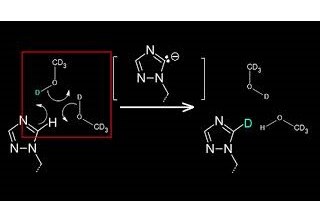
If the 1H spectrum is repeated after some time, the signal at 8.16 ppm becomes smaller and smaller. Triazole H5, located between two nitrogens, is somewhat acidic: methanol slowly removes it to give a carbanion (an ylide) stabilized by the neighbouring nitrogens, which is reprotonated by CD3OD and ends up deuterated. This exchange is much slower than that of the OH, and it shows that the assignment of the two triazole signals is not arbitrary.
 ▶ H/D exchange (in Spanish)