
¹⁹F and ³¹P NMR
19F and 31P have I = ½ and 100 % abundance, so they give their own spectra almost as easily as 1H. They also couple to 1H and 13C. That coupling is reciprocal: it appears with the same constant in the spectrum of each of the two nuclei.
Why they matter
Many drugs contain fluorine, which improves their metabolic stability, and nearly all the chemistry of living things involves phosphorus: phosphates, ATP, nucleic acids, phospholipids. When a molecule contains one of these atoms, its spectrum is a privileged observer. There are few signals, they are well separated and no solvent gets in the way.
19F NMR
19F has a gyromagnetic ratio very close to that of 1H (251.8 versus 267.5 · 106 rad s−1 T−1), and its receptivity is 83 % of the proton's. Its chemical shift range is huge, about 400 ppm. Shifts are measured from CFCl3 (0 ppm), and almost all organic compounds appear at negative values:
| Group | Example | δ 19F (ppm, approximate) |
|---|---|---|
| CF3 on an aromatic ring | C6H5CF3 | −63 |
| CF3 next to a carbonyl | CF3COOH | −76 |
| Aliphatic CF3 | CF3CH2OH | −78 |
| Aromatic F | C6H5F | −110 to −120 |
| Aliphatic CH2F | FCH2–R | −210 to −230 |
Let us see what happens when a hydrogen is replaced by a fluorine. We compare pivalic acid, (CH3)3C–COOH, with its derivative FCH2–C(CH3)2–COOH (spectra simulated with approximate values).

- In the 1H spectrum, the CH2F group appears at 4.25 ppm, strongly deshielded by the electronegative fluorine, and as a doublet. 19F behaves like a small magnet, just as a neighbouring proton would: in half of the molecules the fluorine is aligned with the field and in the other half against it. The geminal constant 2JHF is large, about 47 Hz.
- In the 1H-decoupled 13C spectrum, the fluorine is still there. CH2F moves to 87 ppm and is a doublet with 1JCF ≈ 170 Hz. The other carbons are doublets too, with constants that fall quickly with the number of bonds (about 19 Hz over two bonds and 5 or 6 Hz over three).
- In the 19F spectrum there is a single signal, at −219 ppm, which is a 1:2:1 triplet from the two CH2 hydrogens. Its constant is the same as that of the 1H doublet, 47 Hz: the coupling is reciprocal. Around the triplet there are two small triplets, separated by the 1JCF of 171 Hz: these are the 13C satellites from the 1.07 % of molecules that have 13C in the CH2F, exactly like the 13C satellites of 1H that we will see in the examples. Each has about 0.5 % of the area of the main signal (in the figure they are enlarged 50 times), and their centre is shifted about 0.1 ppm to the right by the isotope effect, which is larger in 19F than in 1H. The more distant 13C give satellites much closer together, which lie under the main signal.
Couplings to fluorine are generally larger than H–H couplings:
| Coupling | Typical value (Hz) |
|---|---|
| 2JHF (H–C–F) | 45 to 50 |
| 3JHF (H–C–C–F) | 5 to 25, depending on the dihedral angle |
| 1JCF | 160 to 290 |
| 2JCF | 20 to 45 |
| 3JCF | 5 to 10 |
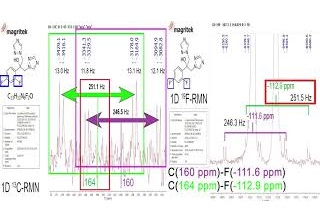
Fluconazole, an antifungal with two fluorines on an aromatic ring, is a good real example. This video works through its 19F spectrum, with the F–F, F–H and F–C couplings. We will study the whole molecule in topic 13.
 ▶ 19F of fluconazole
31P NMR
31P is less sensitive than 19F (receptivity 0.066) but still easy to measure. Its shifts are measured from 85 % phosphoric acid (0 ppm) and span roughly −250 to +250 ppm:
| Type of compound | Example | δ 31P (ppm, approximate) |
|---|---|---|
| Phosphates | (CH3O)3P=O | 0 to 5 |
| ATP phosphates | ATP | −5 to −22 |
| Phosphonates | CH3P(O)(OC2H5)2 | 20 to 35 |
| Phosphine oxides | (C6H5)3P=O | 25 to 45 |
| Phosphines | (C6H5)3P | −60 to +20 |
Trimethyl phosphate, (CH3O)3P=O, shows the reciprocity clearly. In the 1H spectrum, the nine equivalent hydrogens give a doublet at 3.78 ppm, because the phosphorus is three bonds away (3JPH ≈ 11 Hz). In the 31P spectrum, the phosphorus sees nine equivalent hydrogens and its signal splits into 10 lines, with the intensities of row 9 of Pascal's triangle.
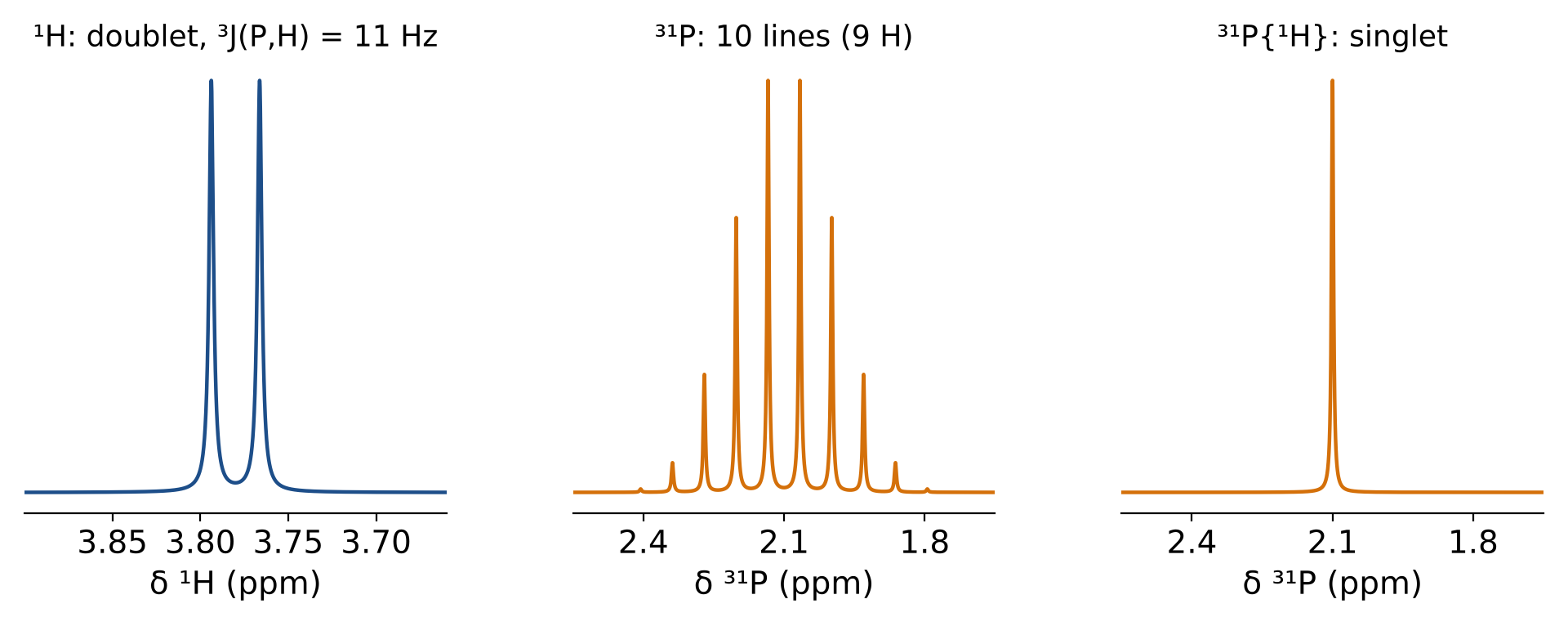
As with 13C, 31P is normally recorded 1H-decoupled, as 31P{1H}: each phosphorus gives a singlet, so the different phosphorus atoms can be counted at a glance. If there is a direct P–H bond, as in dialkyl phosphites, the 1JPH constant is huge, 600 to 700 Hz.
An intermediate seen by 31P: the oxaphosphetane of the Wittig reaction
Because the 31P chemical shift depends so strongly on the number of atoms bonded to phosphorus, 31P NMR can follow a reaction in the tube itself and watch intermediates appear and disappear. The classic example is the Wittig reaction, in which a phosphorus ylide, Ph3P=CHR, and an aldehyde give an alkene and triphenylphosphine oxide.
- For decades it was debated whether the intermediate was a betaine, with separate P+ and O−, or a four-membered ring, the oxaphosphetane. In 1973 Edwin Vedejs and Kenneth A. Snoble recorded the 31P spectrum of the reaction mixture at low temperature and, without lithium salts, saw only one new signal, near −60 ppm. That negative shift is characteristic of pentacoordinate phosphorus, bonded to five atoms, and is far from the ylide and from triphenylphosphine oxide, which appears in the phosphine-oxide region of the table.
- On warming, the oxaphosphetane signal disappears and that of Ph3P=O grows as the alkene forms.
- Bruce E. Maryanoff and co-workers (1984–1986), with higher-field magnets, resolved the signals of the cis and trans oxaphosphetanes, about 2 ppm apart, and followed their interconversion as the temperature rose (“stereochemical drift”). This showed whether the ratio of Z and E alkenes reflected that of the oxaphosphetanes formed at the start.
In Advanced Organic Chemistry you can see animated 3D models of how the cis and trans oxaphosphetanes form.
Two drugs: ciprofloxacin and fosfomycin
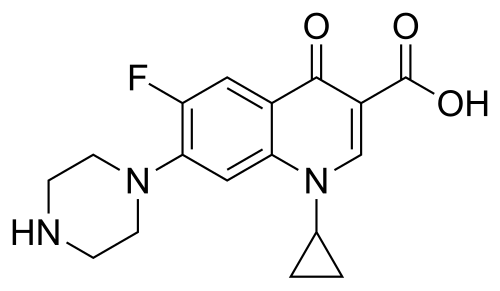
Ciprofloxacin is an antibiotic of the fluoroquinolone family. Its single fluorine gives one 19F signal, split by the two nearby aromatic hydrogens: H5, three bonds away (3JHF ≈ 13 Hz), and H8, four bonds away (4JHF ≈ 7 Hz), so it is a doublet of doublets. In the 1H-decoupled 13C spectrum, C6, bonded to the fluorine, is a doublet with a 1JCF of about 250 Hz, and its neighbours C5 and C7 are doublets of about 20 Hz.
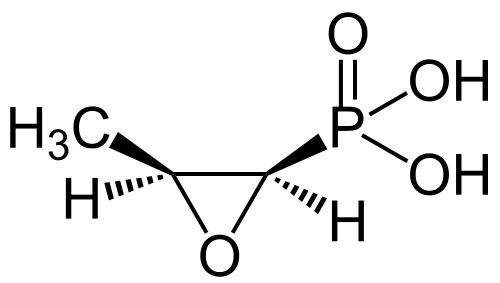
Fosfomycin is a very small antibiotic, a phosphonic acid bonded to an epoxide. In the 31P{1H} spectrum it gives a single singlet; without decoupling, it splits through the couplings with H2, two bonds away, and with H3, three bonds away. In the 1H spectrum, the same P–H couplings split the signals of the two epoxide hydrogens, and the 13C of the carbon bonded to phosphorus is a doublet with a large 1JCP.
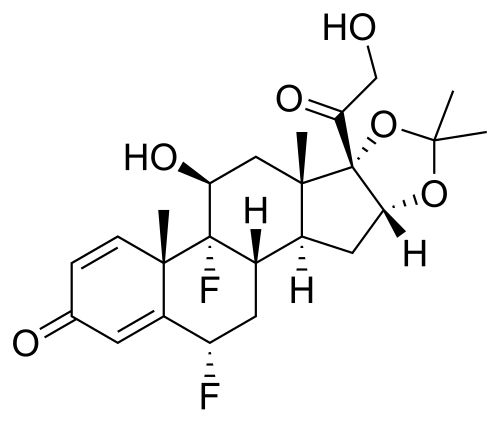
A third example is fluocinolone acetonide, a topical corticosteroid with two fluorines, at positions 6α and 9α. Their environments are very different and give two well-separated 19F signals: 6α-F, which has a hydrogen on the same carbon, is split by a large 2JHF of about 50 Hz; 9α-F, on a carbon without hydrogens, only shows smaller couplings.
If a molecule contains fluorine or phosphorus, the nearby 1H and 13C signals are split even when the spectrum is 1H-decoupled. Do not mistake these splittings for duplicated signals. Just measure the constant and look for it in the spectrum of the heteroatom.