²H and ¹⁵N NMR
Deuterium (2H, I = 1) turns up in every spectrum through the deuterated solvents. It couples to 1H and 13C according to the 2nI + 1 rule, and H/D exchange with D2O helps to locate OH and NH groups. Nitrogen is more elusive: 14N is quadrupolar and 15N is very scarce. That is why 15N is almost always observed through 1H, as is done for 13C in the DEPT, HSQC and similar experiments.
Deuterium in solvents
1H spectra are recorded in deuterated solvents (CDCl3, CD3OD, DMSO-d6, D2O…) for two reasons. First, 2H resonates at a very different frequency (61.4 MHz in a 400 MHz instrument), so the solvent, present in huge excess, does not swamp the sample. Second, the spectrometer uses the deuterium signal to keep the field stable during the measurement, which is called the "lock". The spectrometer "probe" contains several coils around the tube, which are like antennas that send and receive the radio-frequency signals (topic 5). One of them is dedicated to the "lock", to excite 2H and receive its signal back.
No solvent is 100 % deuterated. A small fraction with one hydrogen always remains and gives the residual signals we saw in topic 8. And in 13C spectra, the solvent carbons are bonded to deuterium and appear as multiplets.
The 2nI + 1 rule
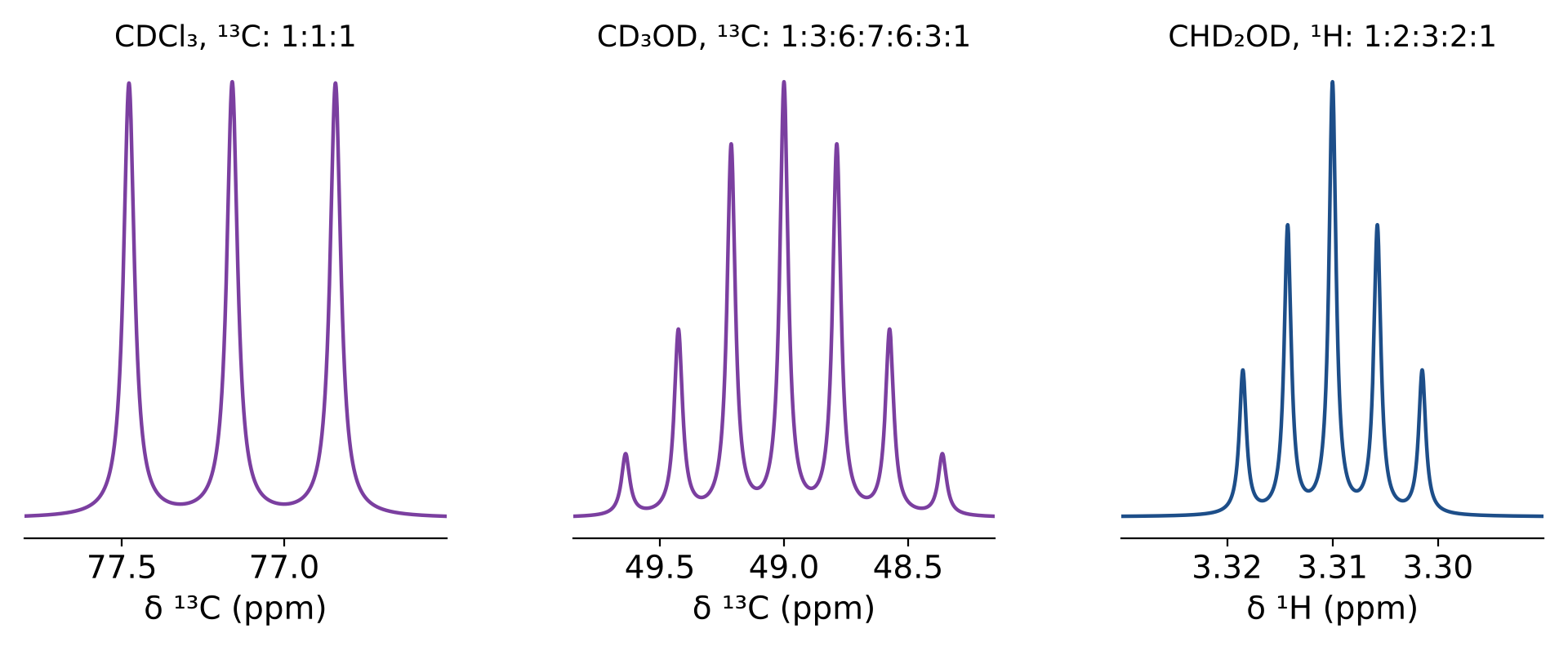
A neighbouring proton has two possible orientations, which is why it splits signals in two. A deuterium, with I = 1, has three (+1, 0 and −1), all equally likely. So one deuterium splits a signal into three lines of equal intensity. In general, n equivalent nuclei of spin I give 2nI + 1 lines; for I = ½ this becomes the familiar n + 1 rule.
| Group | Number of D | Lines | Intensities | Example |
|---|---|---|---|---|
| C–D | 1 | 3 | 1:1:1 | CDCl3 in 13C, 77.16 ppm |
| CD2 or CHD2 | 2 | 5 | 1:2:3:2:1 | residual CHD2OD in 1H, 3.31 ppm |
| CD3 | 3 | 7 | 1:3:6:7:6:3:1 | CD3OD in 13C, 49.00 ppm |
Couplings to deuterium are smaller than to hydrogen, in the ratio of their gyromagnetic ratios (267.5 / 41.1 ≈ 6.5):
JXD ≈ JXH / 6.5
Thus the 1JCH of chloroform, 209 Hz, becomes a 1JCD of 32 Hz in CDCl3. And H–D couplings, 1 to 2 Hz, are so small that they often just broaden the signals.
Exchange with D2O
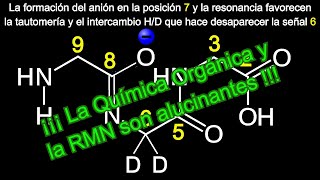
Hydrogens bonded to oxygen, nitrogen or sulfur (OH, NH, COOH, SH) exchange quickly with water. If we add a few drops of D2O to the tube, shake it and record the spectrum again, these hydrogens are replaced by deuterium:
R–OH + D2O ⇄ R–OD + HOD
Their signal disappears from the 1H spectrum, because deuterium does not resonate at that frequency, and the HOD signal grows instead, around 4.7 ppm. This is the simplest way to find out which signals belong to exchangeable hydrogens. The couplings these hydrogens caused in their neighbours disappear as well.
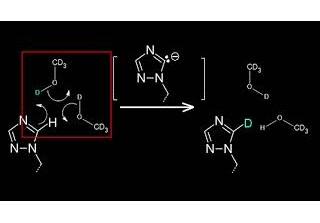
This video shows the exchange in fluconazole. In CD3OD the OH disappears and, more slowly, so does a hydrogen bonded to carbon: the one on a triazole ring, which is acidic enough to exchange.
 ▶ H/D exchange in fluconazole
Deuterium is also used to label molecules. If a compound is made with a deuterium at a particular position, the signal of that hydrogen disappears from the 1H spectrum and we can follow where it goes in a reaction. The 2H spectrum, recorded in a non-deuterated solvent, confirms where the label is.
Nitrogen: 14N and 15N
Nitrogen has two active isotopes, and neither is convenient:
- 14N is abundant (99.6 %), but it has I = 1 and a sizeable quadrupole moment. Its signals are very broad and are hardly used in organic chemistry. Its most visible effect is indirect: it broadens NH signals in the 1H spectrum, especially in amides. In ammonium salts the situation changes. In NH4+ and in R4N+ ions, the nitrogen is surrounded tetrahedrally and symmetrically, the electric field gradient is almost zero and 14N relaxes slowly. Its couplings are then no longer averaged: the 1H of NH4+, in acidic solution to slow down exchange, appears as a 1:1:1 triplet (2nI + 1 = 3, with equal lines because 14N has I = 1) with a 1J of about 52 Hz, and the 14N itself of these salts gives sharp signals. In less symmetric ions, such as RNH3+, the triplet broadens or disappears.
- 15N has I = ½ and gives sharp signals, but it makes up only 0.37 % of nitrogen and its γ is small. Its receptivity is about 45 times lower than that of 13C. Moreover, its γ is negative, so the NOE produced by 1H decoupling can reduce its signal or even cancel it.
The solution is to observe 15N through 1H, with two-dimensional inverse-detection experiments (1H–15N HSQC and HMBC). The proton, which is far more sensitive, picks up the information from the nitrogen bonded to it or nearby. We will see them in topic 11. They give very characteristic 15N shifts (liquid NH3 scale = 0 ppm):
| Type of nitrogen | δ 15N (ppm, approximate) |
|---|---|
| Aliphatic amines | 0 to 60 |
| Amides and lactams | 100 to 140 |
| Nitriles | 230 to 260 |
| Pyridines | 280 to 320 |
| Nitro compounds | 360 to 380 |
D2O locates the exchangeable hydrogens. The 1:1:1 or 1:3:6:7:6:3:1 lines in a 13C spectrum give away the deuterated solvent. And nitrogen is better studied from the proton than directly.