
Review and further knowledge
Before interpreting a spectrum you must be able to recognize the solvent signals. In 13C, deuterated solvents give characteristic multiplets, because deuterium (spin 1) splits the carbon signal into 2n + 1 lines: CDCl3 gives a 1:1:1 triplet at 77.16 ppm. In 1H they give a small residual signal and another from the water they contain.
Deuterated solvents
NMR is far from an easy technique to master, and its spectra often hide details that are hard to interpret. One of the first things to learn is to locate the solvent signals. These are the 13C and 1H spectra of three of the most widely used deuterated solvents.
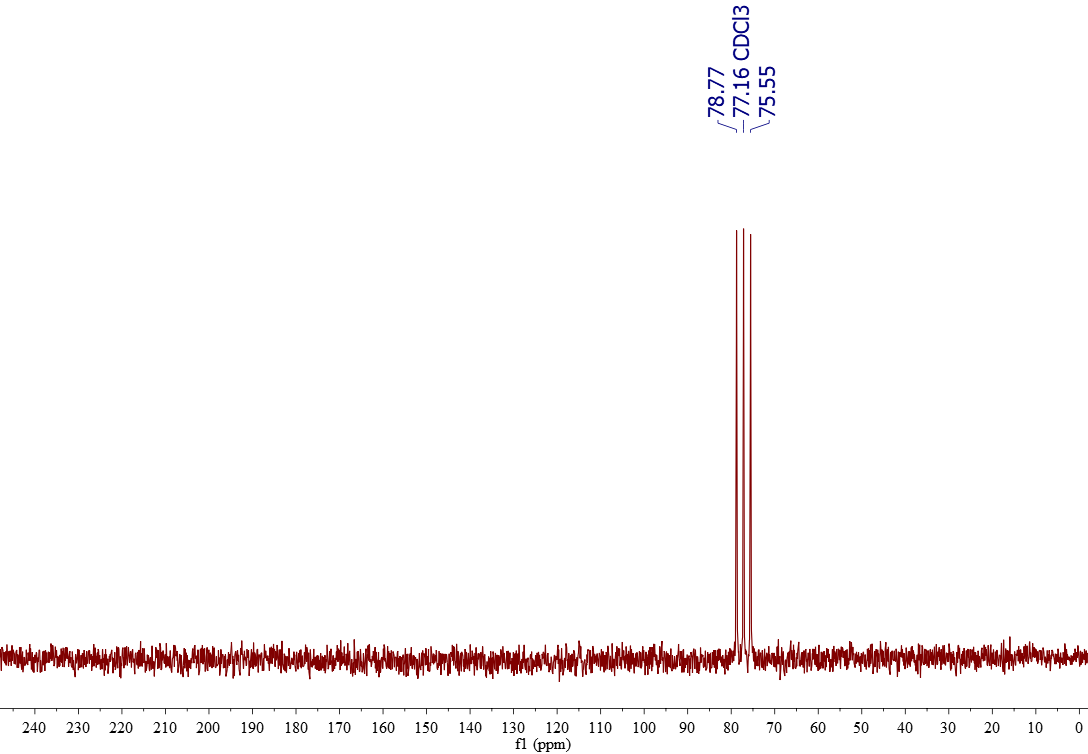
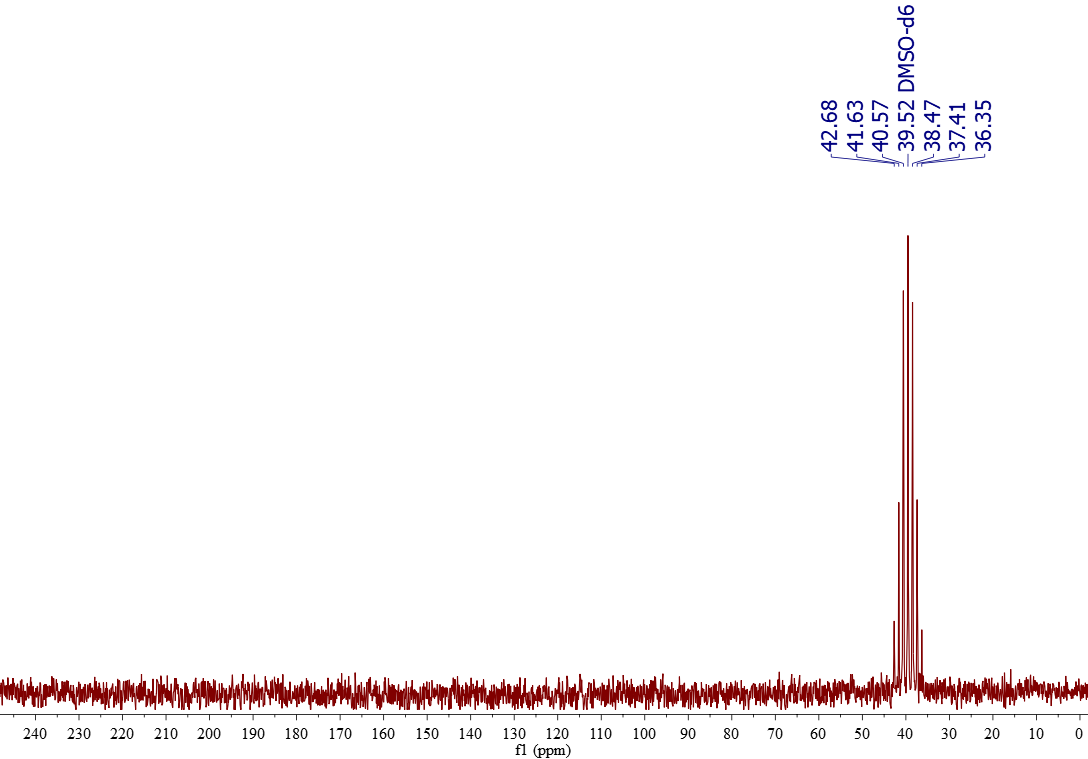
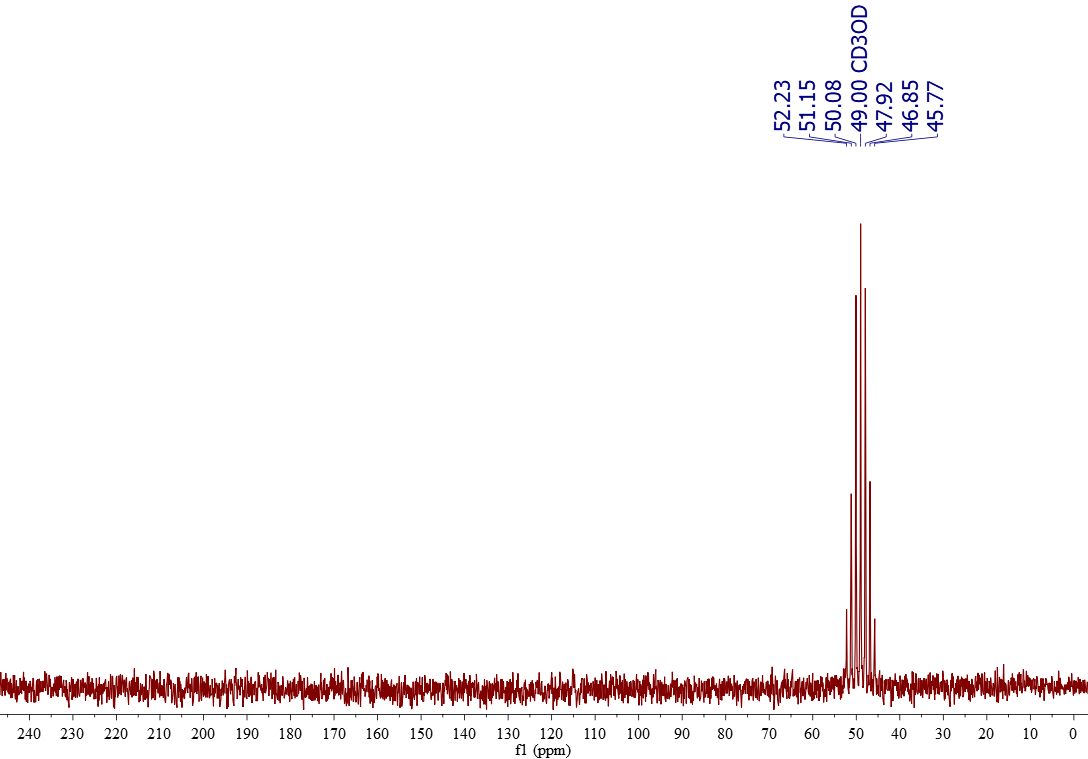
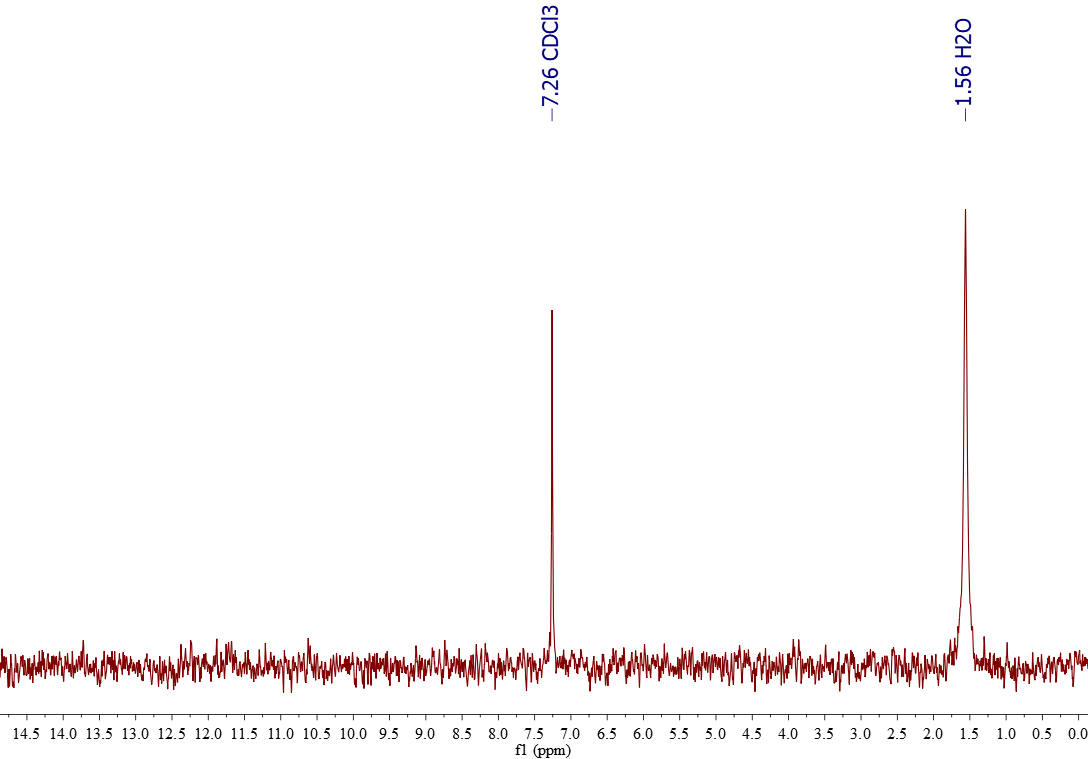
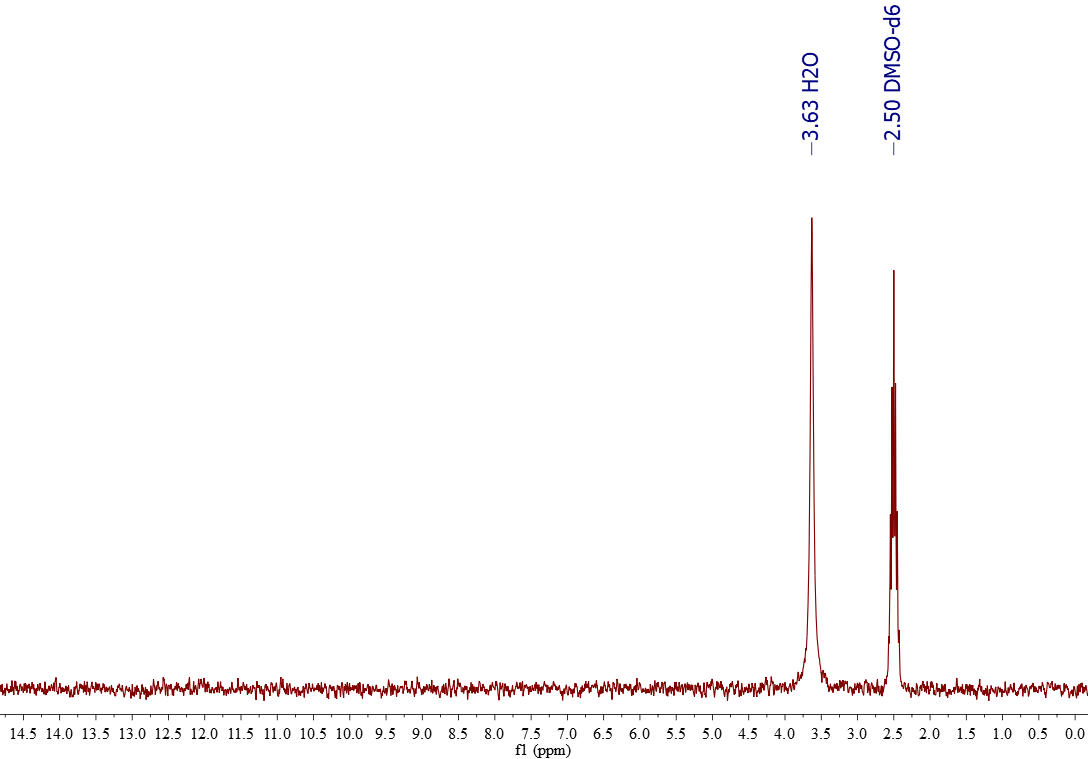
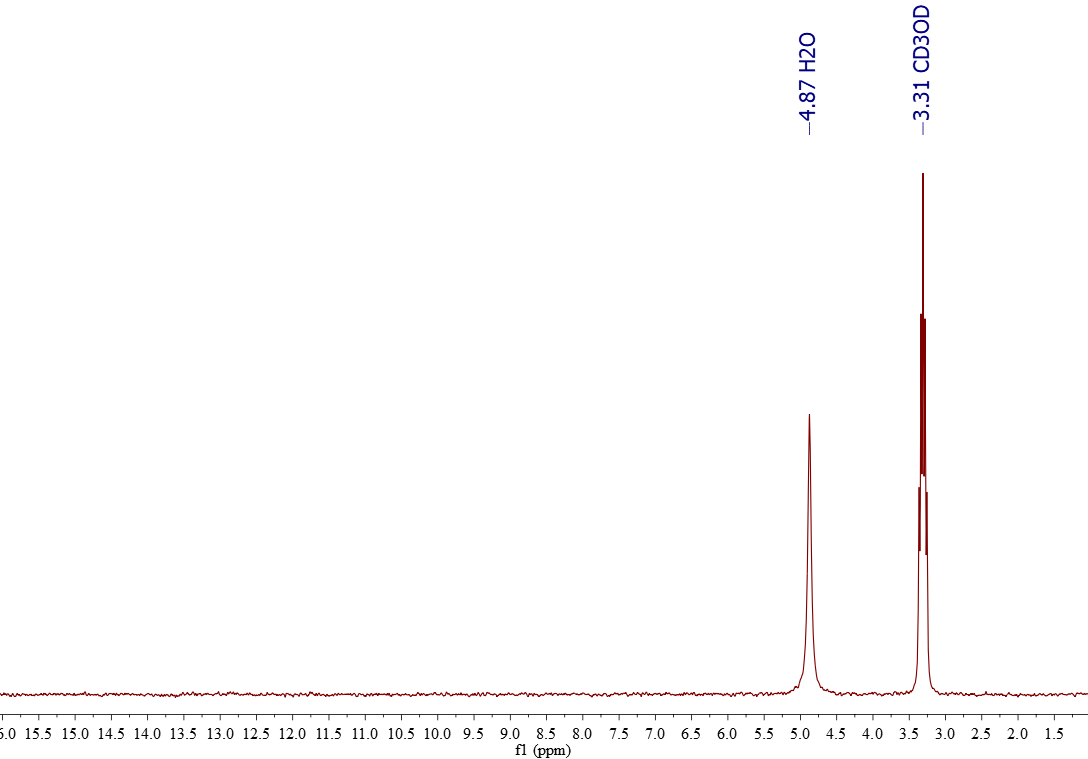
There are many more: benzene-d6, acetone-d6, heavy water, tetrahydrofuran-d8… Their signals are collected in tables, such as those of Gottlieb, Kotlyar and Nudelman (1997) and Fulmer and co-workers (2010), which are worth keeping at hand.
Why CDCl3 gives a triplet in 13C
Deuterium (2H) is NMR-active, but its spin is not ½ but 1. A spin-½ nucleus can only take two orientations in the field; a spin-1 nucleus can take three (+1, 0 and −1), almost equally probable. The N + 1 rule is then generalized as:
number of lines = 2NI + 1
where N is the number of equivalent neighbouring nuclei and I their spin. For a spin-½ nucleus the usual rule, N + 1, is recovered.
- CDCl3: the carbon has one deuterium (N = 1, I = 1): 2·1·1 + 1 = 3 lines, of equal intensity (1:1:1), because the three orientations of deuterium are equally probable. It is the triplet centred at 77.16 ppm (77.0 ppm in older texts), with lines about 32 Hz apart.
- DMSO-d6 and CD3OD: each carbon has three deuteriums: 2·3·1 + 1 = 7 lines, with intensities 1:3:6:7:6:3:1. These are the septets centred at 39.52 ppm (DMSO) and 49.00 ppm (methanol).
The 1H signals: residual solvent and water
No solvent is 100 % deuterated; it is usually 99.8 % or more. What is seen in 1H is the small amount of molecules with one hydrogen, and the dissolved water.
| Solvent | 13C (ppm) | Residual 1H (ppm) | Water in 1H (ppm) |
|---|---|---|---|
| CDCl3 | 77.16 (triplet) | 7.26 (singlet, CHCl3) | 1.56 |
| DMSO-d6 | 39.52 (septet) | 2.50 (quintet, CHD2) | 3.33 |
| CD3OD | 49.00 (septet) | 3.31 (quintet, CHD2) | 4.87 |
In residual DMSO-d5 and CD2HOD, the hydrogen has two neighbouring deuteriums on the same carbon: 2·2·1 + 1 = 5 lines, a 1:2:3:2:1 quintet with small spacings, about 2 Hz.
The position of the water signal depends on the amount of water, the temperature and the sample. In the DMSO spectrum in the figure it appears at 3.63 ppm; in dry DMSO it usually appears at 3.33 ppm. In CD3OD and D2O, the OH and NH of the sample exchange with the deuterium of the solvent and join the water (HOD) signal.
Summary of the most common solvents
| Solvent | 1H residual (ppm) | 13C (ppm) | Water in 1H (ppm) | b.p. (°C) | m.p. (°C) |
|---|---|---|---|---|---|
| CDCl3 | 7.26 | 77.16 | 1.56 | 61 | −64 |
| Acetone-d6 | 2.05 | 29.84; 206.26 | 2.84 | 56 | −95 |
| DMSO-d6 | 2.50 | 39.52 | 3.33 | 189 | 18 |
| CD3OD | 3.31 | 49.00 | 4.87 | 65 | −98 |
| D2O | 4.79 (HOD) | — | — | 101 | 4 |
| Benzene-d6 | 7.16 | 128.06 | 0.40 | 79 | 7 |
| CD3CN | 1.94 | 1.32; 118.26 | 2.13 | 82 | −45 |
| CD2Cl2 | 5.32 | 53.84 | 1.52 | 40 | −95 |
| THF-d8 | 1.72; 3.58 | 25.31; 67.21 | 2.46 | 66 | −108 |
| Toluene-d8 | 2.08; 6.97-7.09 | 20.43; 125.1-137.5 | 0.43 | 111 | −95 |
Chemical shifts from Fulmer et al. (2010); approximate boiling and melting points. The water signal moves with temperature and with the amount of water.
It is important to bear in mind the boiling points of the solvents when we plan to record NMR spectra at different temperatures in order, for example, to observe dynamic phenomena (chemical or conformational equilibria, etc.; see dynamic NMR). For low temperatures, the limit is set by the melting point.
Drying solvents
- Water is almost immiscible with CDCl3, but a tiny amount dissolves and is seen in 1H. It can be reduced by drying the solvent with a desiccant (molecular sieves, for example), but making the water signal disappear is almost impossible.
- DMSO and methanol are miscible with water in all proportions and very hygroscopic. They must be dried with a non-basic desiccant, such as molecular sieves, and kept in a desiccator.
- CDCl3 slowly decomposes with light and air, forming traces of acid (DCl) that can alter sensitive samples. It is kept in the dark and is sometimes filtered through basic alumina before use.
Why deuterated solvents are used
The solvent is by far the most abundant species in the tube. If it were not deuterated, its 1H signal would dominate the spectrum and hide those of the sample. In addition, the spectrometer takes advantage of the fact that 2H is NMR-active and constantly monitors the deuterium signal of the solvent to correct, on the fly, any fluctuations in the magnetic field during the long times of some acquisitions. This process is called the “lock”. Even so, there are nowadays special procedures and pulse sequences that minimize the solvent signal, even if the solvent is not deuterated, without significantly affecting the signals of our sample.