Dynamic NMR: coalescence and energy barriers
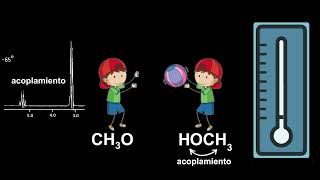
Many molecules change shape all the time: they rotate about bonds with partial double-bond character, invert their rings or exchange protons. If the process occurs at a rate comparable to the frequency difference between the signals, the NMR spectrum changes with temperature. Dynamic NMR uses these changes to measure reaction rates and energy barriers.
Slow, fast and in between
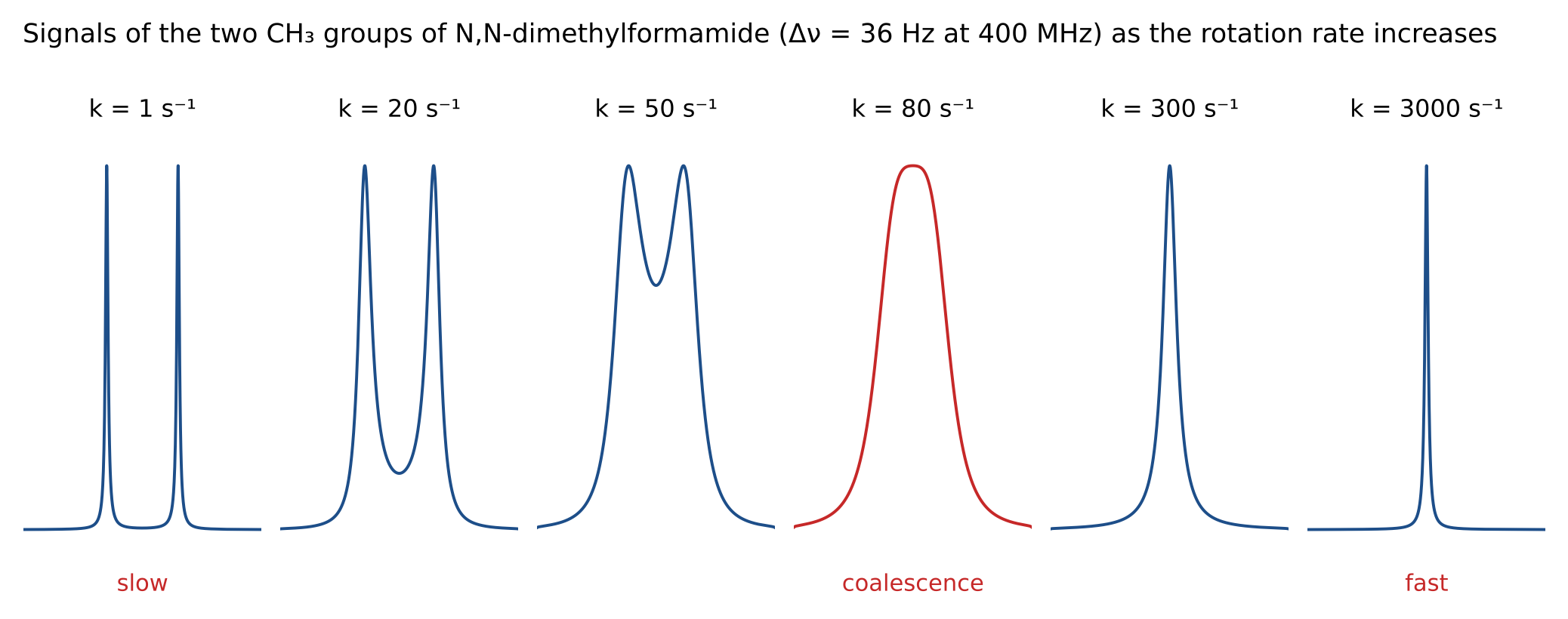
Consider a nucleus that jumps between two environments, A and B, whose frequencies are separated by Δν (in Hz), with a rate constant k. An example is N,N-dimethylformamide (DMF): the C–N bond has partial double-bond character through resonance with the carbonyl, rotation is slow and the two methyl groups are different, one cis and the other trans to the oxygen. At 400 MHz their signals are about 36 Hz apart.
- If exchange is slow (k ≪ Δν), two separate, sharp signals are seen.
- As it speeds up, the signals broaden and move closer.
- At the coalescence temperature, Tc, they merge into a single broad signal with a flat top.
- If exchange is fast (k ≫ Δν), a single sharp signal is seen at the average position, weighted by the populations.
From coalescence to the energy barrier
For two equally populated sites with no coupling between them, the rate constant at coalescence is:
kc = π·Δν/√2 ≈ 2.22·Δν
where Δν is measured in the slow-exchange limit, at low temperature. The Eyring equation then gives the free energy of activation:
ΔG‡ = R·Tc·[22.96 + ln(Tc/Δν)] (in J/mol, with Tc in K and Δν in Hz)
For DMF at 400 MHz (Δν ≈ 36 Hz, kc ≈ 80 s−1), coalescence occurs near 140 °C (413 K), and ΔG‡ = 8.314 × 413 × [22.96 + ln(413/36)] ≈ 87 kJ/mol (20.8 kcal/mol).
Since Δν in hertz is proportional to the field, the coalescence temperature rises slightly with the spectrometer field, although the barrier is the same. A more complete analysis is to simulate the lineshape at several temperatures, obtain k at each and fit the Eyring equation, which gives ΔH‡ and ΔS‡ separately.
Which processes can be studied
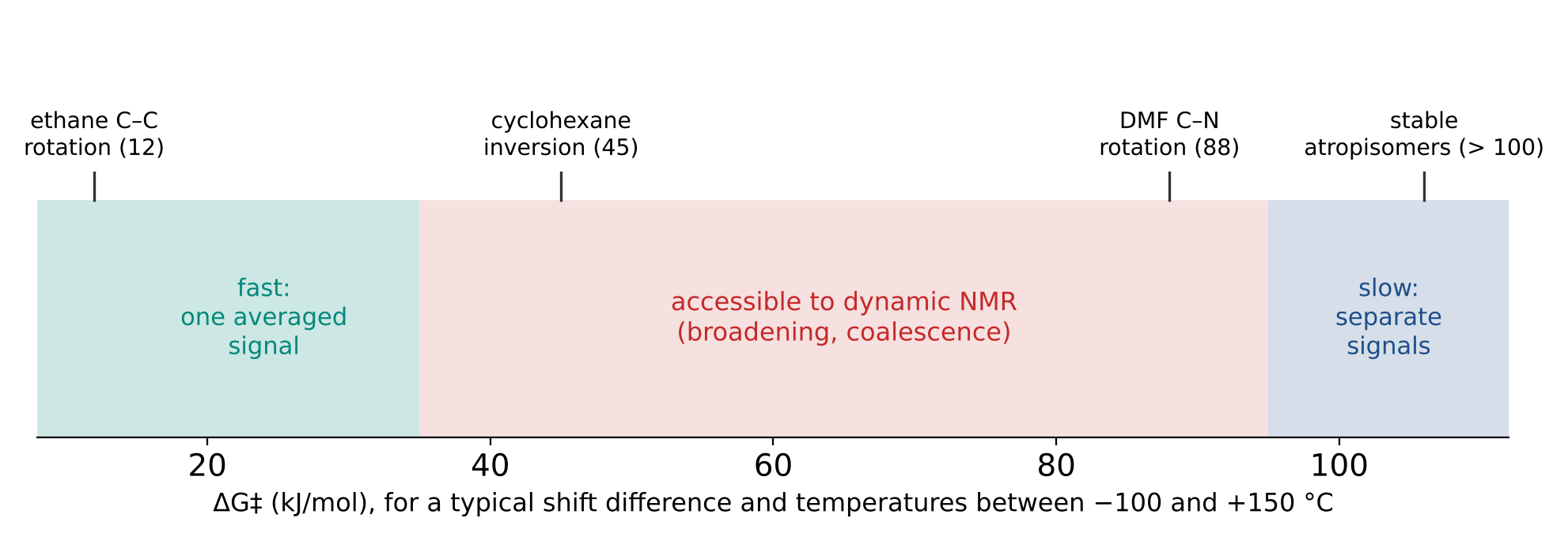
With the usual temperatures of a spectrometer (from about −100 to +150 °C), dynamic NMR measures barriers between about 35 and 95 kJ/mol (about 8 and 23 kcal/mol). Some typical processes:
- Restricted rotation about bonds with double-bond character: amides, carbamates, enamines, nitrosamines. Many amides and carbamates show doubled or broad signals at room temperature because of rotamers, which must not be mistaken for impurities or for a mixture of isomers.
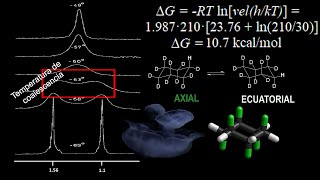
- Ring inversion: the cyclohexane chair inverts with a barrier of about 45 kJ/mol (10.8 kcal/mol), and its axial and equatorial hydrogens can only be distinguished below about −60 °C. At that temperature, in a substituted cyclohexane the 13C spectrum shows separate signals for the two chairs in equilibrium, with the substituent axial and equatorial.
- Nitrogen inversion in amines with bulky substituents or in small rings (aziridines).
- Atropisomerism of biaryls with ortho substituents: if the barrier exceeds about 100 kJ/mol (24 kcal/mol), the two atropisomers can be separated.
- Chemical exchange of OH and NH protons with the solvent or with each other, and tautomerism.
A simple test to tell whether two signals are due to rotamers or to two different compounds: record the spectrum at a higher temperature. If it is a dynamic equilibrium, the signals move closer and eventually coalesce; if they are two compounds, they do not change.