
Enantiomeric purity and absolute configuration: Mosher's method and chiral reagents
Two enantiomers give identical NMR spectra in an achiral solvent. To tell them apart, another chiral, enantiomerically pure molecule must be introduced: this forms diastereomers, which do have different spectra. With this idea the enantiomeric excess of a sample is measured and, with models such as Mosher's, the absolute configuration is assigned.
Enantiomers and diastereomers
Enantiomers have exactly the same physical properties except towards another chiral entity (circularly polarized light, a biological receptor, another chiral molecule). In a solvent such as CDCl3, their NMR spectra are identical. If each enantiomer is combined with a pure chiral molecule, for example (R)-X, the pairs (R,R) and (S,R) are obtained; these are diastereomers and give different spectra.
There are three kinds of reagents:
- Chiral derivatizing agents (CDAs): they bond covalently to the compound. The best known is Mosher's acid, α-methoxy-α-trifluoromethylphenylacetic acid (MTPA), which forms esters with alcohols and amides with amines.
- Chiral solvating agents (CSAs): they form weak, reversible associations (hydrogen bonds, π interactions), without reaction. It is enough to add them to the NMR tube. An example is Pirkle's alcohol (1-(9-anthryl)-2,2,2-trifluoroethanol).
- Chiral shift reagents: lanthanide complexes, such as Eu(hfc)3, which coordinate to basic groups and shift the signals differently for each enantiomer. They are used less today because they broaden the signals.
Enantiomeric excess
If the signals of the two diastereomers are resolved, the ratio of their integrals is the ratio of enantiomers in the sample. The enantiomeric excess is ee = (major − minor)/(total) × 100.
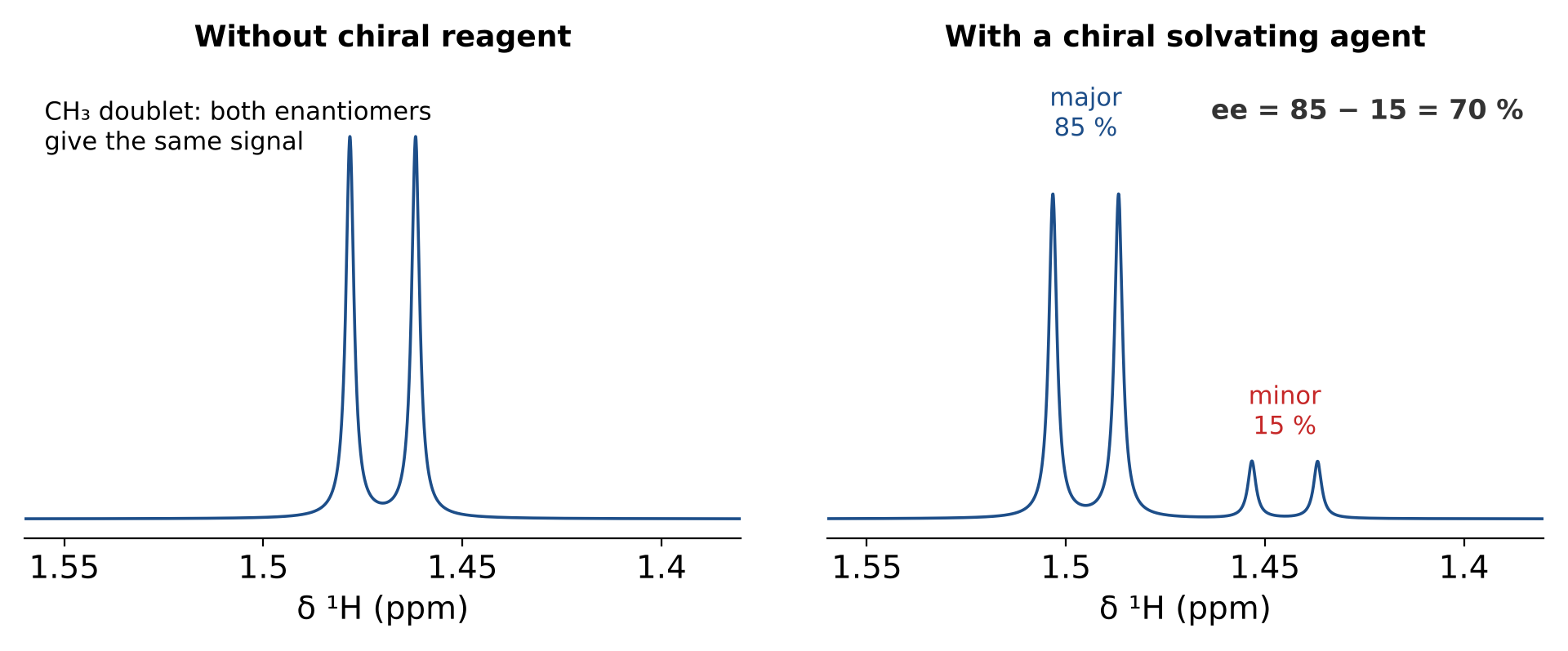
For the measurement to be reliable, the chiral reagent must be enantiomerically pure, and with CDAs the reaction must go to completion: if one enantiomer reacts faster than the other (kinetic resolution), the product ratio does not reflect that of the sample. That is why an excess of reagent is always used. Signals with little coupling, such as OCH3 singlets or the 19F signal of the MTPA CF3, are the most convenient to integrate.
Absolute configuration: Mosher's method
The MTPA esters of a secondary alcohol adopt a preferred conformation in which the carbinol C–H, the C=O and the CF3 lie in one plane. In that conformation, the phenyl ring of the MTPA sits over one of the two substituents of the carbinol and shields it (its hydrogens appear at lower δ). Which substituent is shielded depends on the configuration of the MTPA.
The procedure is to prepare both esters, with (R)- and with (S)-MTPA, assign their 1H spectra and calculate for each hydrogen the difference ΔδSR = δS − δR. All the hydrogens on one side of the carbinol (L1) give positive Δδ values, and all those on the other side (L2), negative ones. Placing each substituent on its side of the model gives the configuration of the stereocentre.
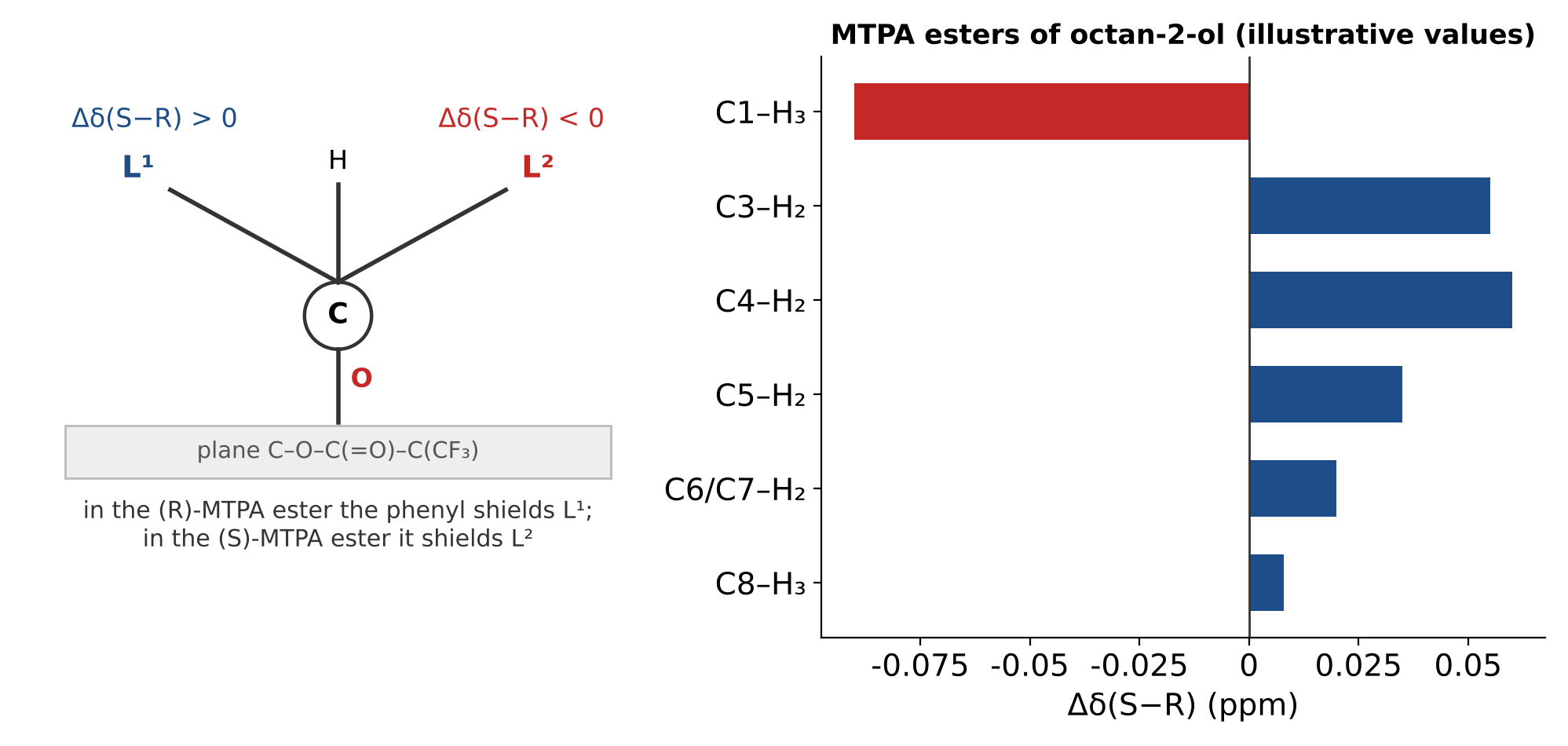
What matters is the consistency of the signs: all the hydrogens of the same substituent must give the same sign, with values that decrease with distance from the stereocentre. If the signs are mixed, the assumed conformation does not hold (for example, because of steric hindrance) and the assignment is not reliable. There are variants of the method for amines, carboxylic acids and tertiary alcohols, with other reagents such as methoxyphenylacetic acid (MPA).
A practical detail that causes many mistakes: the acid chloride (R)-MTPA-Cl gives the (S)-MTPA ester, because replacing OH by Cl changes the CIP priorities at the stereocentre, even though its spatial arrangement does not change.
Chiroptical techniques, such as circular dichroism compared with theoretical calculations, and X-ray diffraction are also used for the absolute configuration.