
Circular dichroism and absolute configuration
A chiral molecule not only refracts right- and left-circularly polarized light differently: it also absorbs them differently. That difference, circular dichroism (CD), appears only within absorption bands and has a sign. The sign depends on the spatial arrangement of the atoms around the chromophore, which is why CD is one of the most widely used methods for determining absolute configuration.
Circular dichroism
A CD spectrometer alternately passes left- and right-circularly polarized light and measures the difference in absorbance. The result is expressed as a difference in molar absorptivities:
Δε = εL − εR
or as molar ellipticity, [θ] = 3298 · Δε (in degrees cm2 dmol−1), because the light leaving the sample is no longer plane-polarized but slightly elliptical. Δε is always much smaller than ε: the ratio Δε/ε, the dissymmetry factor, is usually between 10−4 and 10−2.
Each absorption band of a chromophore in a chiral environment gives a CD band, positive or negative: it is the same Cotton effect observed in optical rotatory dispersion, seen in another way. A positive Cotton effect gives a positive CD band and an ORD curve with its peak at longer wavelength:
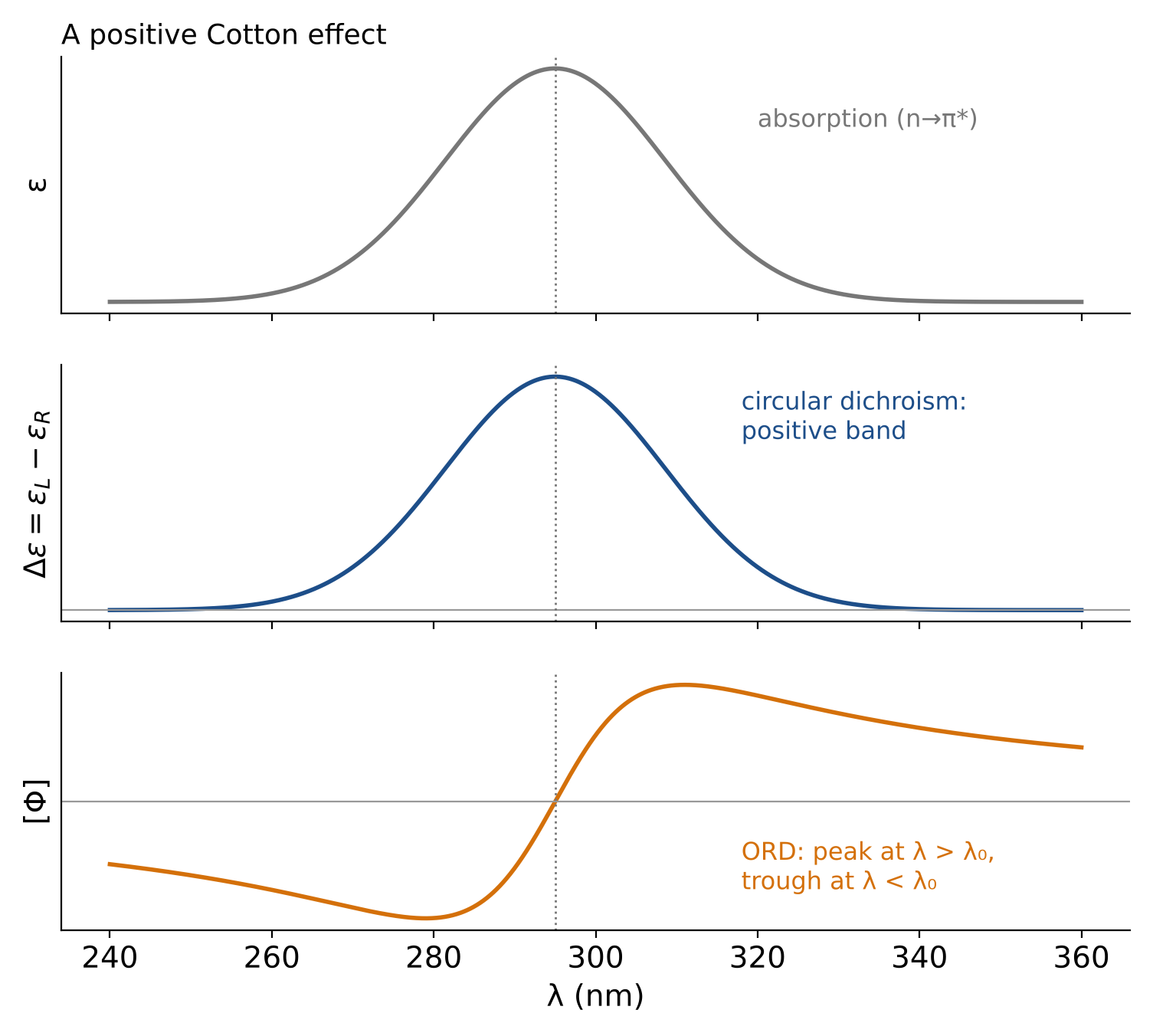
CD and ORD contain the same information (one can be calculated from the other), but CD is easier to interpret: each band is localized at its transition and does not overlap with the tails of the others, as happens in ORD. That is why CD has almost completely replaced ORD.
The octant rule
The n→π* band of saturated ketones, near 290 nm, is weak in absorption but very sensitive to the chirality of its surroundings. In 1961, Moffitt, Woodward, Moscowitz, Klyne and Djerassi proposed an empirical rule to predict the sign of its Cotton effect. The molecule is placed with the C=O bond along one axis and the oxygen towards the observer. Three planes intersecting at the carbonyl carbon divide space into eight octants; almost all the atoms of a cyclohexanone lie in the four rear ones (behind the carbon). Each substituent contributes to the Cotton effect with the sign of the octant it occupies, and those lying on the planes do not contribute:
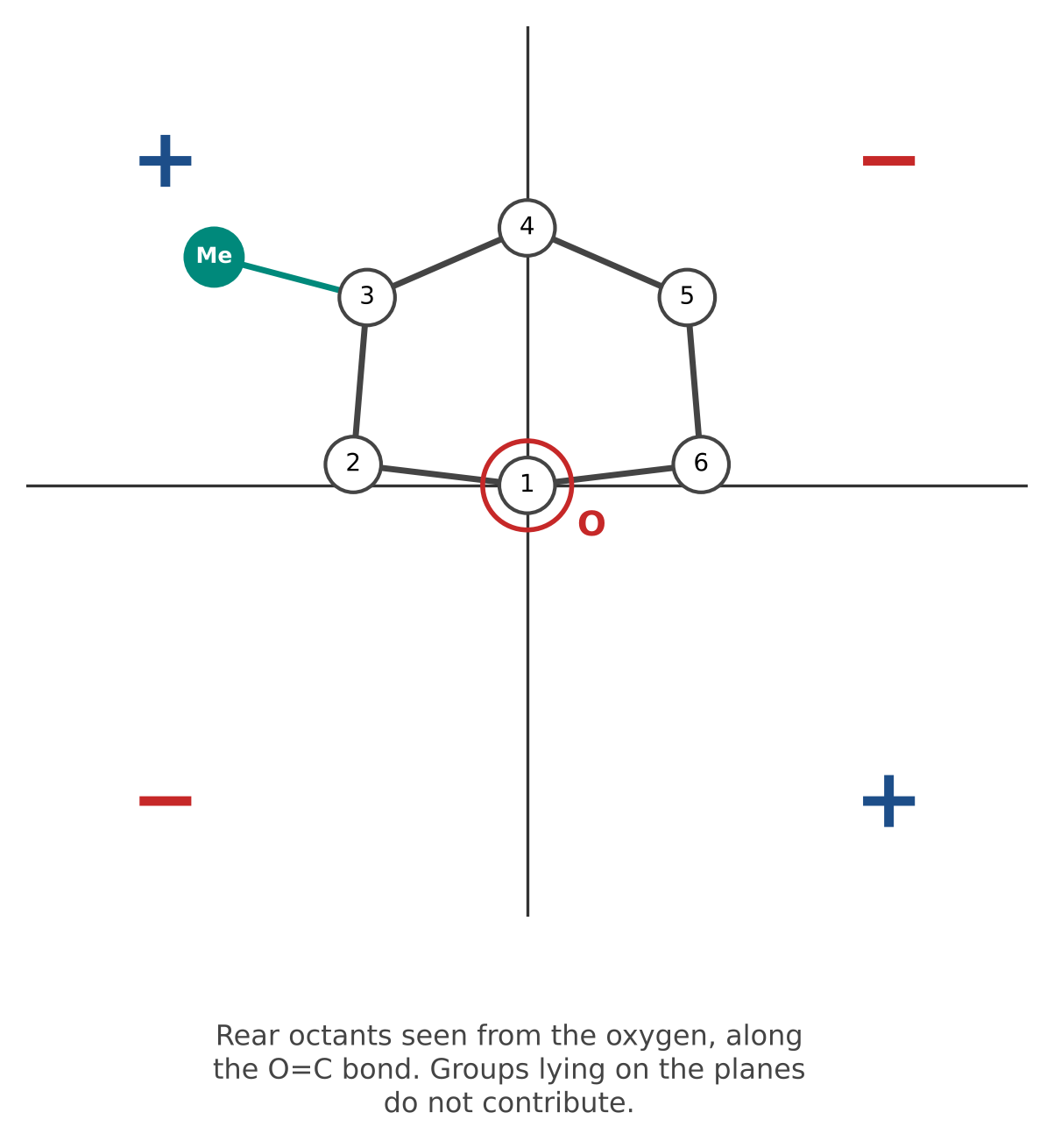
In cyclohexanone, carbons C2 and C6 lie almost in one plane and C4 in the other; C3 and C5 are in octants of opposite sign and their contributions cancel. A substituent breaks the symmetry. In (R)-3-methylcyclohexanone, with the methyl equatorial, the methyl lies in the upper-left octant, which is positive: a positive Cotton effect is predicted, and that is what is observed. The rule was applied with great success to steroid and terpene ketones. It requires knowledge of the conformation and fails when substituents lie in the front octants or when the molecule is very flexible.
The exciton chirality method
When two identical, intense chromophores (two benzoates, for example) are close together in a molecule, their π→π* transitions couple and the absorption band splits into two very close components. The CD spectrum shows two Cotton effects of opposite sign, a couplet, centred on the absorption maximum. Harada and Nakanishi showed in 1969 that the sign of the couplet depends only on the sense of twist between the two transition moments: if the front one has to rotate clockwise to eclipse the back one, the chirality is positive and the first Cotton effect (the one at longer wavelength) is positive; if anticlockwise, both are negative.
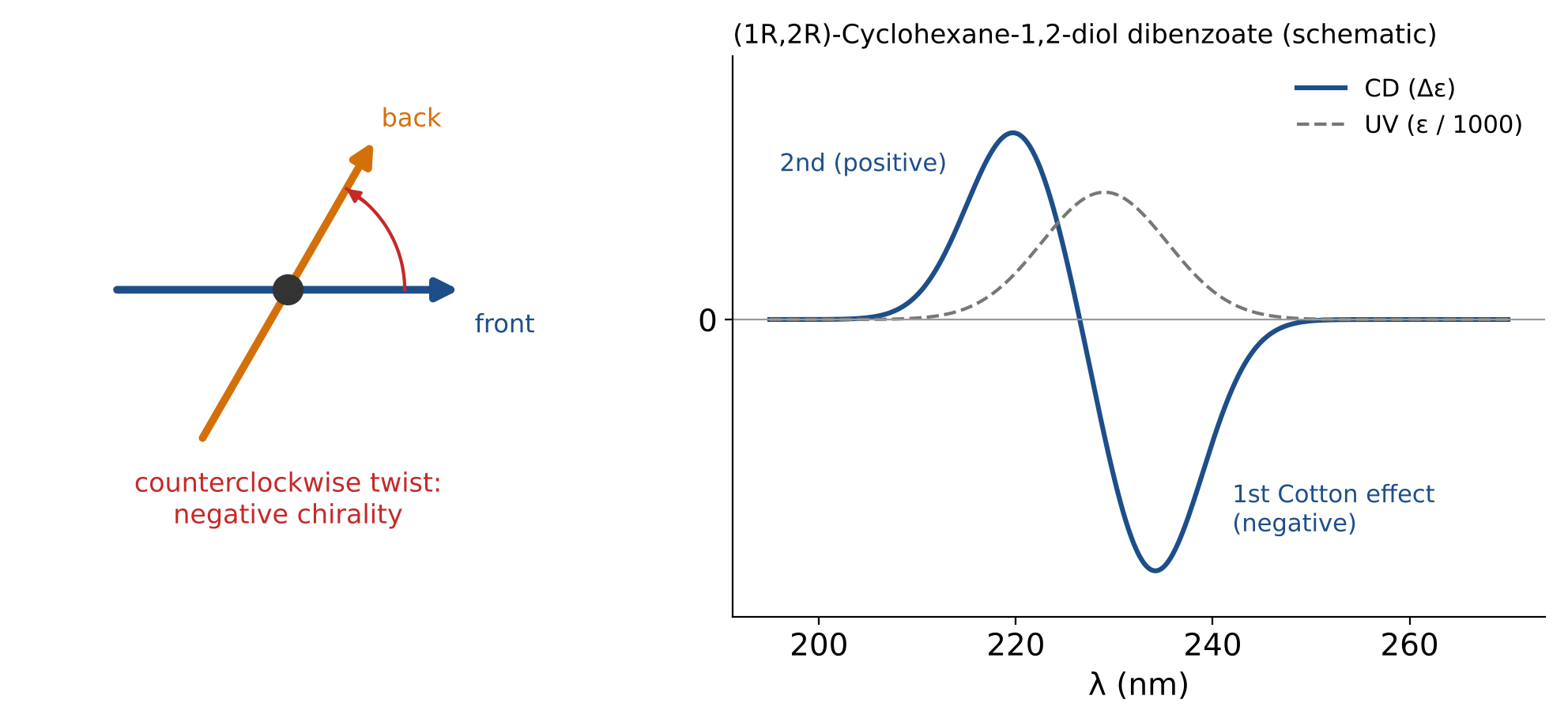
In the dibenzoate of trans-cyclohexane-1,2-diol, the two groups are equatorial and form an O–C–C–O dihedral angle of about 60°. The benzoate transition moment is almost parallel to the C–O bond, so the sense of twist between the two benzoates is that of the dihedral angle. In the (1R,2R) enantiomer the twist is anticlockwise and the couplet is negative. The method is non-empirical, needs only micrograms of sample and applies to diols, amino alcohols and other compounds to which chromophores can be attached.
Comparison with calculated spectra
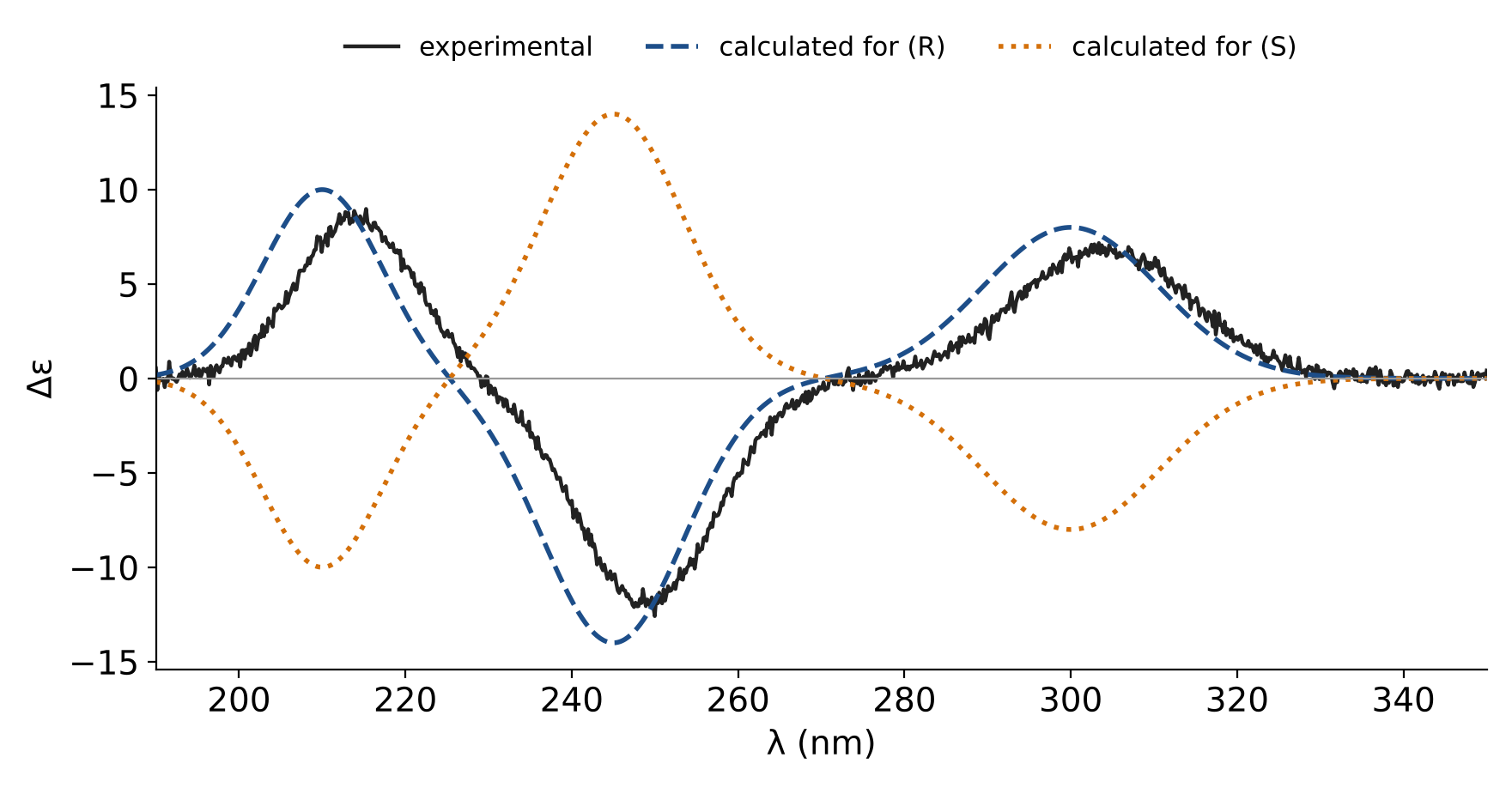
Today the most general way to assign absolute configuration by CD is to compare the experimental spectrum with one calculated by quantum methods (TD-DFT, time-dependent density functional theory). The conformers of the molecule are found, the spectrum of each is calculated for one of the two configurations, they are averaged according to their Boltzmann populations, and the result is compared with the experiment. The enantiomer has the mirror-image spectrum:
The same procedure is applied to optical rotation and to vibrational circular dichroism (VCD), the infrared counterpart of CD, which has the advantage of not needing chromophores: every molecule has vibrations. Together with single-crystal X-ray diffraction (T12) and NMR methods with chiral reagents, such as Mosher's (T12), they make up today's toolkit for determining absolute configuration.