
Optical activity and optical rotatory dispersion
Chiral molecules rotate the plane of polarized light. This property, optical activity, was the first known manifestation of molecular chirality: with it, Pasteur separated the enantiomers of tartaric acid in 1848. Today the polarimeter is still the quickest way to characterize a chiral compound and to check that a sample is not racemic.
The polarimeter
Ordinary light vibrates in all directions perpendicular to its propagation. A polarizer lets through only the light vibrating in one plane: plane-polarized light. On passing through a solution of a chiral compound, the plane of polarization rotates by an angle α, which is measured by turning a second polarizer, the analyser, until the light is extinguished (or, in automatic polarimeters, with a detector).
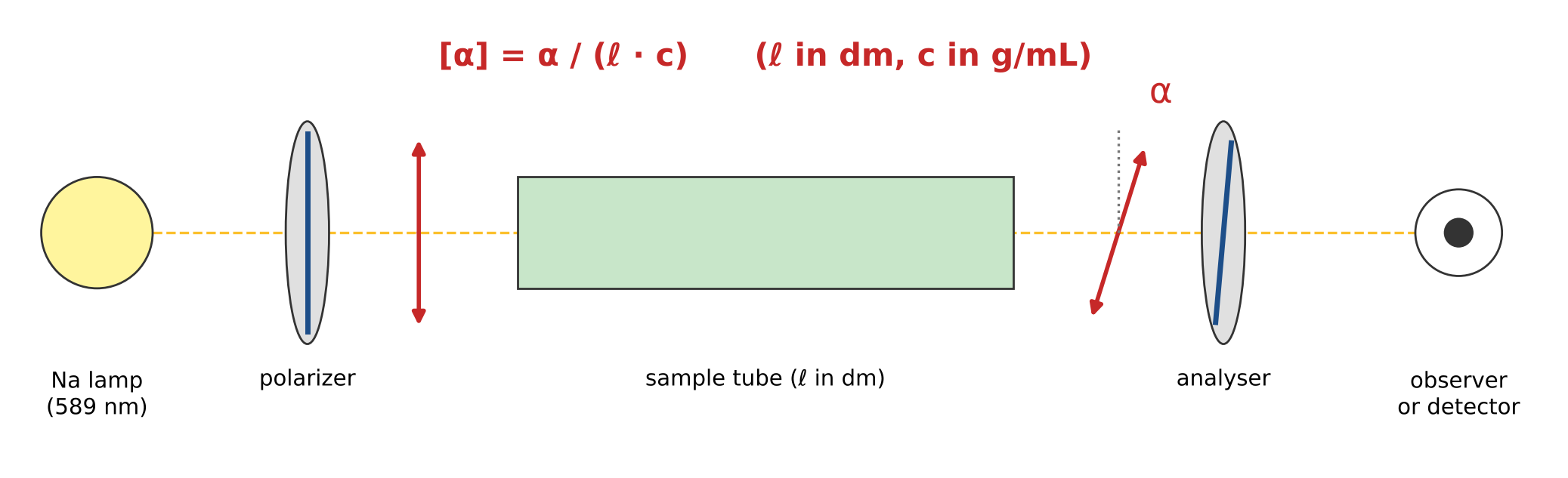
If the plane rotates clockwise, as seen by an observer receiving the light, the compound is dextrorotatory and α is positive: (+). If it rotates the other way, it is laevorotatory: (−). Two enantiomers rotate the plane by the same angle in opposite directions; a racemic mixture therefore does not rotate, and neither does a meso compound, which is not chiral.
Specific rotation
The observed angle is proportional to the length of the tube and to the concentration. To obtain a constant of the compound, the specific rotation is defined:
[α]λT = α / (ℓ · c)
with ℓ in decimetres and c in grams per millilitre (or the density, for a neat liquid). The temperature, the wavelength (almost always the sodium D line, 589 nm), the solvent and the concentration are always given, the latter conventionally in g/100 mL: for example, [α]D20 = +66.5 (c 2.0, H2O) for sucrose. The solvent matters: it can change the value and even the sign of [α]. To compare compounds of different molecular mass, the molar rotation is used, [Φ] = [α] · M/100.
The sign of the rotation bears no simple relationship to the configuration. (R)-Glyceraldehyde is dextrorotatory and (R)-lactic acid is laevorotatory. Moreover, the sign can change with wavelength, solvent or temperature. To deduce the configuration from optical properties, comparison with compounds of known configuration, circular dichroism or quantum-chemical calculation of the rotation is needed.
Enantiomeric excess
A mixture of enantiomers rotates the plane in proportion to the excess of one over the other. The optical purity is defined as the ratio of the observed specific rotation to that of the pure enantiomer, and in most cases it equals the enantiomeric excess:
ee (%) = 100 · [α]obs / [α]pure
This method requires an accurate value of [α] for the pure enantiomer, and it is unreliable when the rotation is small or the sample contains optically active impurities. In some cases the relationship between rotation and ee is not linear, because of molecular aggregation. And there is a subtler trap: the rotation of a chiral compound is the average of those of its conformers, so it changes if the conformational equilibrium changes, even though the enantiomeric composition is the same. Ernest L. Eliel and Ernesto Brunet measured this in 1991 with cis-3-hydroxythiane S-oxide: the same sample, with 61 % ee, gave [α]D = −23.7 in concentrated dichloromethane and −73.8 on dilution, because the molecule switches from one chair to the other. With a single measurement and a reference value taken under other conditions, the calculated ee could come out three times too high or too low (see Conformation and chirality: optical rotation, in the Advanced Organic Chemistry course). Today ee is preferably measured by chromatography on a chiral stationary phase or by NMR with chiral agents (T12).
The origin of optical activity
Plane-polarized light can be regarded as the sum of two circularly polarized waves, one rotating to the right and the other to the left, with the same amplitude and in phase. In a chiral medium, the two components do not travel at the same speed: the medium has a different refractive index for each, nL ≠ nR (circular birefringence). One lags behind the other, and their sum is again a plane wave, but in a rotated plane:
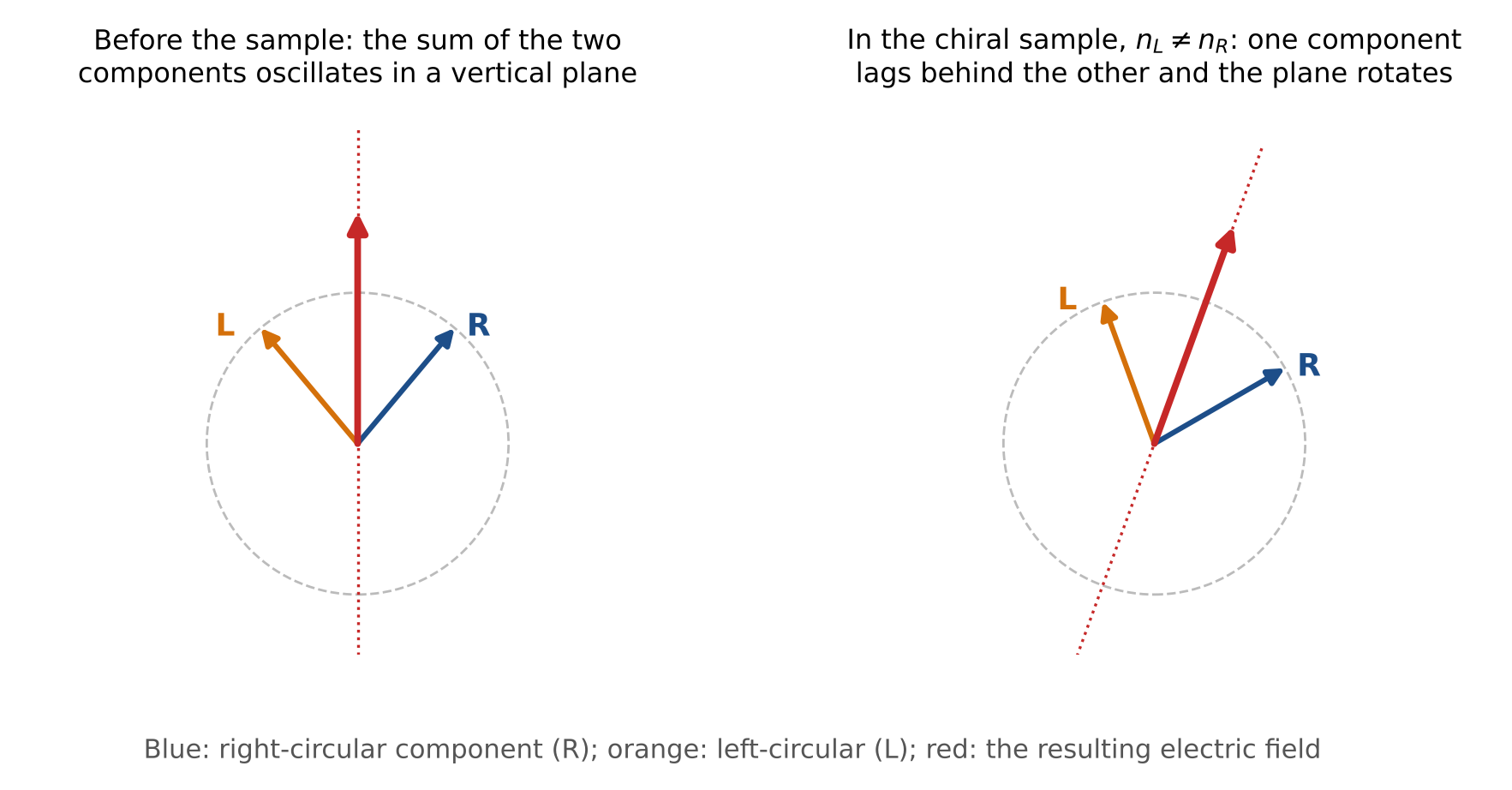
α (radians) = (π · ℓ / λ) · (nL − nR)
The difference between the refractive indices is tiny, of the order of 10−6 to 10−9, but the tube is thousands of times longer than the wavelength, and the effect accumulates to give angles of several degrees.
Optical rotatory dispersion
The refractive index depends on wavelength, and so does the rotation. The curve of [α] or [Φ] against λ is the optical rotatory dispersion (ORD). Far from absorption bands, the rotation increases in absolute value as the wavelength decreases, without changing sign: this is a plain curve. Near an absorption band of the chromophore, the curve shows a peak and a trough: this is an anomalous curve, and the phenomenon is called the Cotton effect, after Aimé Cotton, who described it in 1895.
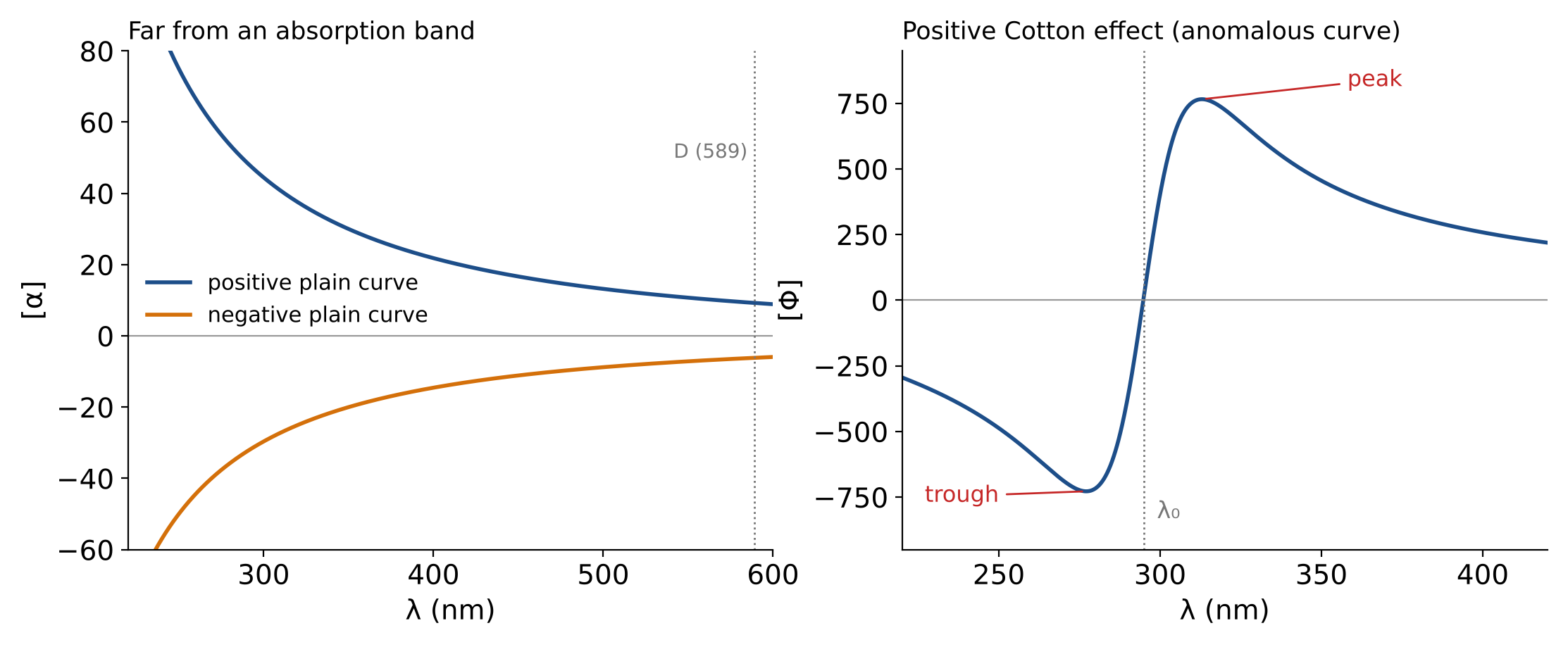
In a positive Cotton effect, the peak lies at longer wavelength than the trough; in a negative one, the other way round. The Cotton effect is a probe of the chirality around the chromophore, and its relationship to absolute configuration is best studied with circular dichroism.