
Conformation and chirality: optical rotation
The optical rotation of a chiral compound is not a constant of its configuration: it is the average of the rotations of its conformers, each weighted by its population. If the conformational equilibrium changes with the solvent, the concentration or the temperature, the rotation changes too, even though the configuration is the same.
Review chirality and optical activity in Organic Chemistry made transparent. This section tells, almost as a detective story, the experiment with which Ernest L. Eliel and Ernesto Brunet put numbers to that idea in 1991.
An old suspicion
It has long been known that the specific rotation of a chiral compound depends on temperature, solvent and concentration. For decades this was ascribed, qualitatively, to the association of the molecules with each other and with the solvent, above all through hydrogen bonds. In 1959 J. H. Brewster proposed another explanation: rotation depends critically on conformation.
His favourite example was lactic acid, CH3CH(OH)CO2H. From the polarizability of the four groups at the stereocentre, the (R) acid should be dextrorotatory, and so are its esters and salts; yet in water it is levorotatory. The simplest explanation is a cyclic structure, closed by an internal hydrogen bond, which changes the conformation. One question remained open: does the hydrogen bond change the rotation directly, or because it changes the conformation? Answering it required a molecule whose conformational equilibrium could be measured and shifted at will.
A molecule with two chairs
That molecule was cis-3-hydroxythiane S-oxide: a six-membered ring with a sulfur atom, oxidized to a sulfoxide, and a hydroxyl group in the 1,3 position and on the same side. As in a cis-1,3-disubstituted cyclohexane, the two groups are equatorial in one chair (E) and axial in the other (A). In chair A they are so close that the OH forms an intramolecular hydrogen bond with the sulfoxide oxygen; in E they are far apart, but exposed to the outside.
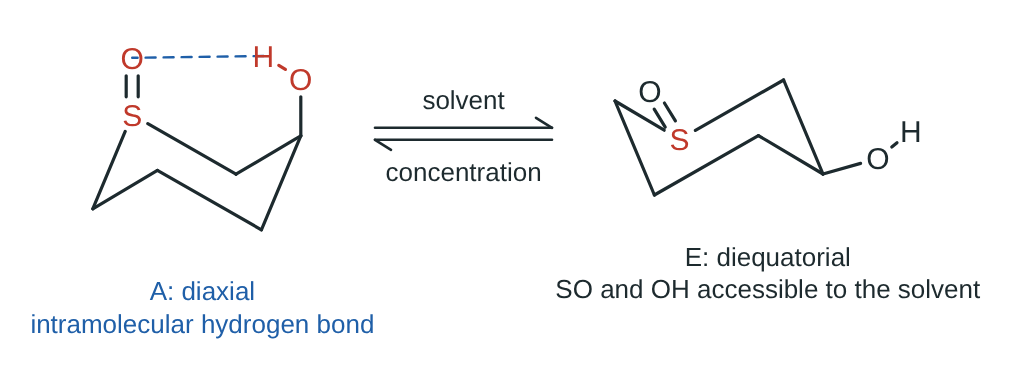
Rotate the two models (prepared with HyperChem; they are of the (1R,3S) enantiomer, the configuration J. H. Brewster suggested for the sample studied): in chair A the OH hydrogen points towards the sulfoxide oxygen; in E both groups face away from the ring.
The two authors had previously seen, by NMR, that this equilibrium responds dramatically to concentration. In concentrated solution the molecules associate with each other through hydrogen bonds, or with the solvent if it can form them, and chair E predominates, in which the SO and the OH are more accessible. In methanol, which binds to them, chair E persists at any dilution. But in a solvent that does not form hydrogen bonds, such as dichloromethane, on dilution the intramolecular bond wins and the molecule switches to chair A.
How are the conformers counted? The chair flips very fast and at room temperature a single spectrum is seen, the average of the two. The clue lies in the coupling constant between the OH hydrogen and that of the carbon bearing it, J(H–O–C–H): at −80 °C, when the ring flip is frozen, the two chairs are seen separately, with JA = 9.7 Hz and JE = 4.8 Hz in CD2Cl2. At any other temperature or concentration the observed value is the weighted average, Jobs = JAxA + JExE, which gives the mole fractions xA and xE. Coupling constants are covered in the course Organic structure determination.
The experiment
The molecule was still needed in optically active form. 3-Thianone was enantioselectively oxidized to its S-oxide with the Sharpless reagent as modified by Henri Kagan (titanium tetraisopropoxide, diethyl tartrate, water and tert-butyl hydroperoxide), with 61% enantiomeric excess; the ketone was reduced with sodium borohydride and the cis isomer was separated from the trans by chromatography. Its specific rotation was then measured at many concentrations in three solvents:
| Solvent | Conformation | [α]D, concentrated | [α]D, dilute |
|---|---|---|---|
| methanol | always E | −18.7° | −18.7° |
| dichloromethane | from E to A on dilution | −23.7° (4.7 M) | −73.8° |
| acetone | from E to A, but it stalls | −27.4° (2.0 M) | −45° |
In methanol the rotation does not change with concentration: the molecule is always in chair E. And the values in concentrated solution, where chair E also dominates, are very similar in all three solvents, even though the hydrogen-bond donor is different (methanol or the OH of another molecule). In dichloromethane, by contrast, the rotation triples on dilution.
A perfect straight line
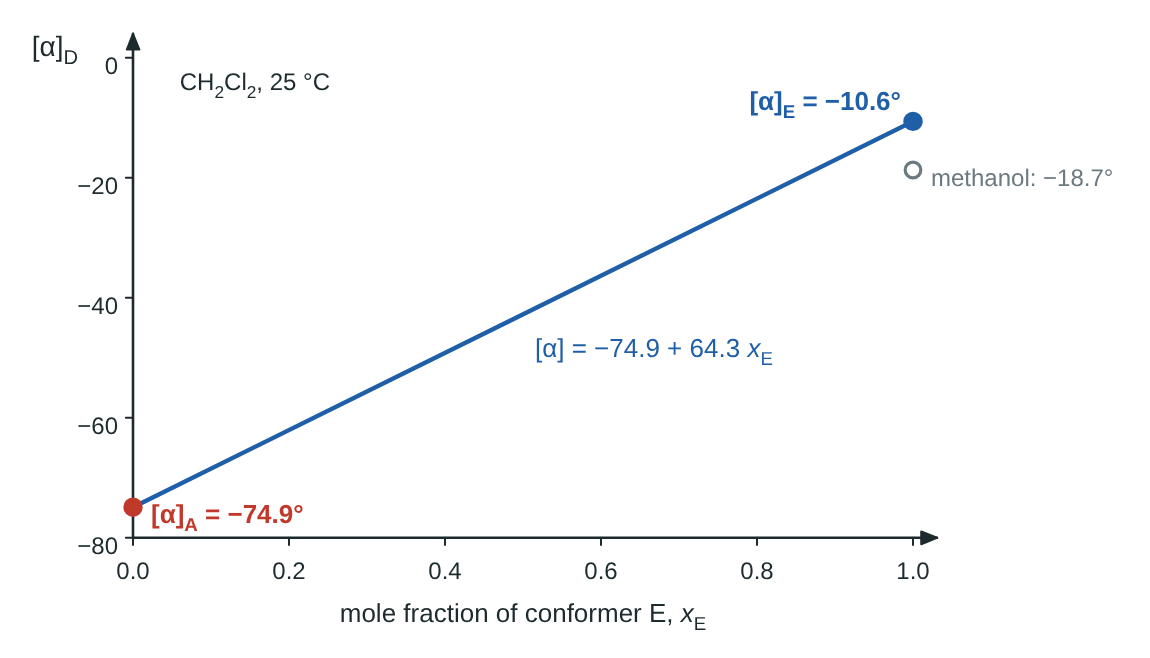
The decisive test was to plot the rotation measured in dichloromethane against the mole fraction of chair E obtained by NMR in the same solutions. The points fall on a straight line (r = 0.998): [α]D = −74.9 + 64.3 xE, which can also be written as [α]D = −10.6 xE − 74.9 xA. It has exactly the same form as the coupling-constant equation: the observed rotation is the average of the rotations of the two conformers, weighted by their mole fractions. Its ends give the rotation of each pure chair: −74.9° for A and −10.6° for E. The same molecule, with the same configuration, rotates the plane of polarized light seven times more in one chair than in the other.
Try it: shift the equilibrium
- Fraction of A, xA
- Observed JHO–CH
- Predicted [α]D
The value extrapolated for pure chair E in dichloromethane (−10.6°) does not quite match that in methanol (−18.7°), where the molecule is also all E: the solvent, by binding to the SO and the OH, somewhat modifies the rotation of the same conformer. It is a small effect compared with that of the change of chair.
Acetone, an instructive exception
In acetone things are not so simple. On dilution the fraction of chair E falls as in dichloromethane down to a concentration of about 0.2–0.3 M, and then hardly changes, at around one third, even though dilution continues a hundredfold; the rotation also levels off, near −42°. Acetone is a hydrogen-bond acceptor: its C=O can bind to the OH of the solute. Beyond a certain dilution, the intramolecular bond of chair A and the bond to acetone of chair E have similar strengths and balance each other.
Moreover, the data in acetone do not fit the equation with the rotations measured in the other two solvents: no value of [α]E between −18.7° and −10.6° satisfies it with [α]A = −74.9°. In acetone the rotation of at least one of the chairs is different: there is an intrinsic solvent effect on rotation, added to the conformational effect.
What it teaches us
- Rotation is a conformational average. Like coupling constants or chemical shifts, the rotation of a flexible molecule is the average of those of its conformers. The hydrogen bond acts mainly through the conformation it imposes.
- Comparing rotations requires the same conditions. To relate configurations by the sign of rotation, or to calculate optical purity from [α], using the same solvent is not enough: one must also work at a concentration and temperature at which the conformational equilibrium is the same. A concentration error can triple the rotation.
- The solvent also acts directly. The case of acetone shows that, besides shifting the equilibrium, the solvent can change the rotation of each conformer.
- This is how it is calculated today. When optical rotation, electronic circular dichroism or vibrational circular dichroism are predicted computationally to assign an absolute configuration, each conformer is calculated separately and averaged according to its Boltzmann population. This experiment is a clean, quantitative experimental demonstration of that principle.
Conformer populations also decide the overall rate of a reaction, as in the Winstein–Holness equation of the Curtin–Hammett principle. And the chirality of a “frozen” conformation is that of atropisomers.
- E. L. Eliel, E. Brunet, «Quantitative relationship between optical rotation and conformation», J. Org. Chem. 1991, 56, 1668–1670.
- E. L. Eliel, E. Brunet, Tetrahedron Lett. 1985, 26, 3421; J. Org. Chem. 1986, 51, 677.
- J. H. Brewster, J. Am. Chem. Soc. 1959, 81, 5475.
- P. Pitchen, E. Duñach, M. N. Deshmukh, H. B. Kagan, J. Am. Chem. Soc. 1984, 106, 8188.