Relative configuration and conformation by NMR
Once the connectivity is established, it remains to find out how the atoms are arranged in space. NMR gives the relative configuration (that of some stereocentres with respect to others) and the conformation with two main tools: coupling constants, which depend on dihedral angles, and the NOE, which depends on distances.
The two tools
- The vicinal coupling constant, 3JHH, depends on the H–C–C–H dihedral angle according to the Karplus equation: it is large (8–13 Hz) when the two hydrogens are antiperiplanar (180°) and small (1–5 Hz) when they are at about 60° or 90°.
- The NOE, measured in a NOESY or ROESY experiment, appears between hydrogens that are less than about 5 Å apart in space, even if they are separated by many bonds. Its intensity falls off with the sixth power of the distance.
The two are complementary: coupling constants report on relationships between neighbouring hydrogens, and the NOE on relationships over longer distances, for example between the two faces of a ring.
Six-membered rings
In a chair cyclohexane, an axial hydrogen has two axial neighbours in an antiperiplanar position and gives large constants (Jax-ax ≈ 10–13 Hz). An equatorial hydrogen has only small constants (Jax-eq and Jeq-eq ≈ 2–5 Hz). That is why the simple width of a multiplet is often enough to tell whether the hydrogen is axial or equatorial.
A classic example is the 4-tert-butylcyclohexanols. The tert-butyl group is so bulky that it locks the chair with itself in an equatorial position. In the trans isomer, the OH is also equatorial and H1 is axial; in the cis isomer, the OH is axial and H1 equatorial.
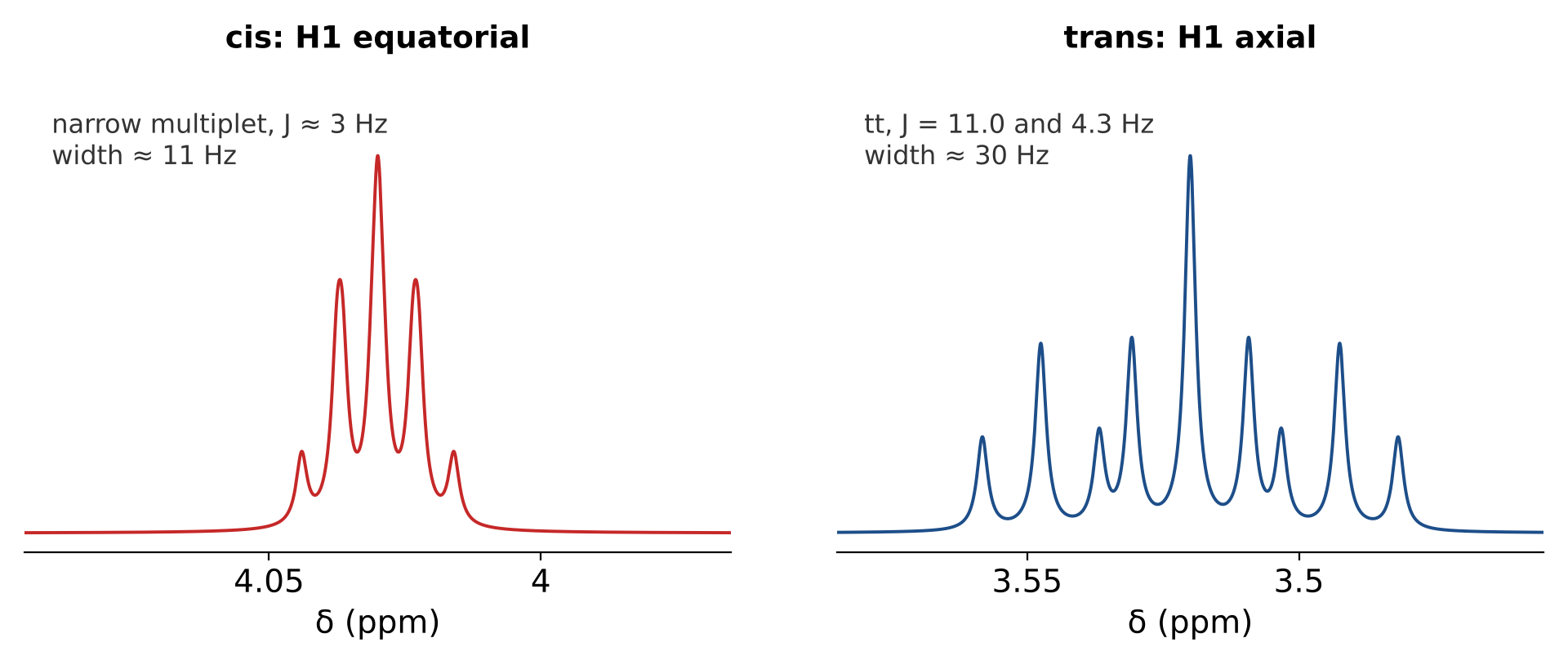
Besides the shape, the shift helps: equatorial hydrogens usually appear at a higher chemical shift than the equivalent axial ones. And the NOE confirms it: an axial H1 shows an NOE with the other two axial hydrogens on the same face (H3 and H5, in a 1,3-diaxial relationship), and an equatorial one does not.
Five-membered rings and polycyclic systems
In five-membered rings, which are flexible, cis and trans constants overlap (both between 2 and 10 Hz) and do not allow a safe decision. Here the NOE is the main tool: two cis substituents have their hydrogens on the same face and show an NOE between them.
In rigid polycyclic systems, such as steroids or terpenes, a network of NOEs is built: each correlation places a hydrogen on the α or β face of the molecule, and the relative configuration of all the stereocentres follows from the consistency of the whole set.
Open chains
Open chains are harder, because they rotate freely and what is measured is an average over several conformations. There are two strategies:
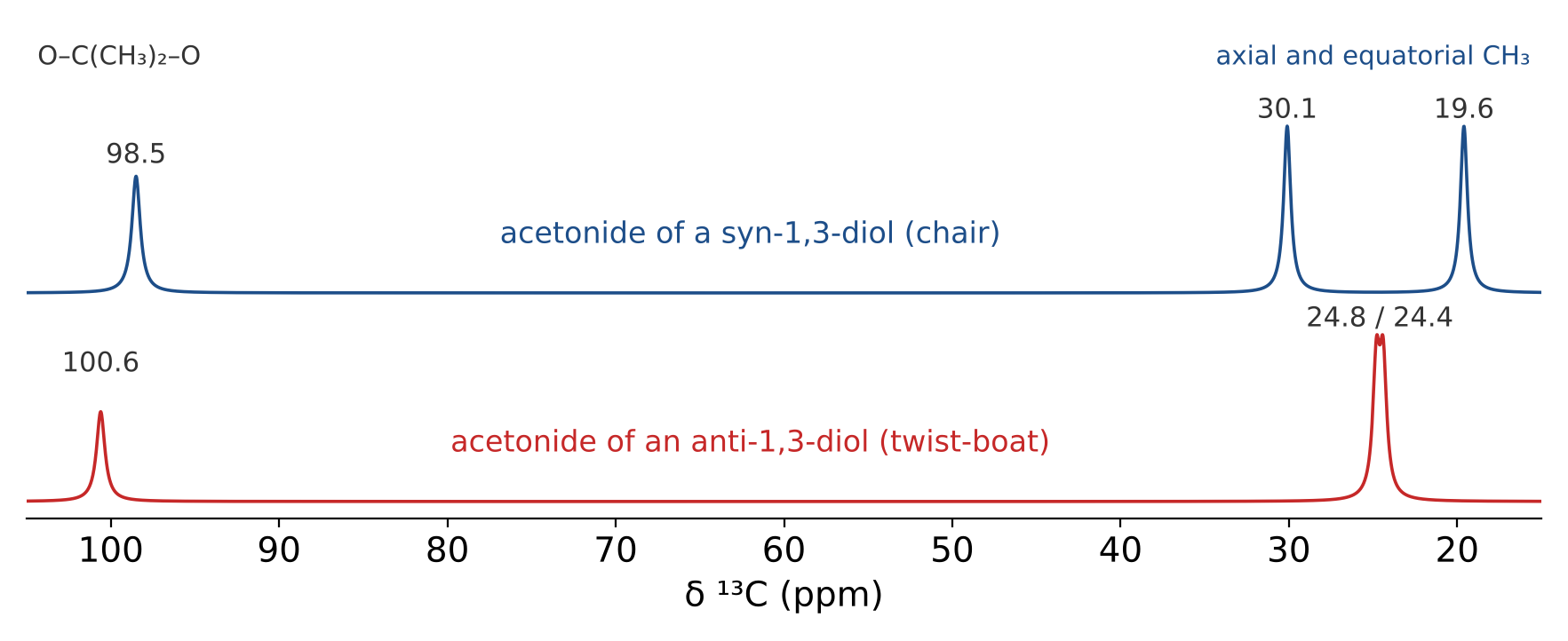
- Locking the conformation by forming a ring. The best-known example is the acetonide method (Rychnovsky) for 1,3-diols: the diol is converted into its acetonide (a 1,3-dioxane) and the 13C spectrum is examined. That of a syn diol adopts a chair, with one axial methyl (about 19 ppm) and one equatorial methyl (about 30 ppm), and the acetal carbon near 98.5 ppm. That of an anti diol cannot adopt a chair without placing a substituent axial and prefers a twist-boat, with both methyls near 25 ppm and the acetal carbon near 100.5 ppm.
- Analysing the coupling constants 3JHH and 2,3JCH of each bond to deduce which rotamer predominates (Murata's J-based configuration analysis), supported by the NOE.
None of these techniques gives the absolute configuration: a molecule and its mirror image have exactly the same coupling constants and the same NOEs. The absolute configuration requires chiral reagents, chiroptical methods or X-ray diffraction.