Coupling constants and the Karplus equation
The value of the coupling constant depends on the number of bonds separating the nuclei and on the geometry. Vicinal 3J constants follow the Karplus equation: they are large when the two hydrogens are antiperiplanar (180°), somewhat smaller when they are eclipsed (0°) and almost zero at 90°. Thus the constants distinguish cis and trans alkenes, axial and equatorial hydrogens, or the positions on an aromatic ring.
Typical values
| Type of coupling | Example | J (Hz) |
|---|---|---|
| Geminal on an sp3 carbon, 2J | H-C-H of a diastereotopic CH2 | 10-15 |
| Geminal on an alkene, 2J | =CH2 | 0-3 |
| Vicinal with free rotation, 3J | CH3-CH2- | 6-8 (≈ 7) |
| Vicinal on an alkene, cis | H-C=C-H on the same side | 6-12 (≈ 10) |
| Vicinal on an alkene, trans | H-C=C-H on opposite sides | 12-18 (≈ 16) |
| Aromatic ortho | H on adjacent carbons | 7-9 |
| Aromatic meta | H separated by one carbon | 1-3 |
| Aromatic para | Opposite H | 0-1 |
| Cyclohexane, axial-axial | H-C-C-H at 180° | 8-13 |
| Cyclohexane, axial-equatorial and equatorial-equatorial | H-C-C-H at about 60° | 2-5 |
| Aldehyde, CHO-CH | H-C(=O)-C-H | 1-3 |
| Long range, 4J | Allylic (H-C=C-C-H); “W” in rigid systems | 0-3 |
A few simple rules make the table useful:
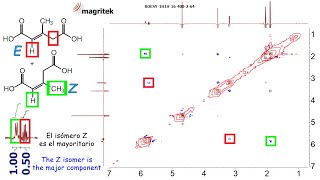
- In a disubstituted alkene, a constant of about 16 Hz indicates a trans (E) isomer, and one of about 10 Hz a cis (Z) one. It is the most direct way of assigning the configuration of a double bond.
- On an aromatic ring, 8 Hz doublets reveal ortho hydrogens. A para-disubstituted benzene gives two “doublets” of about 8 Hz (really an AA'BB' system); a meta-disubstituted one has an isolated hydrogen, with small couplings.
- Couplings over four or more bonds are usually small and are only seen in rigid systems, when the bonds form a planar “W”, or through double bonds.
The Karplus equation
In 1959 Martin Karplus (Nobel Prize in Chemistry 2013, for other work) showed that the vicinal constant 3J between two hydrogens H-C-C-H depends on the dihedral angle φ between them, the one seen in a Newman projection along the C-C bond. A simple form of the equation is:
3J(φ) ≈ 7.8 cos2φ − 1.1 cos φ + 1.4 Hz
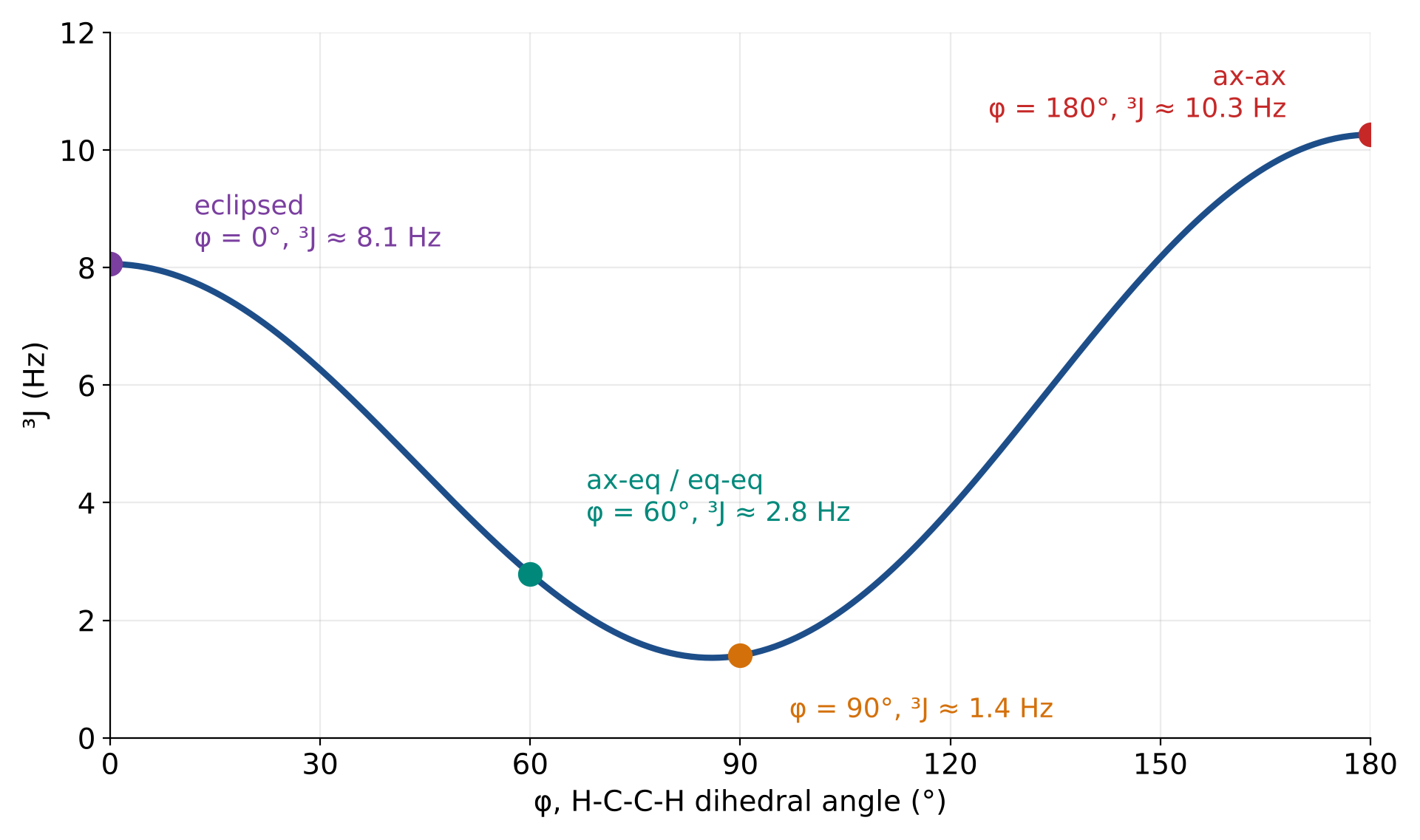
- At 180° (antiperiplanar hydrogens) the constant is largest, about 10 Hz or more.
- At 0° (eclipsed) it is somewhat smaller, about 8 Hz.
- Near 90° it is smallest, almost zero.
In freely rotating chains, the constant is an average over the conformations, which is why it is almost always about 7 Hz. The exact values of the constants are affected by the electronegativity of the substituents, their relative orientation and other factors, so Karplus's original equation is for comparison, not for measuring angles precisely. Other variants of the Karplus equation have been proposed, for example the Haasnoot–de Leeuw–Altona equation, which allows a finer fit (Karplus equation on Wikipedia).
Application to cyclohexanes
In a cyclohexane chair, two neighbouring axial hydrogens form a dihedral angle of about 180°, and their constant is large, 8 to 13 Hz. An axial and an equatorial hydrogen, or two equatorial ones, form angles of about 60°, with small constants, 2 to 5 Hz. Review the conformational analysis of cyclohexane in La Química Orgánica Transparente.
A hydrogen on a six-membered ring that shows one or two large constants (8-13 Hz) is axial. If all its constants are small (2-5 Hz), it is equatorial.
A classic example is glucose. In β-D-glucopyranose all the substituents are equatorial and H1, axial, couples with H2, also axial, with J ≈ 8 Hz. In α-D-glucopyranose the C1 OH is axial and H1 equatorial, and the constant drops to about 3.7 Hz. That is how the two anomers are distinguished in solution. These ideas are applied to relative configuration in the topic on stereochemistry.