Review and further knowledge
The same sample recorded at 80, 300 and 600 MHz gives spectra that look different, but the chemical shifts (in ppm) and the coupling constants (in Hz) are the same. What changes is how many hertz fit into each ppm: at high field the signals look narrower and further apart, and second-order effects disappear.
Three spectra of the same sample
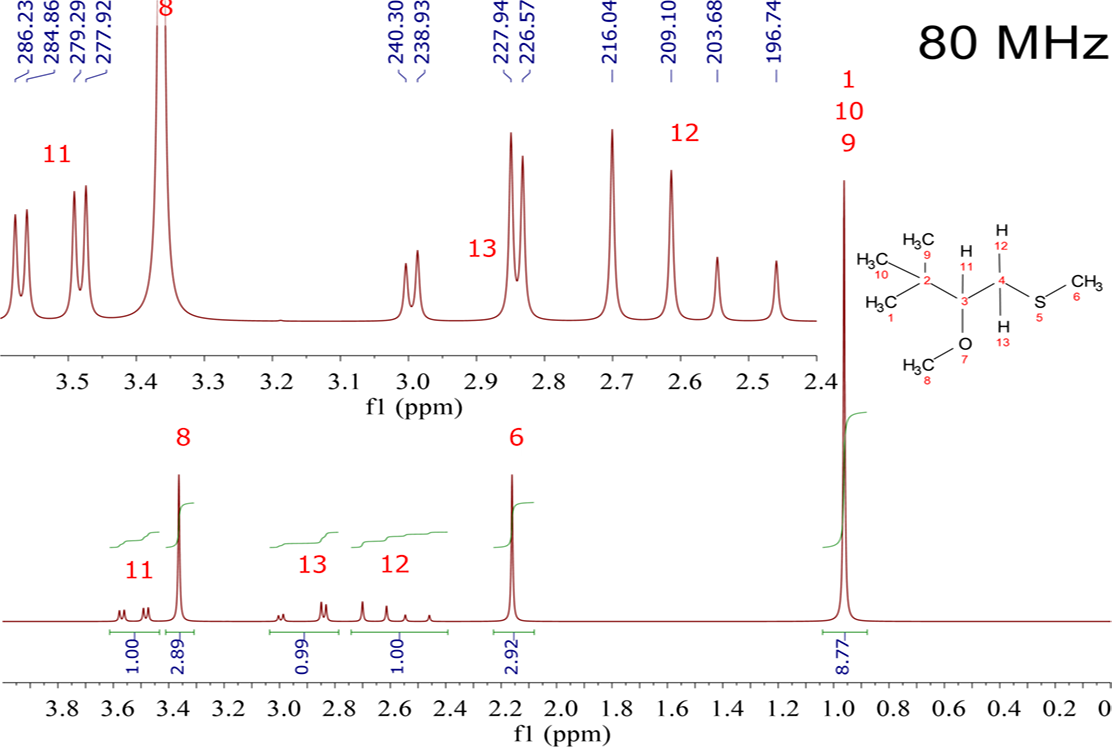
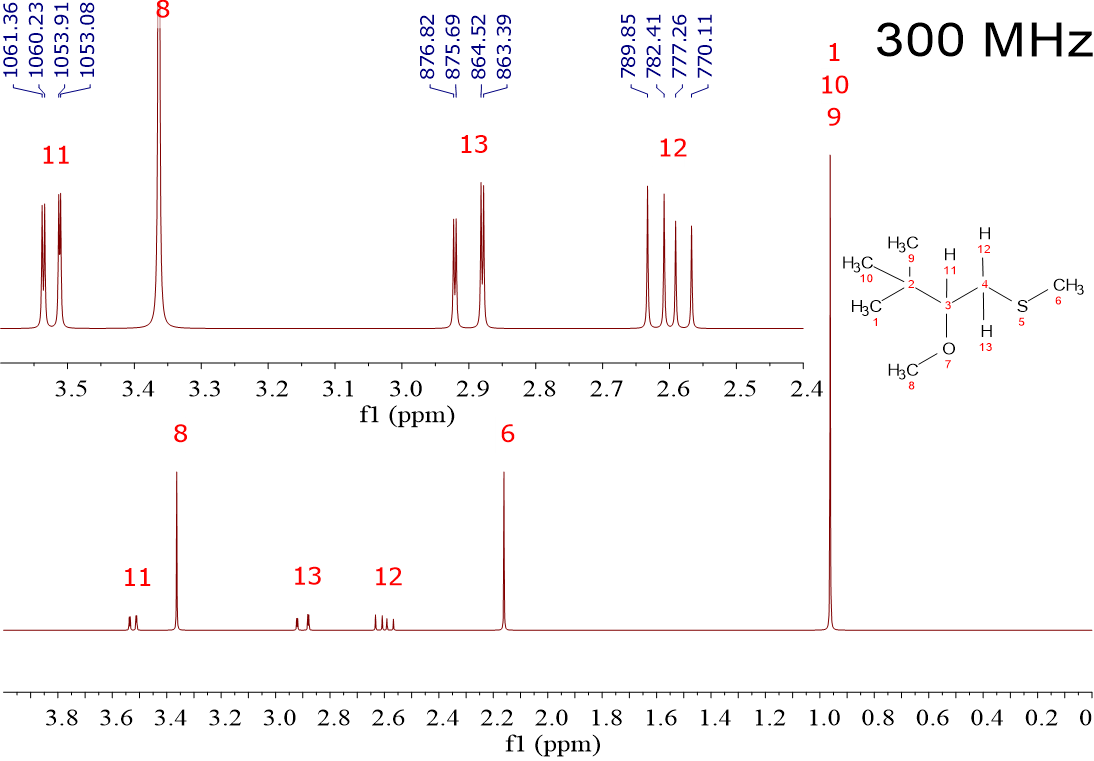
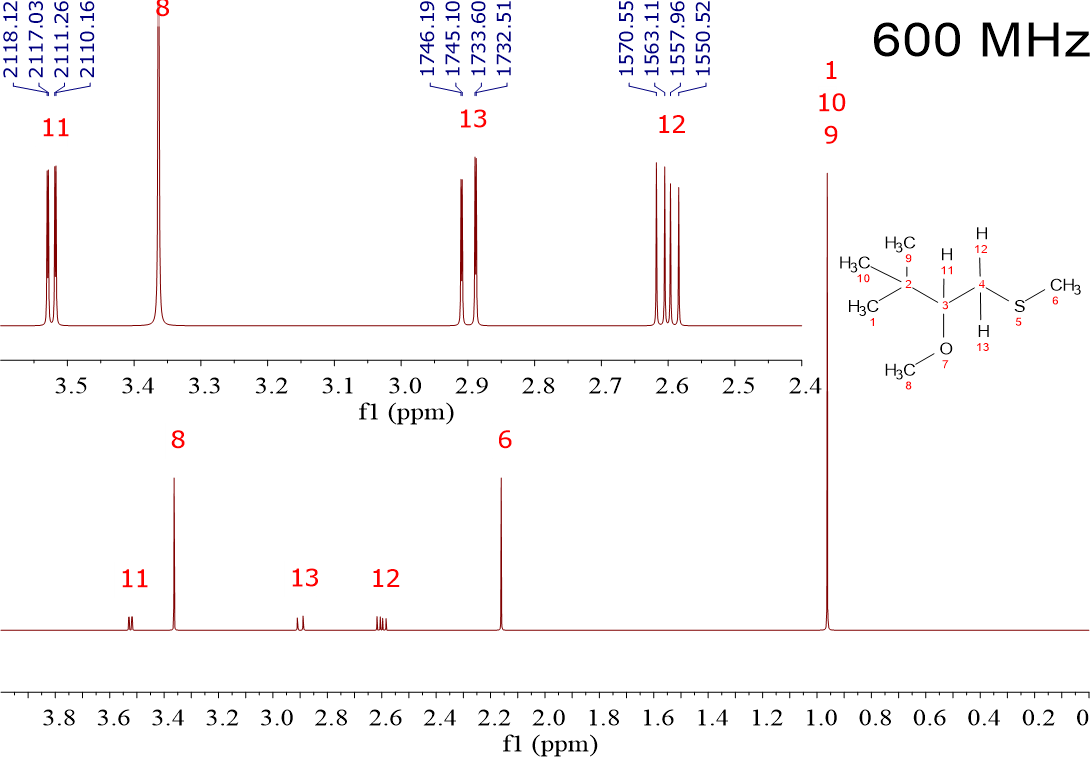
NMR is far from an easy technique to master, and its spectra are often hard to interpret. This course cannot explain everything, but it can give you experience that will put you above average in the art of determining structures. Compare these three spectra of 2-methoxy-3,3-dimethyl-1-(methylsulfanyl)butane, the compound from complex systems, recorded on 80 MHz (1.88 T), 300 MHz (7.05 T) and 600 MHz (14.1 T) instruments. What similarities and differences do you see?
The similarities
- All three spectra have three singlets and three multiplets.
- The chemical shifts of the singlets are identical: 0.95, 2.15 and 3.35 ppm.
- So are those of the multiplets, taking the centre of each: 2.60 ppm (H12), 2.90 ppm (H13) and 3.53 ppm (H11).
- The separations between the lines of the multiplets, in hertz, are practically the same. In H13, for example: 1.37 and 12.36 Hz at 80 MHz; 1.13 and 12.30 Hz at 300 MHz; 1.09 and 12.59 Hz at 600 MHz.
The differences
- The appearance: the signals look sharper going from 80 to 300 and to 600 MHz.
- The frequency in hertz of each line is different on each instrument.
- The relative heights of the lines of the multiplets: at 80 MHz, the outer lines of H12 and H13 are much weaker than the inner ones; at 300 MHz this happens much less, and at 600 MHz hardly at all.
The conclusions
- The number of signals of a compound and their chemical shifts in ppm do not depend on the frequency of the instrument, that is, on the strength of its magnetic field.
- What changes is how many hertz each ppm of the scale contains: 80 Hz on the 80 MHz instrument, 300 Hz on the 300 MHz one and 600 Hz on the 600 MHz one.
- The signals look narrower on more powerful instruments because there are more hertz per ppm. Believe it or not, in all three spectra they have the same width at half height, about 0.5 Hz. But that width takes up 0.6 % of a ppm at 80 MHz, 0.17 % at 300 MHz and 0.08 % at 600 MHz.
- The position of the signals in hertz depends on the instrument. The centre of the H12 doublet of doublets, for example, is about 206 Hz from TMS at 80 MHz, 780 Hz at 300 MHz and 1560 Hz at 600 MHz. Dividing by the instrument frequency always gives the same number: 2.60 ppm.
- The separation between two signals is the same in ppm, but not in hertz. The centres of H12 and H13 are about 27 Hz apart at 80 MHz, 90 Hz at 300 MHz and 180 Hz at 600 MHz.
- The smaller that separation in hertz compared with the coupling constant between the two nuclei, the more their multiplets are distorted. At 80 MHz, the separation between H12 and H13 (27 Hz) is of the same order as their geminal constant (12.4 Hz), and the roof effect appears: these are second-order effects.
- High-field instruments give spectra practically free of second-order effects. At 600 MHz, H12 and H13 are about 180 Hz apart, more than ten times their constant.
To make a joke of it: as with cars, a top-of-the-range model is not the same as a runabout, especially in price, but both get you to the same place. A 600 MHz instrument can cost over a million euros; an 80 MHz benchtop one costs a few tens of thousands and gives very useful information, provided second-order effects are taken into account.
There is another important difference: sensitivity. It grows roughly with the field to the power 3/2, so a 600 MHz instrument is, from the magnet alone, about twenty times more sensitive than an 80 MHz one, and even more with the cryogenic probes of high-end instruments. With it, less than a milligram of sample is easily enough.