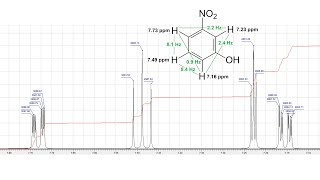
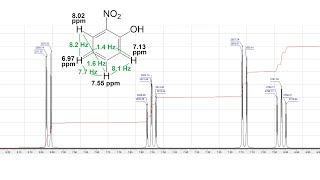
Complex and second-order systems
When the neighbours of a hydrogen are not equivalent, each splits it with its own constant and multiplets such as the doublet of doublets appear. And when two coupled nuclei have close chemical shifts (Δν not much larger than J), the line intensities become distorted: the inner lines grow and the outer ones shrink (the “roof” effect). These are second-order systems, described with letters: AX, AB, ABX…
A simple example… that does not follow the rule
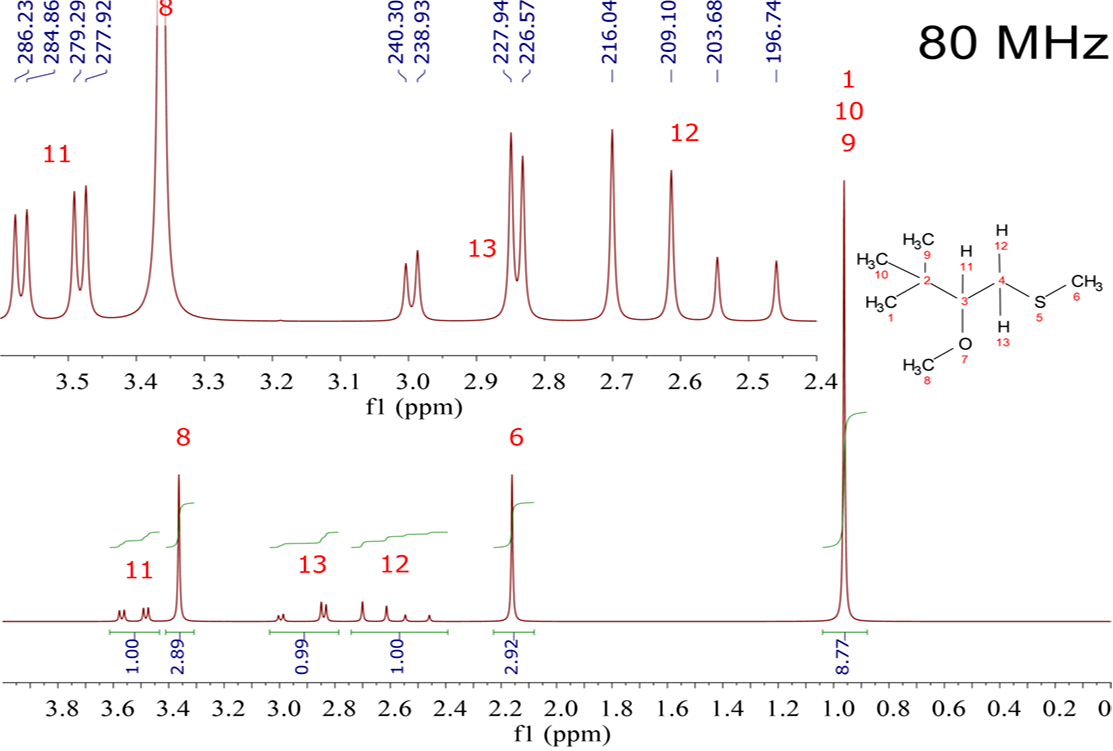
Sometimes the hydrogens next to another do not all act “as one”: the splittings do not obey the N + 1 rule, nor their intensities Pascal's triangle. Look at this spectrum, recorded at 80 MHz. It belongs to 2-methoxy-3,3-dimethyl-1-(methylsulfanyl)butane, (CH3)3C-CH(OCH3)-CH2-SCH3; the red numbers show the assignment.
The singlets
The easiest signals are three singlets with integrals 9 : 3 : 3, from the methyl groups. The three CH3 of the tert-butyl group (1, 9 and 10) are equivalent, have no neighbours and are bonded to a carbon of low electronegativity: 0.95 ppm. The CH3 groups 6 and 8 are not equivalent to each other or to the tert-butyl ones, and they have no neighbours either. Since electronegativity follows the order O > S > C, the CH3O appears at 3.35 ppm and the CH3S at 2.15 ppm.
Hydrogens 11, 12 and 13
The difficulty lies, as in so many spectra, in the signals of hydrogens 11, 12 and 13. H11 has two neighbours, H12 and H13 (N = 2): should it be a triplet? No: it is a doublet of doublets. And H12 and H13 look equivalent: should they give a single doublet together, from their only neighbour H11? No again: they give two different signals, at 2.58 and 2.92 ppm, and each is, once more, a doublet of doublets, with peculiar intensities.
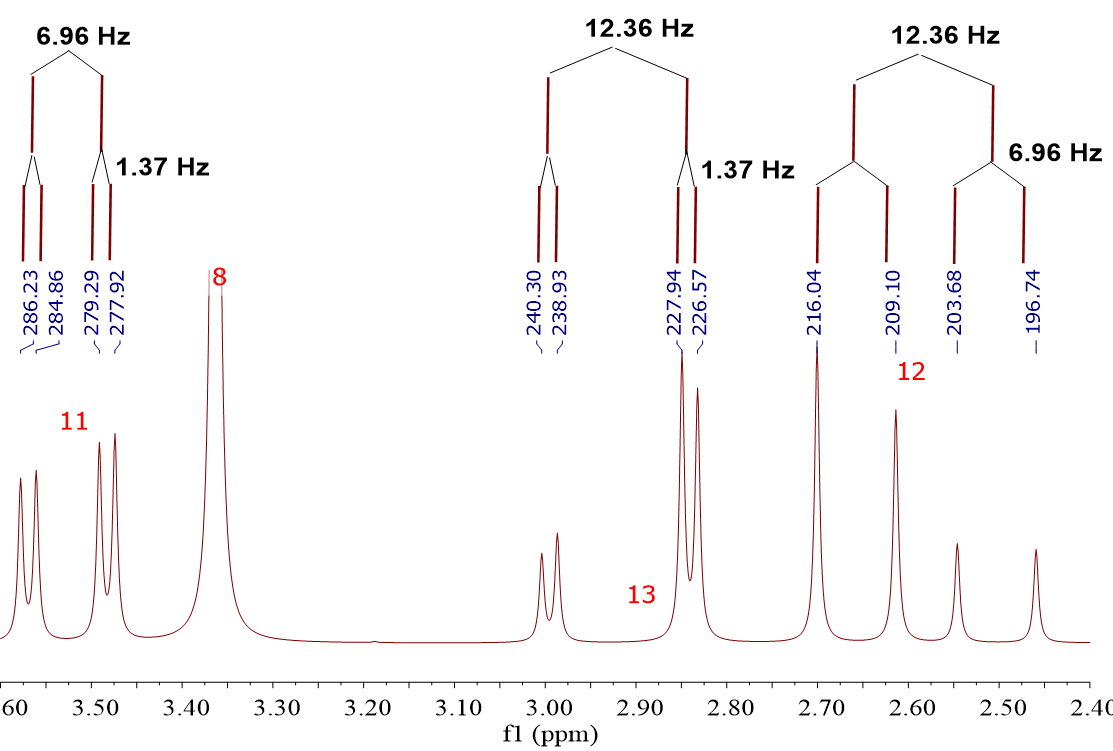
What is wrong? Treating H12 and H13 as equivalent, which they are not. Carbon 3 has four different substituents: it is a stereocentre. The two hydrogens of the adjacent CH2 are therefore diastereotopic: they resonate at different shifts and each influences the others in its own way.
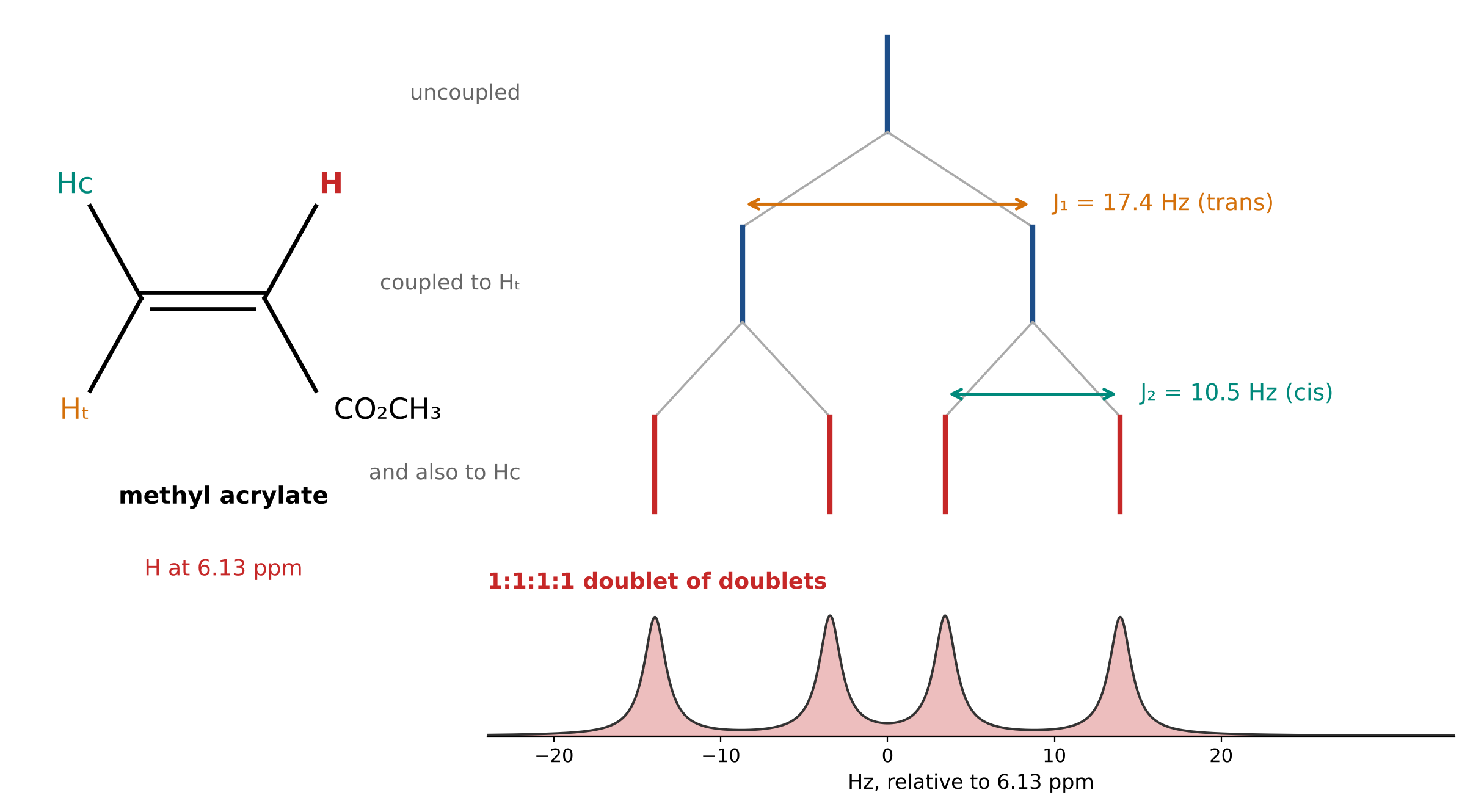
- H11 couples with H12 with 3J = 6.96 Hz and with H13 with 3J = 1.37 Hz. Two different constants produce a doublet of doublets instead of a triplet.
- Since coupling is mutual, those same constants appear in H12 (6.96 Hz) and in H13 (1.37 Hz).
- Where does the 12.36 Hz splitting shared by H12 and H13 come from? From the coupling between them, through two bonds: 2J = 12.36 Hz, a geminal coupling, which is only seen because they are not equivalent.
A doublet of doublets has four lines of equal intensity (in first order): it is split first by one constant and then each line by the other. If the two constants were equal, the two central lines would coincide and a 1:2:1 triplet would result. To analyse it, measure the separations between the first and second lines (the small J) and between the first and third (the large J).
Spin-system notation
Groups of nuclei coupled to each other are described with letters. Each letter is a nucleus (or a group of equivalent nuclei, with a subscript for their number), and the distance between the letters in the alphabet indicates how similar their chemical shifts are, compared with the coupling constant:
- AX: two nuclei far apart (Δν ≫ J). Two first-order doublets. An ethyl group with a large Δν is an A3X2 system.
- AB: two nuclei with close shifts (Δν comparable to J). Four lines with the roof effect.
- ABX: two nuclei close to each other and a third far away, like H12, H13 and H11 in our example at 80 MHz. At high field it becomes practically an AMX system, of three well-separated nuclei.
The “roof” effect
What happens when two coupled nuclei come close in chemical shift? This simulated spectrum shows a two-nucleus system A and B with J = 10 Hz and an ever smaller separation Δν:
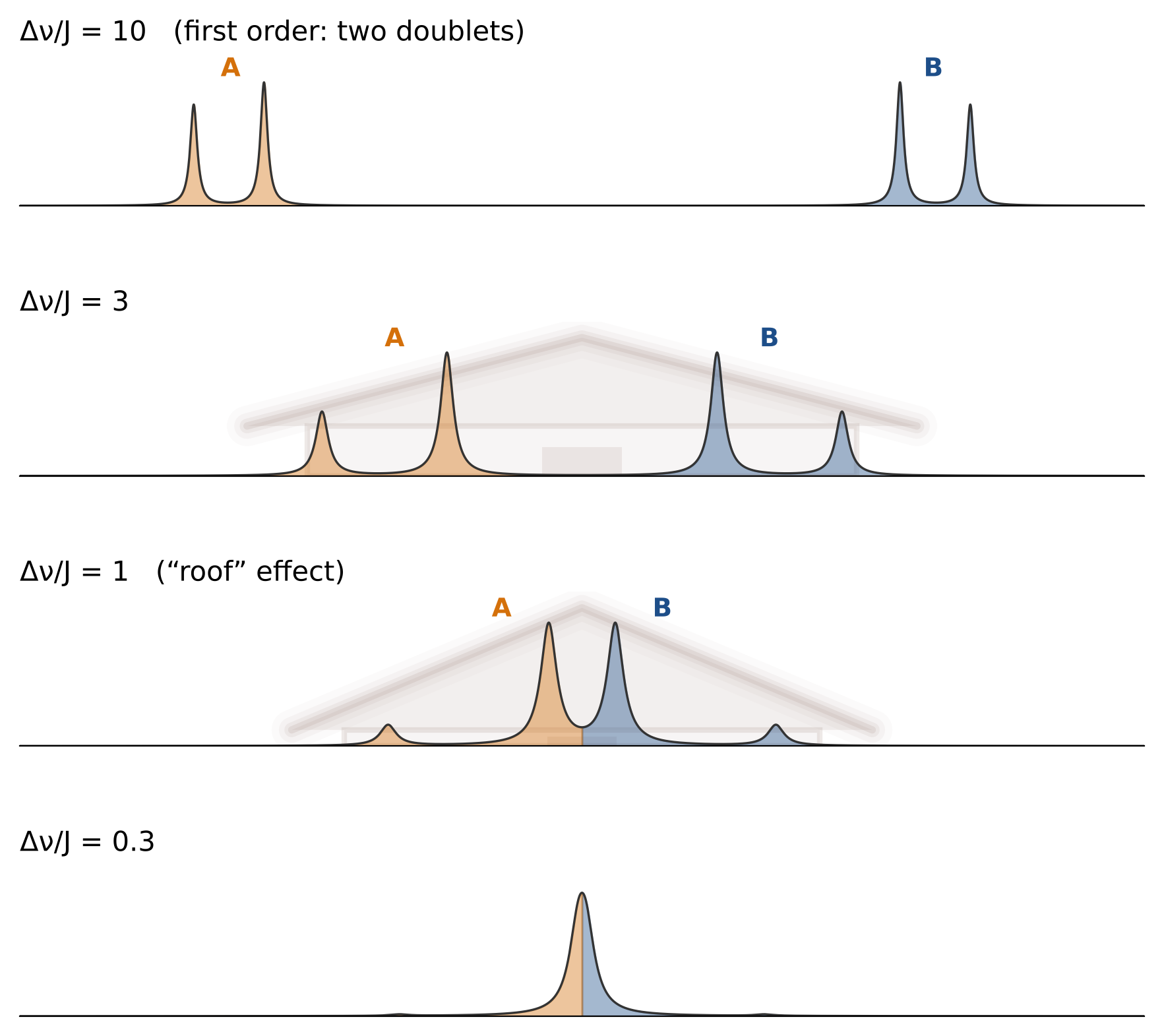
- The two lines of each doublet are still separated by exactly J.
- The inner lines grow and the outer ones shrink: the two doublets lean towards each other like the two sides of a roof. This is a very useful clue: a multiplet “points” towards the multiplet it is coupled to.
- The chemical shift of each nucleus is no longer at the centre of its doublet, but displaced towards the centre of the system.
- If Δν becomes much smaller than J, the outer lines disappear and practically a single signal remains: two nuclei with the same δ do not show their coupling.
In our example at 80 MHz, H12 and H13 are about 27 Hz apart, barely twice their 2J of 12.4 Hz. That is why their outer lines are much weaker than the inner ones. Since Δν, in hertz, grows with the field and J does not, second-order effects fade on more powerful instruments, as shown in the review of the topic.
Some systems never simplify, however strong the field. In a para-disubstituted benzene with two different substituents, the two hydrogens of each pair have the same δ but do not couple equally with each hydrogen of the other pair: they are chemically equivalent (isochronous) but magnetically non-equivalent (anisogamous). They form an AA'BB' (or AA'XX') system, which looks like a pair of doublets with small extra lines.