
First-order systems
Each neighbouring hydrogen has a probability of almost 50 % of being aligned with or against the field. With N equivalent neighbours there are N + 1 different field combinations, and the signal splits into N + 1 lines, separated by the constant J, with intensities given by Pascal's triangle: 1:1, 1:2:1, 1:3:3:1… These are first-order systems.
One neighbour: the doublet
Why do the signals of hydrogens with neighbours split and follow the N + 1 rule? Remember that 1H nuclei are small magnets that, in the field, are split almost 50:50 between the two orientations, with and against. If two hydrogens are neighbours (separated by two or three bonds), they influence each other.
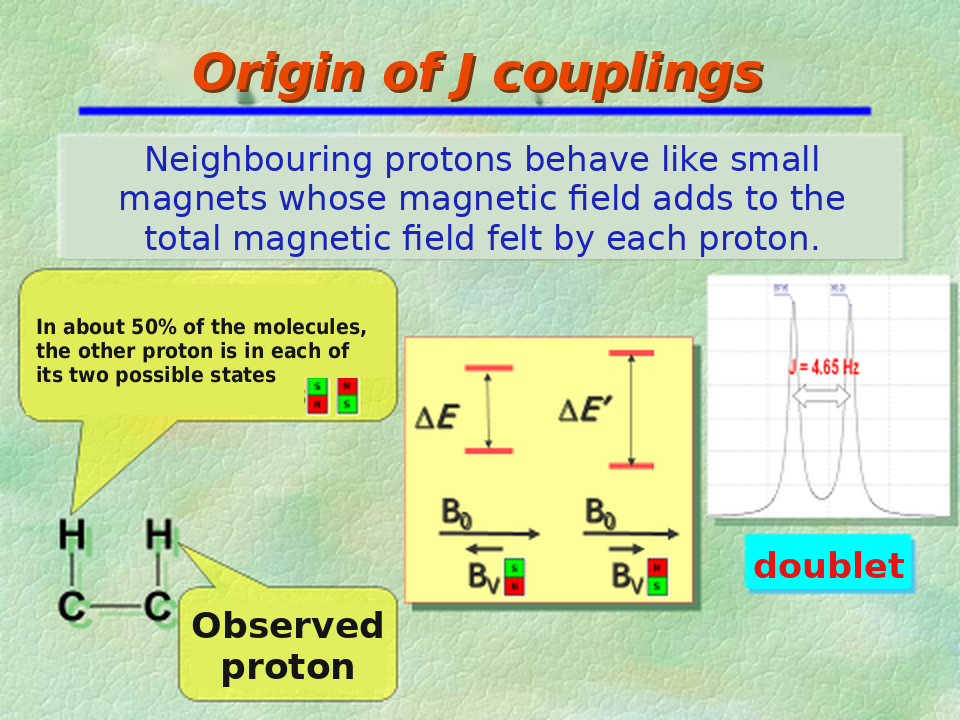
How does one hydrogen of a CH-CH fragment “see” the other? In half of the molecules, the neighbour is aligned with the field and adds a tiny bit to the field felt by our hydrogen; in the other half, it is against it and subtracts. Our hydrogen therefore resonates at two slightly different frequencies, with equal probability: it gives a doublet of two equal lines. One neighbour (N = 1) gives N + 1 = 2 lines.
Two neighbours: the triplet
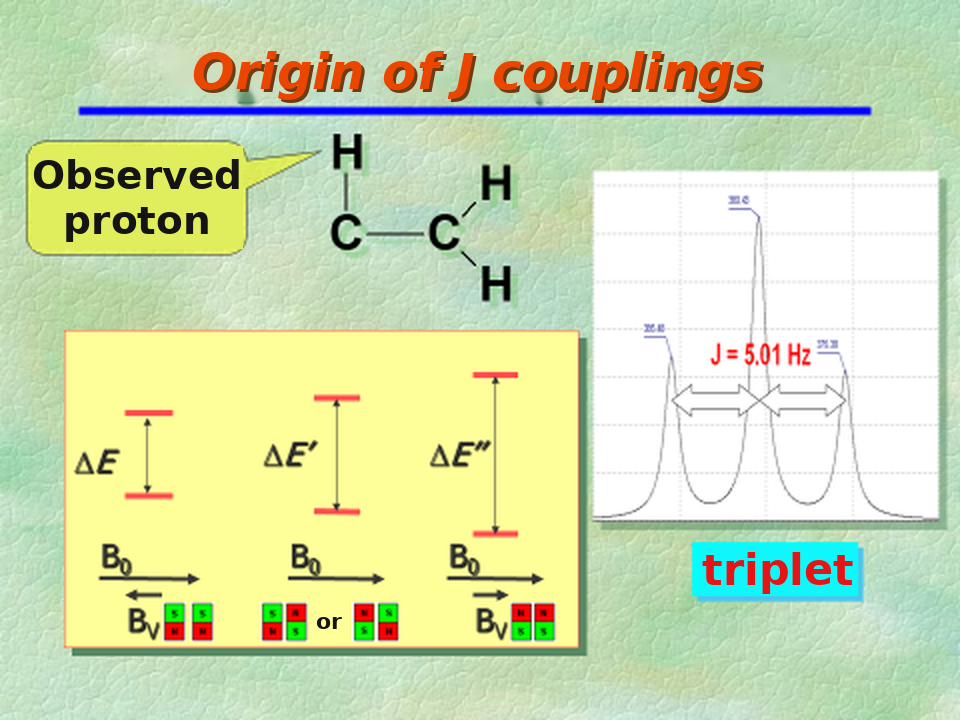
Two equivalent neighbouring hydrogens can both be with the field, both against it, or one with and one against. This last situation, which neither adds nor subtracts, can happen in two ways (the first with and the second against, or the other way round). That is why a hydrogen with two neighbours (N = 2) appears as a triplet (N + 1 = 3) with intensities 1:2:1.
Three neighbours: the quartet
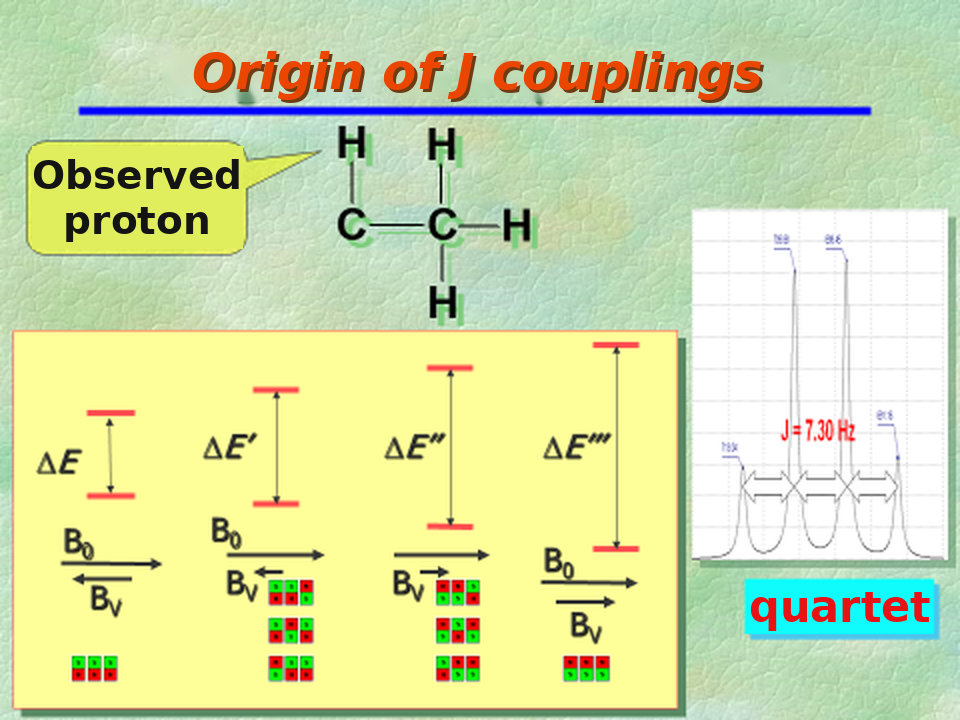
You can surely guess the story of the quartet. The three neighbours can all be with the field or all against it; between those two extremes there are two intermediate situations, two with and one against or the other way round, each of which can happen in three ways. A hydrogen with three neighbours (N = 3) appears as a quartet (N + 1 = 4) with intensities 1:3:3:1.
Pascal's triangle
And so on. The intensities of the lines are the binomial coefficients, which are obtained from Pascal's triangle (or Tartaglia's, as it is called in Italy): each number is the sum of the two above it.
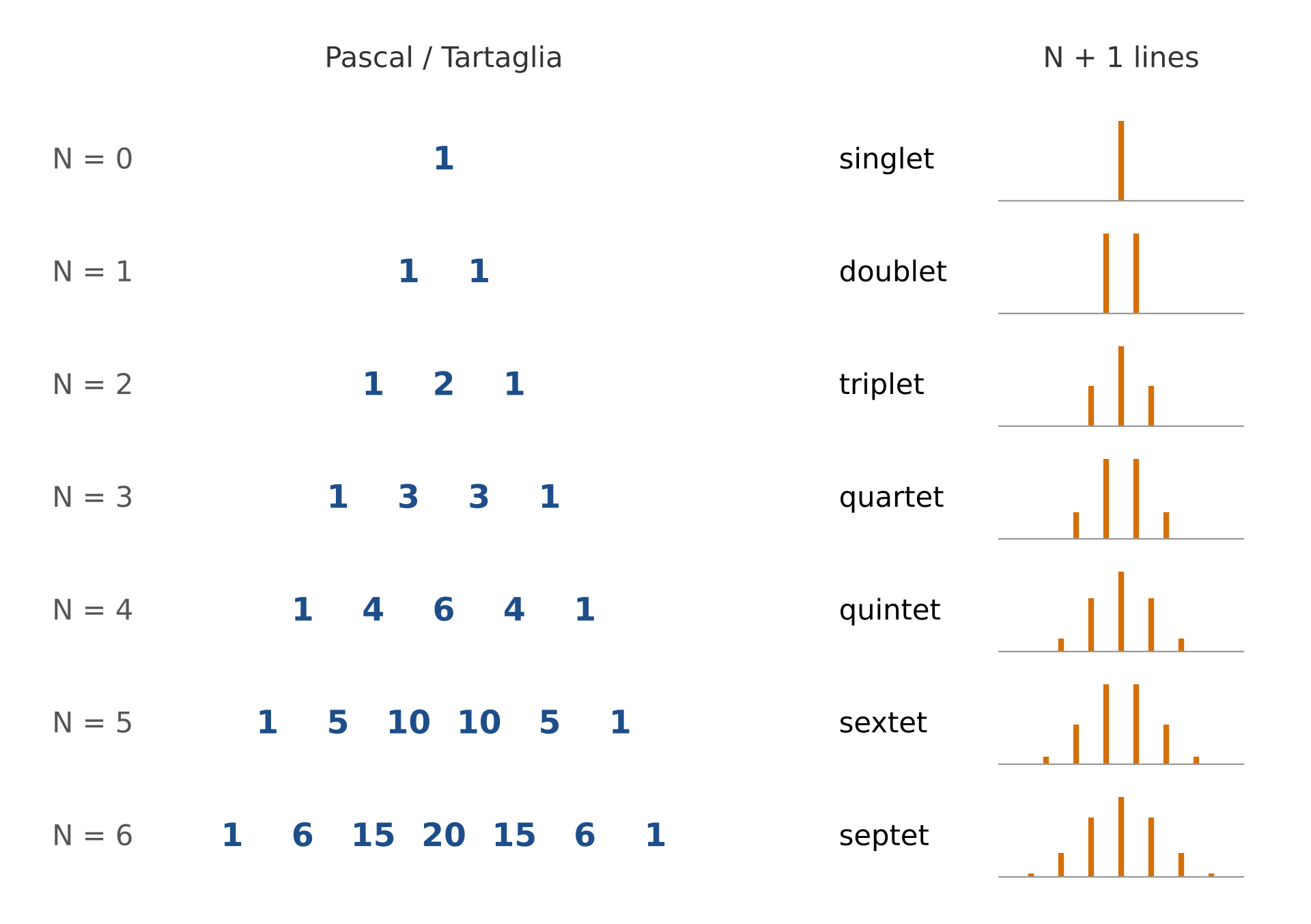
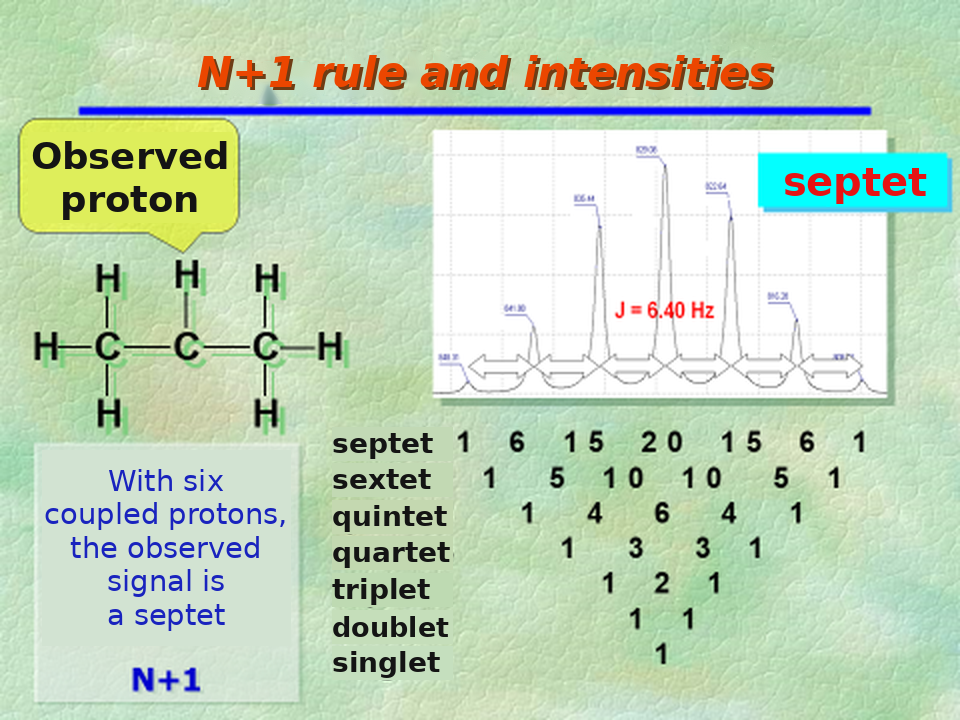
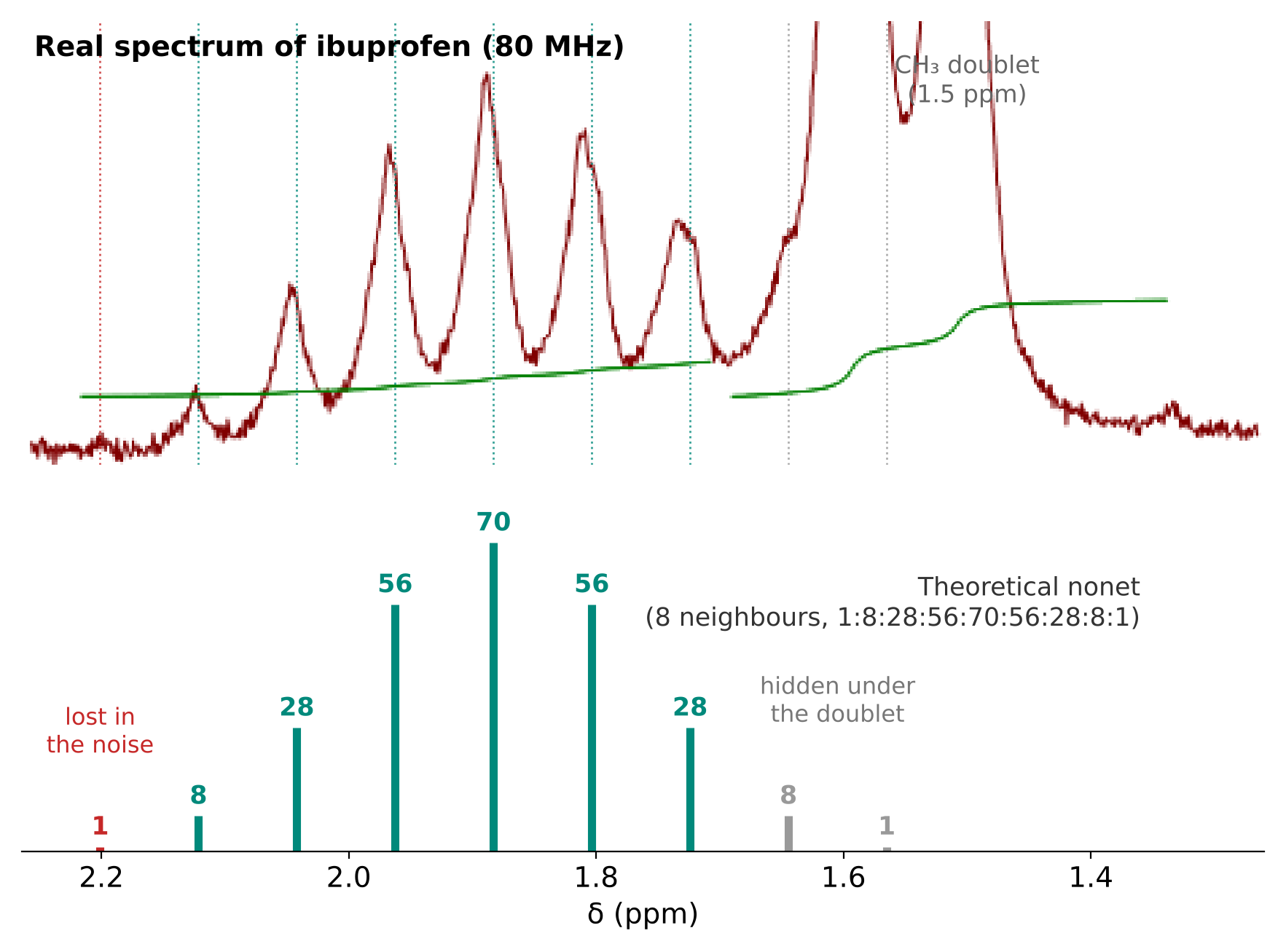
The outer lines of large multiplets are very weak. In a septet, the ratio between the outer and the central line is 1 : 20, and the outer ones are easily lost in the noise: a septet can look like a quintet. In ibuprofen, the isobutyl CH has eight neighbours and should be a nine-line multiplet with intensities 1:8:28:56:70:56:28:8:1; the outer ones are barely visible.
The conditions for first order
The lines of a first-order multiplet are equally spaced, separated by the coupling constant J, which usually lies between 0 and 18 Hz. That spacing does not depend on the spectrometer frequency, because it depends only on the coupled nuclei, which act on each other as tiny magnets. The N + 1 rule and Pascal's triangle work when two conditions are met:
- All the neighbours couple with the same constant. If not, more complex multiplets appear, such as the doublet of doublets.
- The chemical shift difference between the coupled groups, in hertz, is much larger than J (in practice, more than about ten times). If not, second-order effects appear.
What happens when they are not met is shown on the next page.
The hydrogens of OH and NH groups usually exchange between molecules so fast that they do not “stay” long enough to couple: their signal is a broad singlet and does not split those of their neighbours. That is why in ethanol in CDCl3 the CH2 is a quartet and not a doublet of quartets.