
Signal shape: “scalar” coupling
A group of equivalent hydrogens with N neighbouring hydrogens gives a signal of N + 1 lines. This is scalar coupling: the spins of neighbouring nuclei “communicate” through the electrons of the bonds. The separation between the lines, the coupling constant J, is measured in hertz and does not depend on the field of the spectrometer.
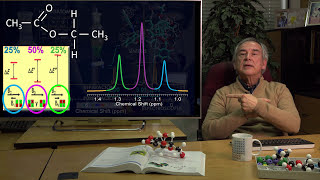 ▶ Ethyl acetate: couplings
The N + 1 rule, the other way round
You have already seen examples of multiplets in the chloropropanes. Until now we have looked at it in one direction: N neighbouring hydrogens turn the signal of a group into a multiplet of N + 1 lines. When interpreting a spectrum we have to do it the other way round: if a group gives a multiplet of n lines, it has n − 1 neighbouring hydrogens. Ibuprofen is a good example.
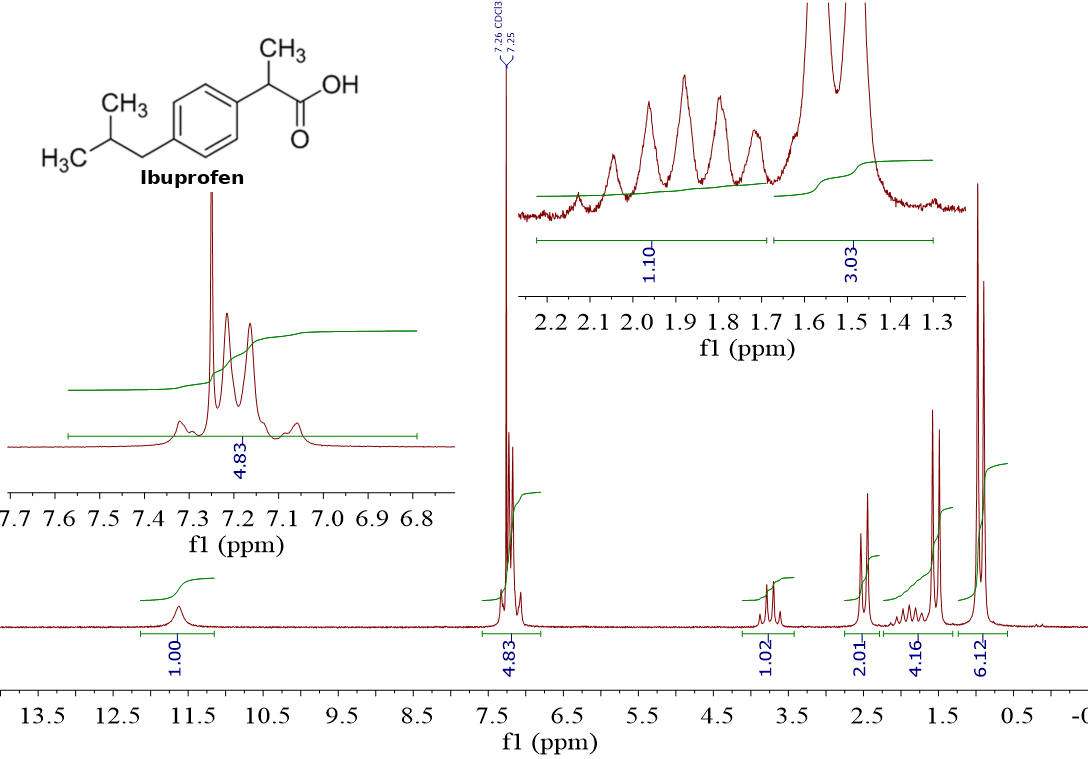
- 0.9 ppm: integrates for 6 and is a doublet. Six equivalent hydrogens with a single neighbour: the two CH3 of the isobutyl group, next to their CH.
- 1.5 ppm: integrates for 3 and is a doublet (see the expansion). Three hydrogens with a single neighbour: the CH3 bonded to the CH of the acid.
- Between 1.6 and 2.1 ppm: a complex signal, partly overlapping the previous doublet. It is the isobutyl CH, which has eight neighbours (the six of the two CH3 and the two of the CH2). It should be a multiplet of 8 + 1 = 9 lines, whose very weak outer lines are barely visible.
- 2.5 ppm: integrates for 2 and is a doublet. Two equivalent hydrogens with a single neighbour: the CH2, bonded to the isobutyl CH.
- 3.7 ppm: integrates for 1 and is a quartet. One hydrogen with three neighbours: the CH bonded to the CH3 and to the COOH.
- 7.2 ppm: a complex signal integrating for almost 5. From its chemical shift it can only be the four aromatic hydrogens. But careful! The expansion shows a taller, sharper line at 7.26 ppm: it is the residual CHCl3 of the solvent, which “distorts” the integral. The four ring hydrogens are equivalent in pairs, and the two pairs resonate very close together (at about 7.10 and 7.25 ppm); that is why the signal is complex.
- 11.7 ppm: a broad singlet integrating for 1, highly deshielded: the OH of the acid, which has no neighbours to couple with.
Read like this, each multiplet tells us how many hydrogens there are next door. Together with the chemical shift and the integral, it allows the chain of the molecule to be rebuilt piece by piece.
How coupling is transmitted
Why are the signals of hydrogens with neighbours split? A nucleus with spin slightly orients the spins of the electrons in its bond; these in turn influence those of the next bonds, and the effect reaches another nucleus. Thus each nucleus “feels” the orientation of its neighbours, with or against the field, and its signal is split. That is why it is called scalar or through-bond coupling.
- It is denoted by the letter J with a superscript giving the number of bonds between the nuclei: 2J (geminal, H-C-H), 3J (vicinal, H-C-C-H)… It weakens quickly with the number of bonds, and beyond four it is usually negligible.
- It is mutual: if Ha splits Hb by, for example, 7.32 Hz, Hb splits Ha by 7.32 Hz. Equal constants reveal which groups are neighbours.
- It is measured in hertz and does not depend on the magnetic field of the spectrometer, because it arises only from the interaction between the nuclei.
- Equivalent nuclei do not split their own signals: the three hydrogens of a CH3 couple with each other, but the spectrum does not show it.
- It does not depend on the orientation of the molecule, so it does not average to zero as the molecules tumble in solution.
In the following pages we will see why the lines have the intensities they do (first-order systems), what happens when the neighbours are not equivalent (complex systems) and what the value of J tells us about geometry (the Karplus equation). First, it is worth distinguishing this coupling from another that acts through space: dipolar coupling.