
Some preliminary examples
Let us start “deciphering” spectra with very simple molecules. The chloromethanes and the chloropropanes are enough to discover the three features of a 1H spectrum: the position of the signals (the chemical shift), their area (the integral) and their shape (the coupling).
 ▶ The chloromethane series
Four molecules, four positions
Look at these four 1H spectra. They belong to four very simple and very similar molecules, CH4, CH3Cl, CH2Cl2 and CHCl3, but their spectra are different. What do you notice?
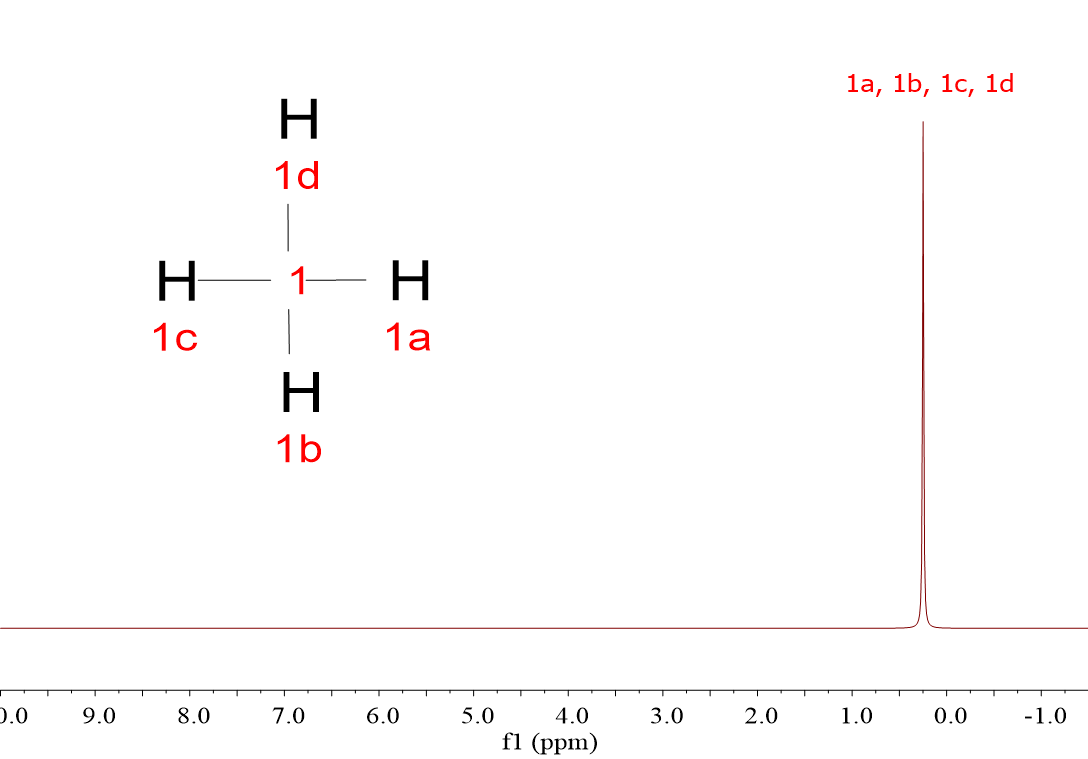
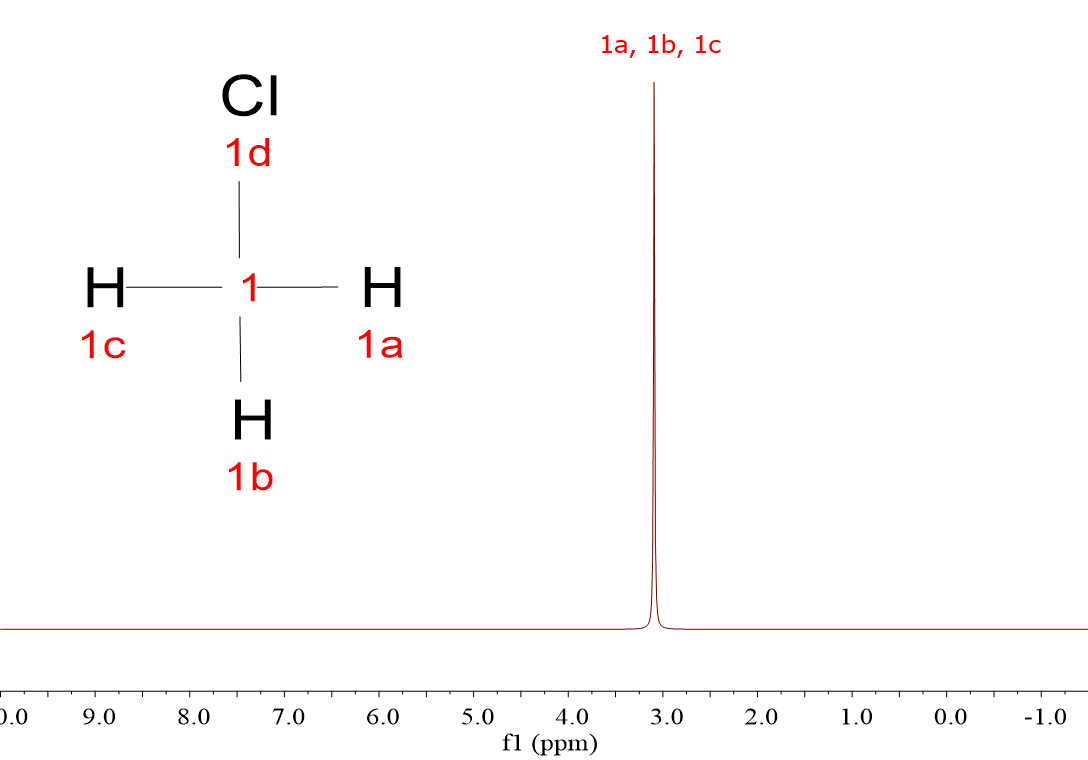
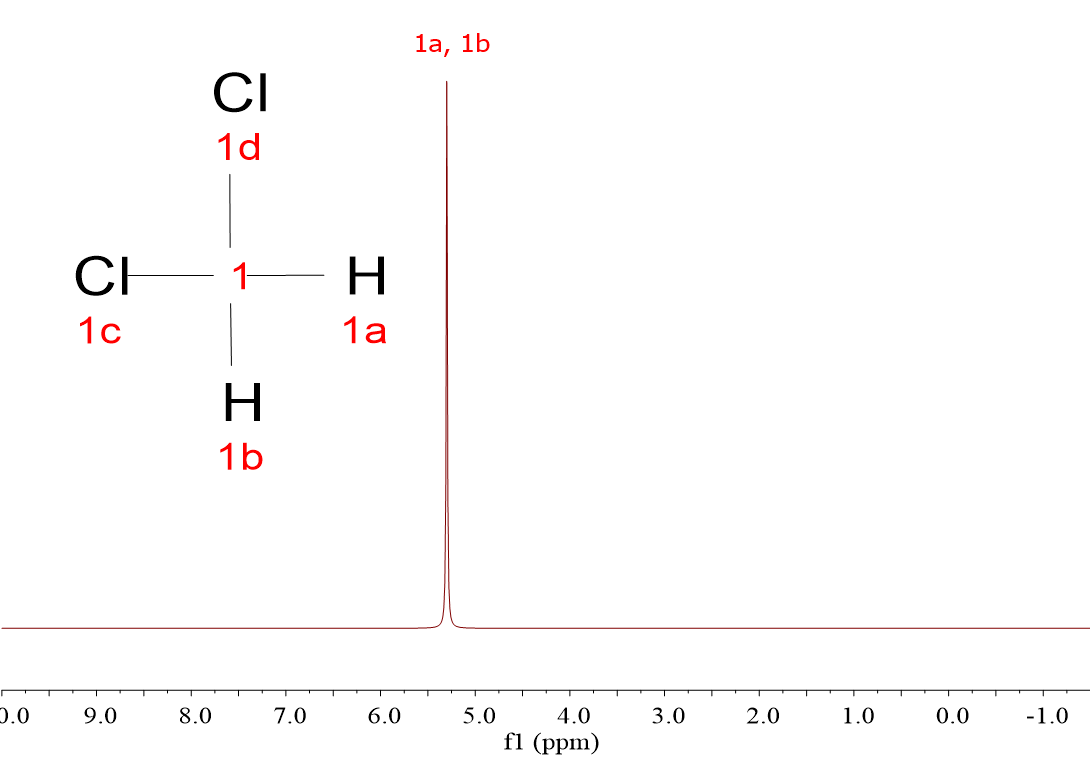
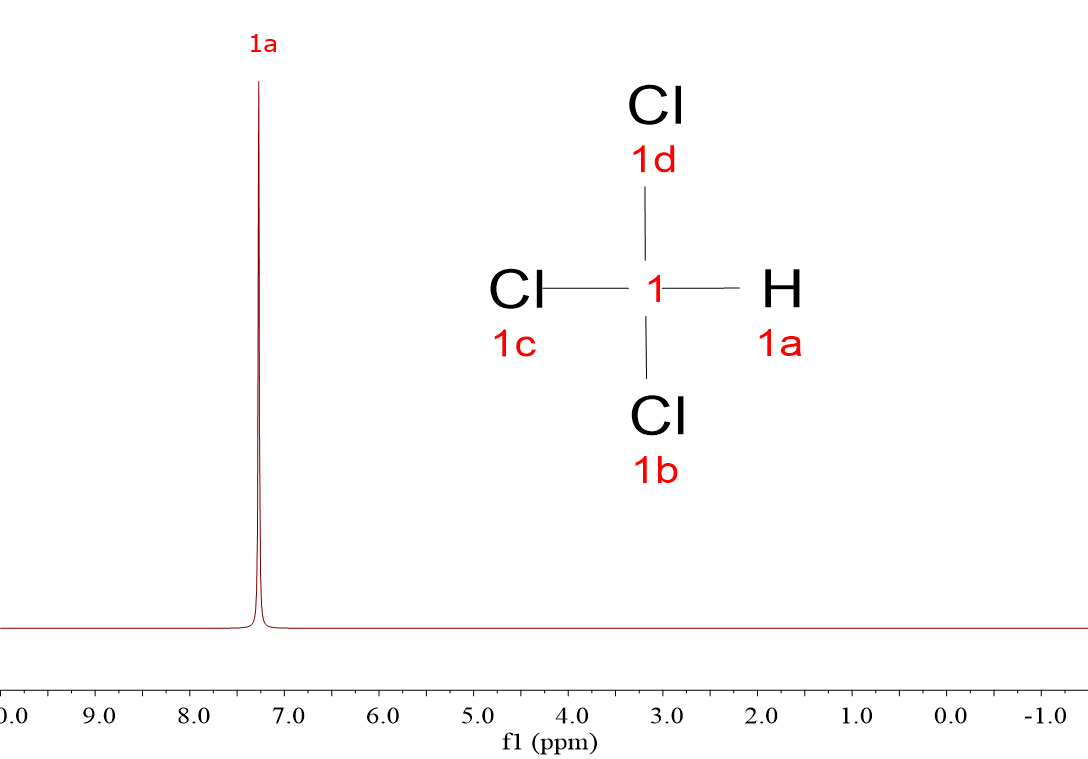
All four molecules give a single signal: although three of them have more than one hydrogen, within each molecule the 1H are equivalent and “resonate” the same way. But what do you notice when you compare where each signal appears? As the number of chlorine atoms increases, the signal moves to the left, towards higher values on the horizontal scale: 0.23 ppm (CH4), 3.05 (CH3Cl), 5.30 (CH2Cl2) and 7.26 ppm (CHCl3).
First criterion. Hydrogens resonate at different chemical shifts depending on their chemical environment, that is, on the nature of the atoms around them.
A mixture: four signals of different area
Suppose we mix equimolar amounts of the four substances and record the spectrum of the mixture. What will we see?
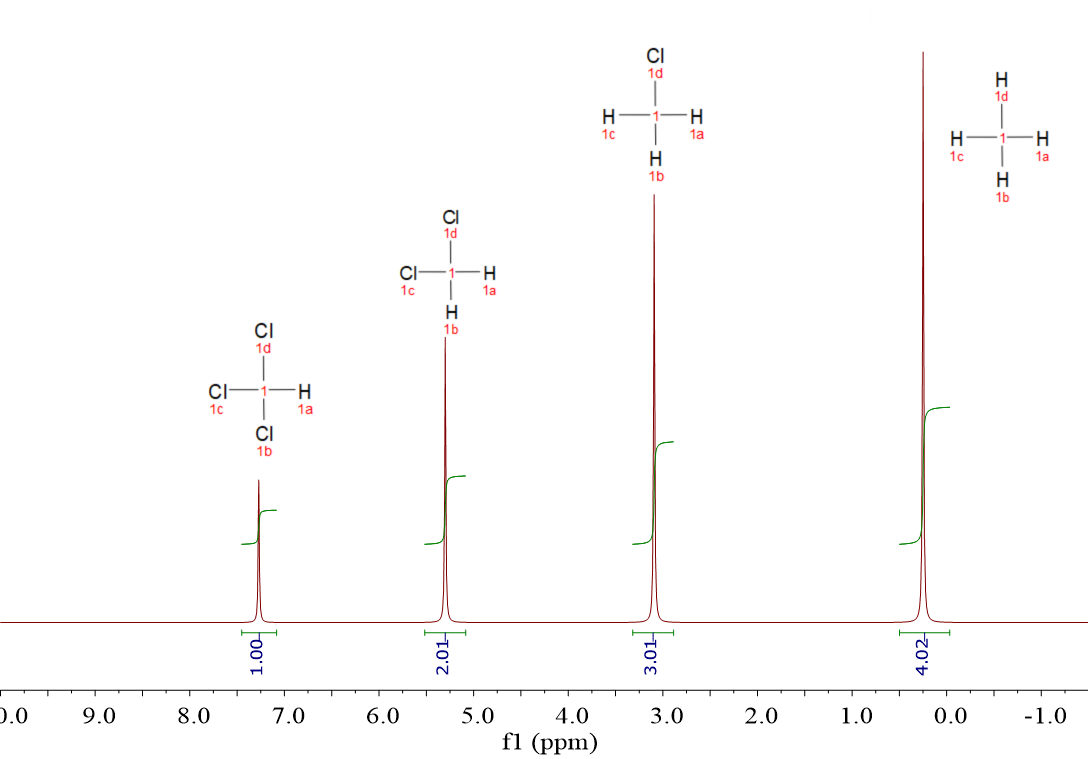
You guessed it: four signals, at the chemical shifts of each compound. But do you notice anything else? The intensities are not equal, even though the number of molecules of each component is the same. Why? Because the molecules have different numbers of hydrogens. If we measure the area of each signal (its integral), the relative areas are 1 : 2 : 3 : 4, the number of hydrogens in CHCl3, CH2Cl2, CH3Cl and CH4.
Second criterion. The area of each signal is proportional to the number of hydrogens that produce it.
Two isomers: 1- and 2-chloropropane
Now let us look at the spectra of ClCH2CH2CH3 and CH3CHClCH3. What strikes you? Before reading on, make a list and then check whether we agree.
- Each spectrum has more than one signal.
- The signals have a characteristic pattern of integrals.
- The chemical shifts are different.
- The signals have shapes of their own.
Number of signals and integrals
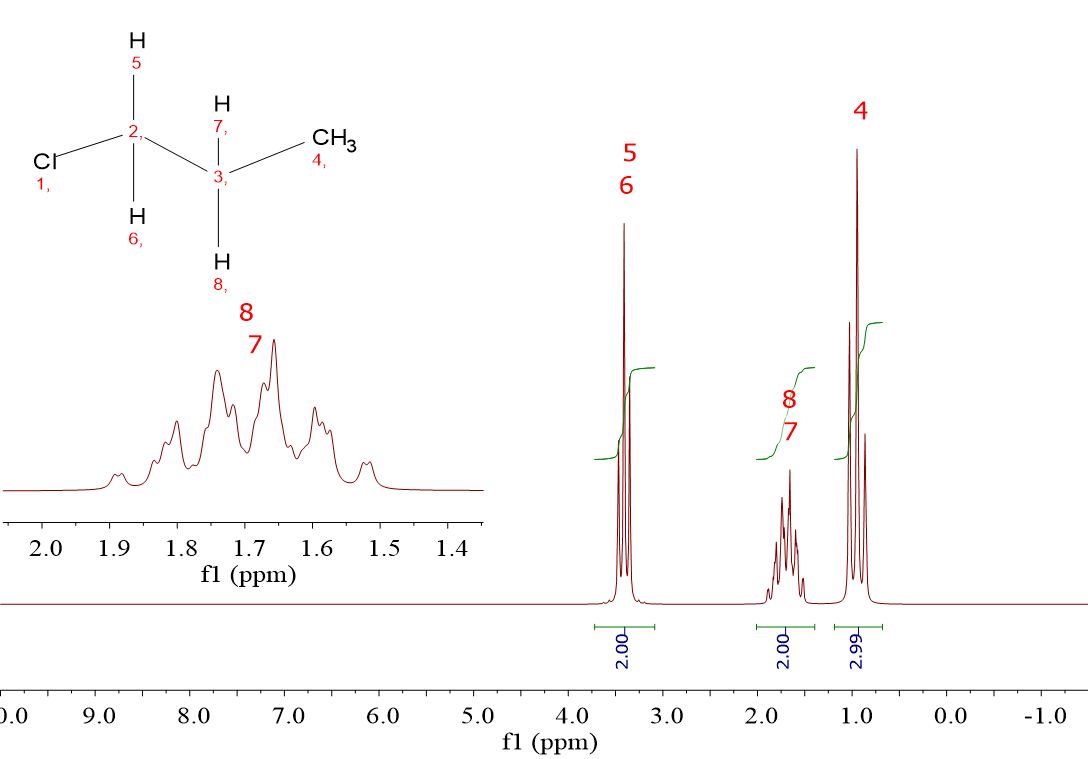
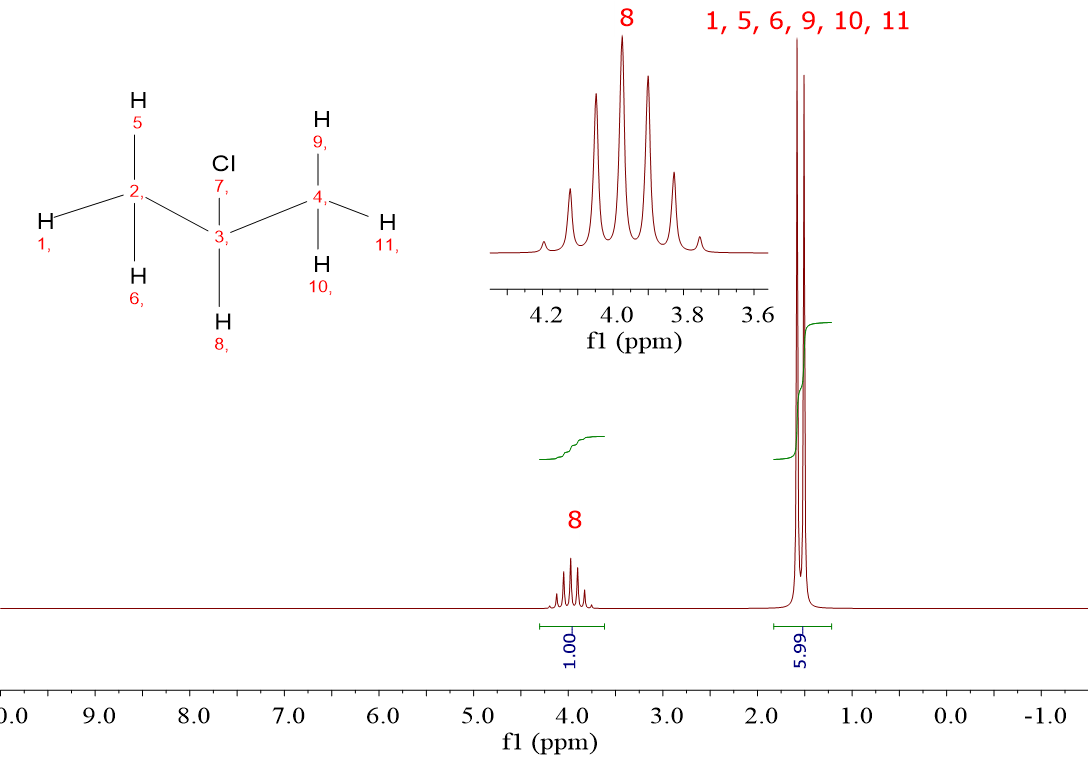
1-Chloropropane gives three signals because it has three types of hydrogen: those of the ClCH2, those of the central CH2 and those of the CH3. They integrate for 2, 2 and 3. 2-Chloropropane gives only two signals, because it has only two types of hydrogen: that of the CHCl and those of the two CH3, which are equivalent. They integrate for 1 and 6.
Chemical shifts
In 1-chloropropane the signals appear at 3.5, 1.8 and 1.0 ppm. The one at 1.0 ppm integrates for 3: it is the CH3. How do we assign the other two, which integrate the same? By their closeness to the chlorine. The one at 3.5 ppm is the CH2Cl, and the one at 1.8 ppm, the central CH2. The closer the hydrogen is to the chlorine, the larger its chemical shift: CH2Cl (two bonds from Cl), 3.5 ppm; central CH2 (three), 1.8 ppm; CH3 (four), 1.0 ppm.
In 2-chloropropane there is one signal at high shift, at about 4.0 ppm, and another lower, at 1.5 ppm. From the integrals we know that the first is the CH, whose hydrogen is the closest to the chlorine. What does that value resemble? That of CH3Cl (3.05 ppm), the compound with a single chlorine. The CH3 groups, further away, appear much further to the right.
The shape of the signals
One striking feature remains: the shape of the signals. In 1-chloropropane there is a triplet at 1.0 ppm, a complex sextet at 1.8 ppm and a triplet at 3.5 ppm. In 2-chloropropane, a septet at about 4.0 ppm and a doublet at 1.5 ppm.
- The CH3 groups of 2-chloropropane have only one neighbouring hydrogen, that of the CH, and their signal is a doublet: the number of neighbours plus one.
- The CH has six neighbours, the hydrogens of the two CH3, and its signal is a septet.
- In 1-chloropropane, the CH3 and the CH2Cl have as neighbours the two hydrogens of the central CH2 and appear as triplets. The neighbourhood is limited to the adjacent position.
- The central CH2 has five neighbours (two from the CH2Cl and three from the CH3) and appears as a sextet. Since those neighbours are not equivalent to each other, the sextet is “complex”.
Third criterion. Couplings split the signals and tell us how many neighbouring hydrogens each group has. They are studied in the topic on coupling; in this one we deal with the first two criteria.