Topicity: equivalent and non-equivalent nuclei
Topicity describes the symmetry relationship between two nuclei in a molecule. Homotopic and enantiotopic nuclei are equivalent and always appear at the same chemical shift (in an achiral solvent). Diastereotopic nuclei, such as the two hydrogens of a CH2 near a stereocentre, are not equivalent and usually give different signals.
Nuclei with the same or different chemical shifts
We have already seen that the 1H of a molecule give signals at different chemical shifts depending on where they are in it. But when can we be sure that two hydrogens appear exactly together? It depends on their topicity.
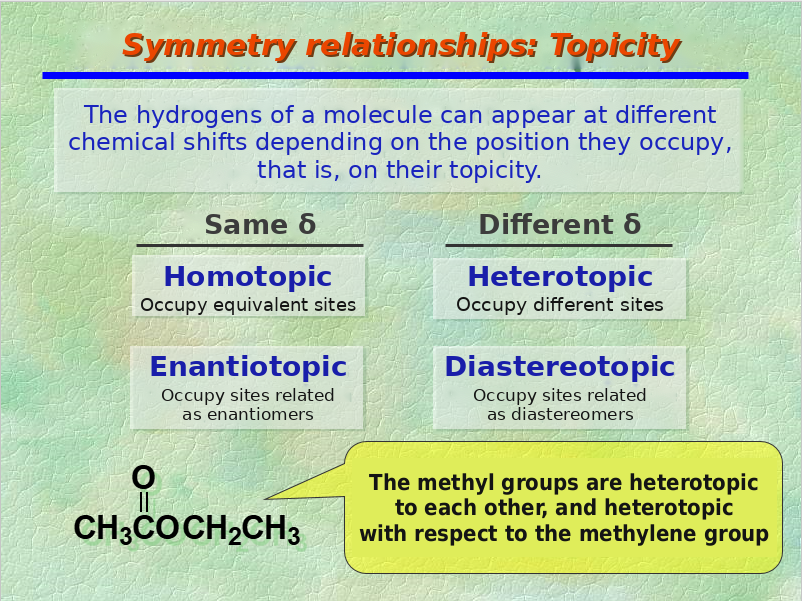
- Heterotopic (or constitutionally different): they occupy different positions in the molecule, like the two CH3 of butanone, CH3COCH2CH3. In general they appear at different shifts.
- Homotopic: they are interchangeable by a rotation of the molecule. They are isochronous: they must resonate at the same chemical shift.
- Enantiotopic: they are related as an object and its mirror image. They are also isochronous, except in a chiral environment.
- Diastereotopic: they are not related by any symmetry operation, even if they look as if they were. They can resonate at different shifts and, in general, they do, although an accidental coincidence can never be ruled out.
The trick of imaginary isotopic substitution
The topicity of two hydrogens is found with a trick: mentally replace one of them with deuterium, then the other, and compare the two imaginary compounds obtained. Review the concepts of chirality and stereoisomerism in La Química Orgánica Transparente.
Homotopic: the same compound
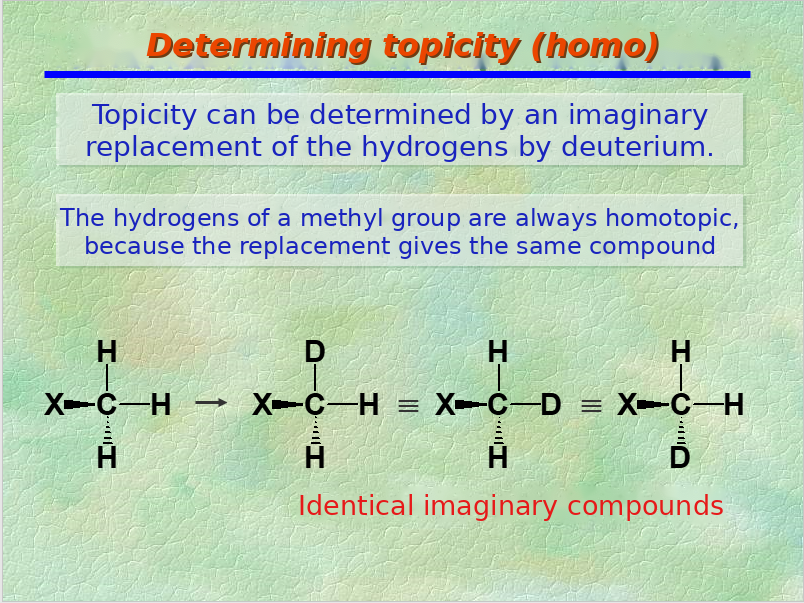
If the two substitutions give the same compound, the hydrogens are homotopic. This is the case for the three hydrogens of any methyl group, which swap places as the C-C bond rotates, and for the two hydrogens of CH2Cl2.
Enantiotopic: two enantiomers
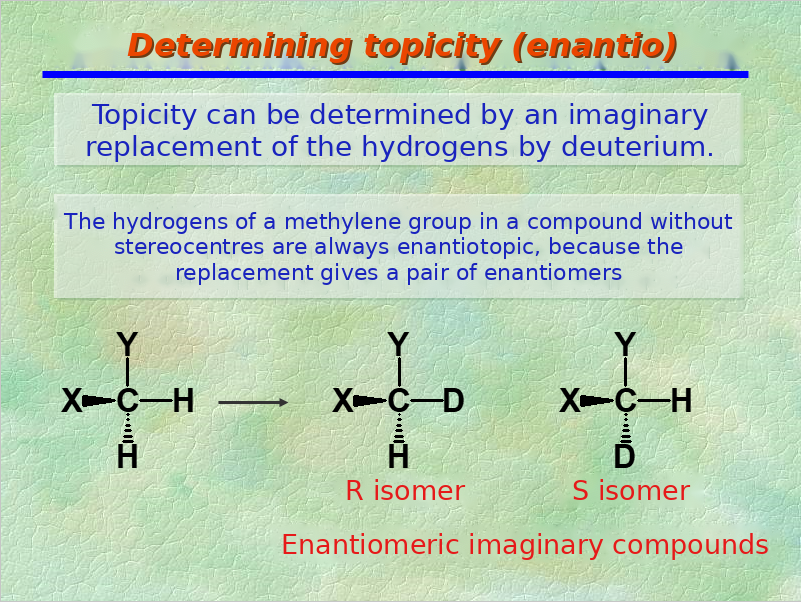
If the two substitutions give a pair of enantiomers, the hydrogens are enantiotopic. This is the case for the two hydrogens of the CH2 of ethanol, CH3CH2OH, or of any CH2 with two different substituents in a molecule without stereocentres. Since enantiomers have the same properties in an achiral environment, enantiotopic hydrogens are isochronous. In a chiral solvent or in the presence of a chiral reagent they can be told apart; this is exploited in the topic on stereochemistry.
Diastereotopic: two diastereomers
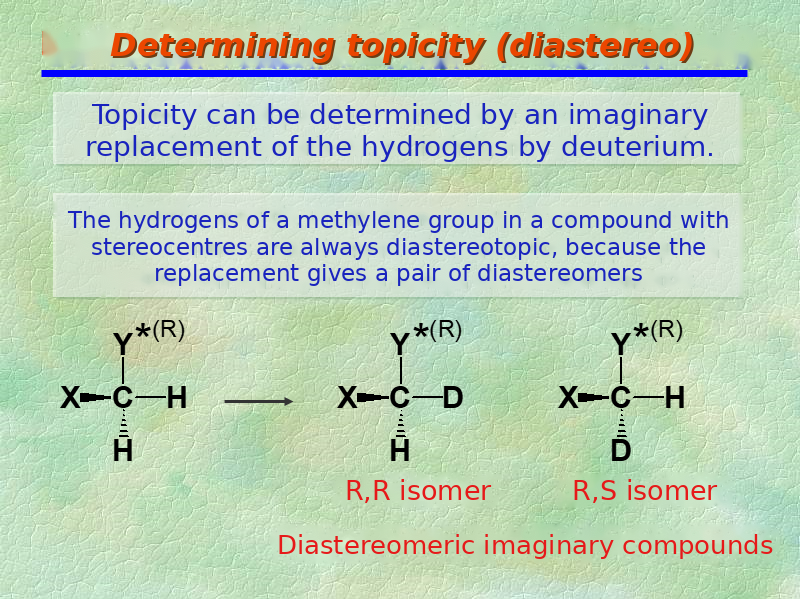
If the two substitutions give a pair of diastereomers, the hydrogens are diastereotopic. This happens with the two hydrogens of a CH2 in a molecule that has at least one stereocentre. Diastereomers have different properties, and diastereotopic hydrogens can appear at different shifts. Moreover, since they are not equivalent, they couple with each other.
Two hydrogens on the same CH2 are not necessarily equivalent. If there is a stereocentre in the molecule, they are diastereotopic and can give two signals, coupled to each other. We will see a real example in complex systems.
More examples of diastereotopicity
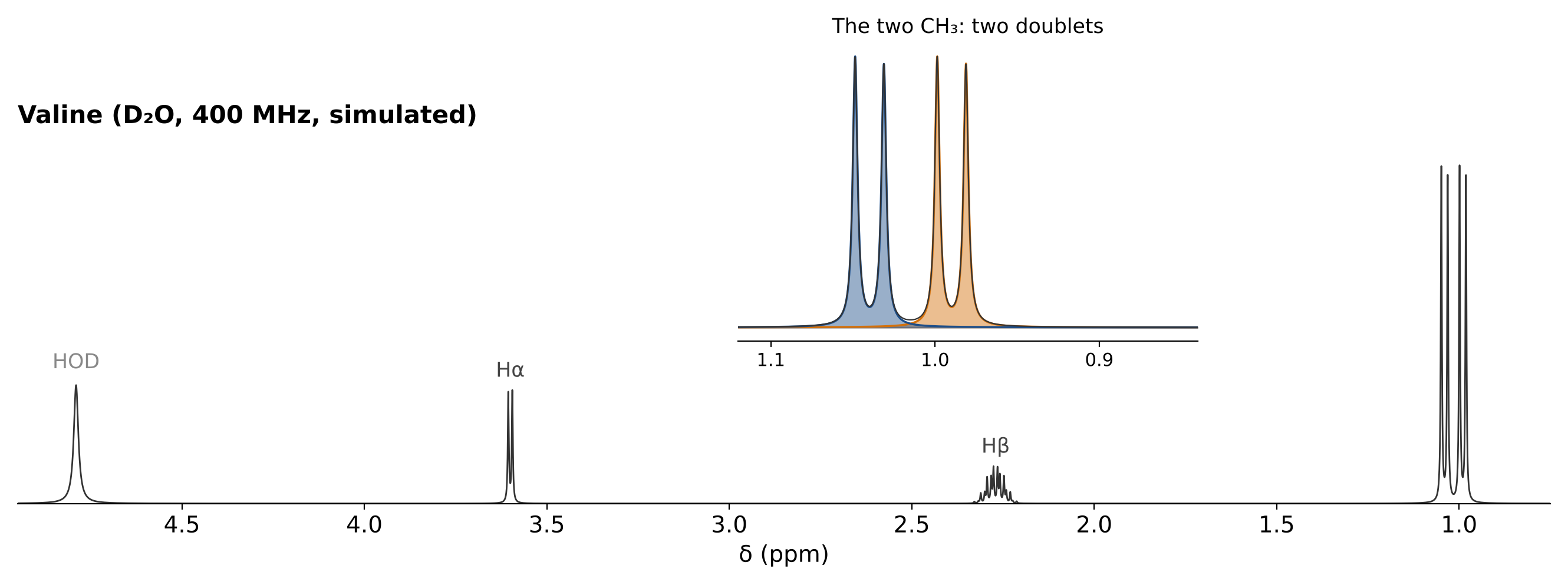
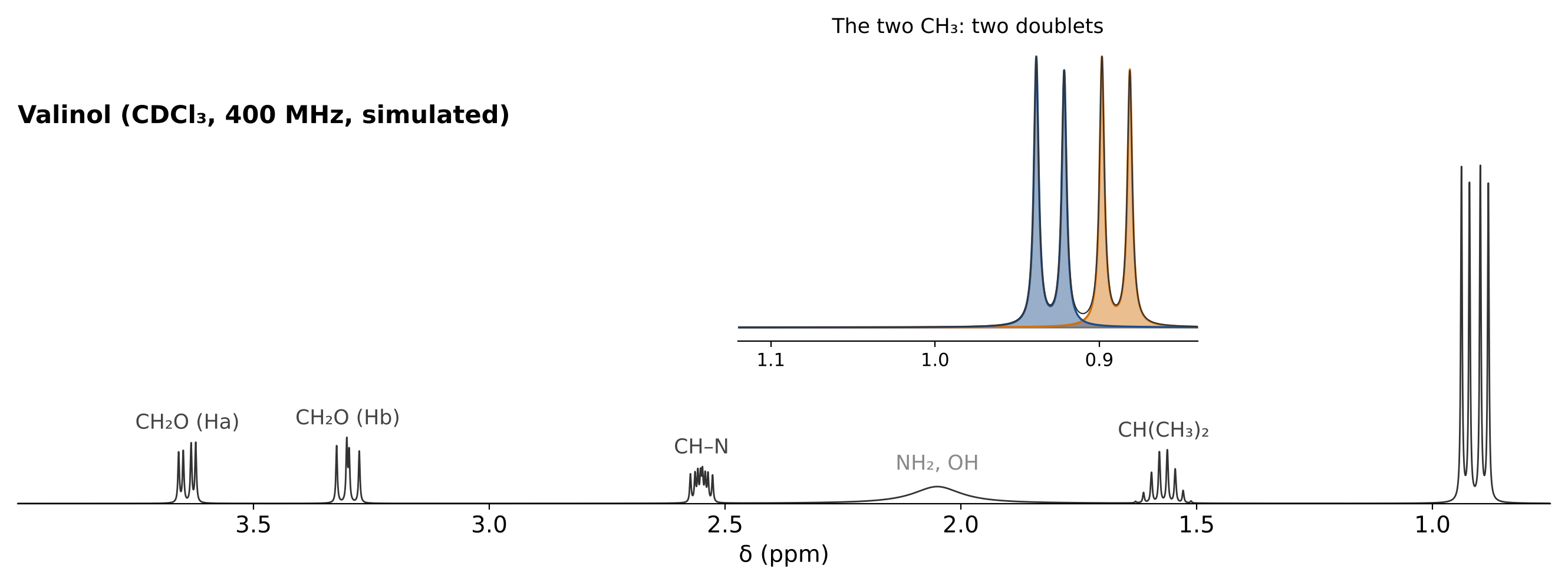
- The methyls of an isopropyl group. Not only hydrogens can be diastereotopic: groups can too. In valine and valinol, (CH3)2CH-CH(NH2)-…, the carbon bearing the amino group is a stereocentre, and the two CH3 of the isopropyl group give two separate doublets, for example at about 0.90 and 0.95 ppm, instead of a single six-hydrogen one. You can see it in the models and simulated spectra below.
The two isopropyl methyls, in blue and orange, cannot be interchanged by any symmetry operation: the neighbouring stereocentre makes them diastereotopic. In the simulated spectra each gives its own doublet (in the expansion, with the same colours, although the model does not show which doublet belongs to which methyl).
- Molecules without stereocentres. In glycerol, HOCH2CH(OH)CH2OH, there is no stereocentre, but if one of the hydrogens of a CH2 is replaced by deuterium, the central carbon becomes one. The two hydrogens of each CH2 are diastereotopic to each other. The two CH2 groups, on the other hand, are enantiotopic to each other. You will see it in the glycerol signal of olive oil, whose triglycerides are esters of glycerol.
- Rings. In a substituted cyclohexane, the axial and equatorial hydrogens of the same CH2 are diastereotopic. If the ring flips quickly, they exchange and give an averaged signal, as we will see in dynamic NMR.