
Scalar and “dipolar” coupling: the nuclear Overhauser effect
Nuclei influence each other in two ways. Scalar coupling (J) travels through the bonds and splits the signals. Dipolar coupling acts directly through space, as between two magnets; in solution it averages to zero and splits nothing, but it leaves a trace: the nuclear Overhauser effect (NOE). If one signal is perturbed, the intensity of those of nuclei less than about 5 Å away changes, whether or not they are neighbours in the chain.
Two ways of “feeling” each other
We already know that a nucleus with spin is a small magnet. Two nearby nuclei can notice each other by two different routes:
| Scalar coupling (J) | Dipolar coupling | |
|---|---|---|
| Route | Through the electrons of the bonds | Directly, through space |
| Range | Two or three bonds (sometimes four or five) | Distances up to about 5 Å, however many bonds there are |
| Orientation of the molecule | No effect | Depends on it |
| In solution | Splits the signals (multiplets) | Averages to zero: does not split the signals |
| What is observed | The J constants: which nuclei are bonded and with what geometry | The NOE: which nuclei are close in space |
The field that a magnet creates at a point depends on the direction: it adds to the external field in some directions and subtracts in others. Since the molecules in a solution tumble millions of times per second in all directions, the dipolar interaction between two nuclei averages exactly to zero and does not appear in the spectrum as a splitting. (In solids, where the molecules do not tumble, it is noticeable, and it broadens the signals enormously.)
The trace of dipolar coupling: the NOE (nuclear Overhauser effect)
Although it averages to zero, the dipolar interaction fluctuates constantly as the molecules tumble, and those fluctuations are the main reason why nuclei return to equilibrium after a pulse (relaxation). When two nuclei are close, they relax partly through each other: this is cross-relaxation. As a result, if the populations of the levels of one of them are altered, those of the other change too.
The simplest experiment is the one-dimensional NOE:
- One signal, that of HA, is irradiated selectively and continuously until the populations of its two levels are equal (it is “saturated”).
- The spectrum is recorded. The signals of nuclei close in space to HA change in intensity; in small molecules, they increase by a few per cent.
- A normal spectrum is subtracted: only the irradiated signal and those that have changed remain in the “difference spectrum”.
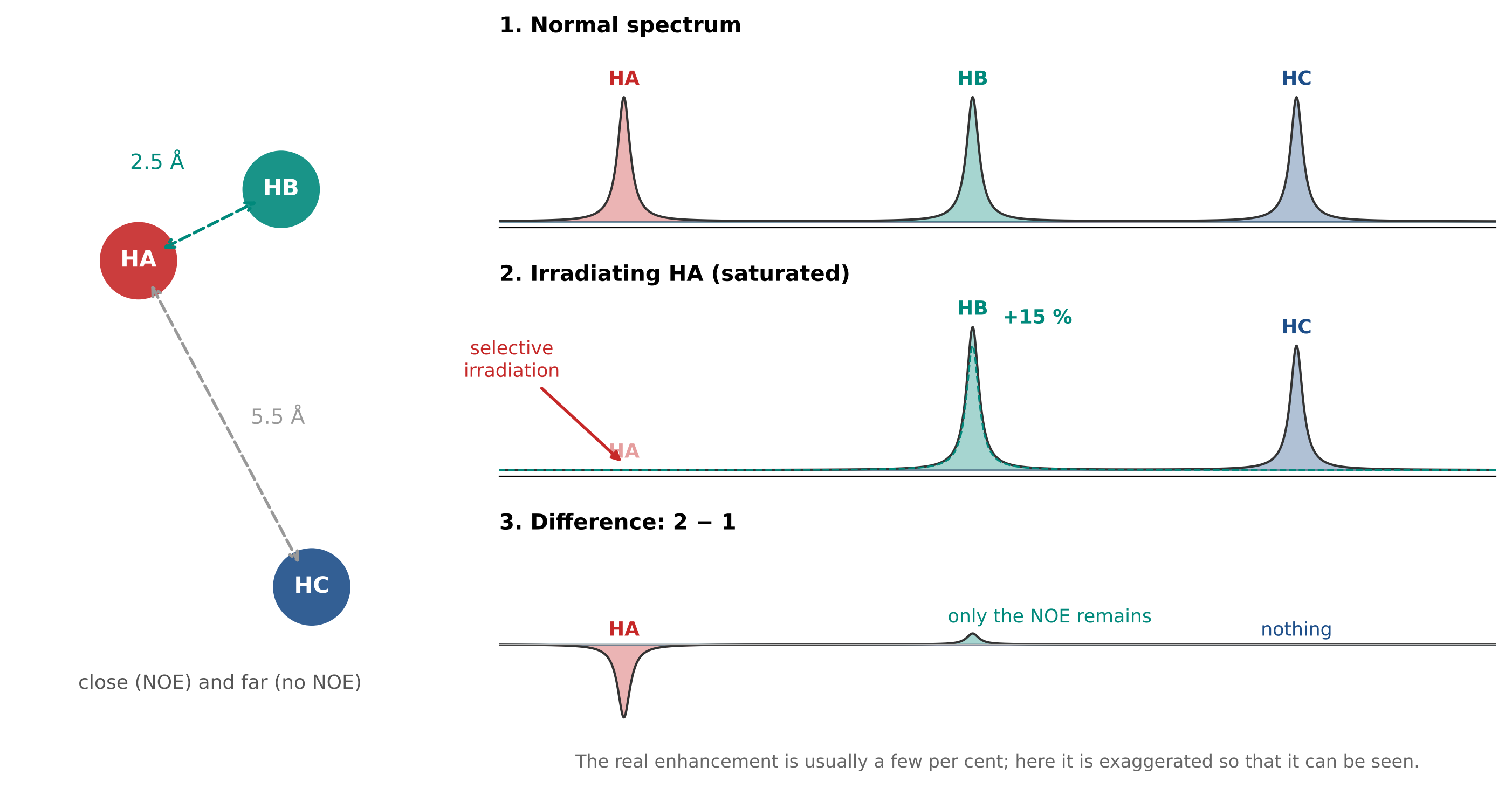
The NOE decreases with the sixth power of the distance (r−6): at twice the distance, sixty-four times less. In practice it is only observed between nuclei less than about 5 Å apart. That is why it is a “ruler” for measuring short distances.
The effect was predicted by Albert Overhauser in 1953 for the electrons and nuclei of metals, hence its name. For the hydrogen nuclei of a small molecule in solution, the theoretical maximum enhancement is 50 %, and real values are much smaller. In large molecules, such as proteins, which tumble slowly, the NOE becomes negative, and in medium-sized molecules it can vanish; for these a variant, the ROE, is used.
An example: methyl angelate and methyl tiglate
Scalar coupling is not enough for everything. In a trisubstituted alkene, such as methyl 2-methylbut-2-enoate, CH3-CH=C(CH3)-CO2CH3, there is only one hydrogen on the double bond and no cis or trans constant to measure. How can the Z isomer (angelate) be told from the E one (tiglate)?
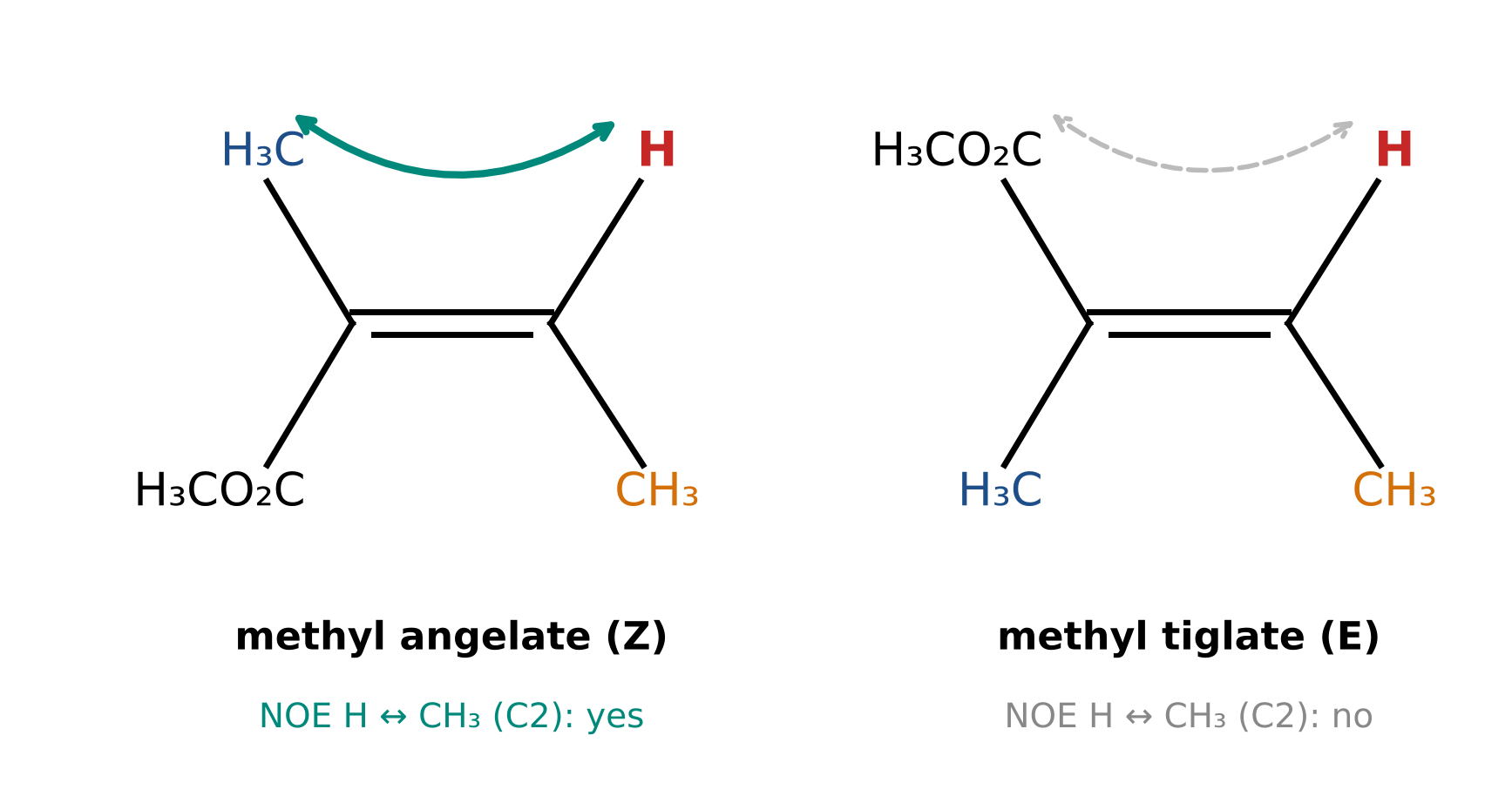
The vinylic hydrogen signal is irradiated. In both isomers the signal of the CH3 bonded to the same carbon, which is always close, increases. But only in the angelate (Z), where the hydrogen and the C2 CH3 are on the same side of the double bond, does the signal of that methyl increase too. In the tiglate (E) the vinylic hydrogen is on the side of the ester, and the NOE appears instead between the two methyls. The chemical shift confirms it: in the tiglate the vinylic hydrogen, close to the carbonyl, appears further left (at about 6.9 ppm) than in the angelate (at about 6.0 ppm).
What the NOE is used for
- To assign relative configuration: E/Z alkenes, cis/trans substituents on a ring, faces of a steroid. It is studied in the topic on stereochemistry.
- To find out the conformation and to determine the three-dimensional structure of proteins in solution, from hundreds of H-H distances.
- To see everything at once, the two-dimensional NOESY experiment (and its variant ROESY) shows all the NOEs of a molecule at the same time.
The same phenomenon acts between different nuclei. When 13C spectra are recorded while irradiating the hydrogens, the 1H→13C NOE makes the signals of carbons bearing hydrogens grow to almost three times their size, and it is one of the reasons why, in those spectra, the area of the signals is not proportional to the number of carbons that give rise to them and, therefore, why it makes no sense to measure the integral, as we will see in 13C NMR.