
Signal intensity and the NOE
In normal 13C spectra the intensity of a signal is not proportional to the number of carbons. Carbons without hydrogens give small signals for two reasons: they relax very slowly and they do not get the boost of the NOE, which can almost triple the signal of carbons bearing hydrogens. If the spectrum needs to be quantitative, there is a way to record it: inverse gated decoupling with long waits.
Large carbons and small carbons
The area of 13C signals is not exactly proportional to the number of carbons producing them, as it was in 1H. Look at these two examples.
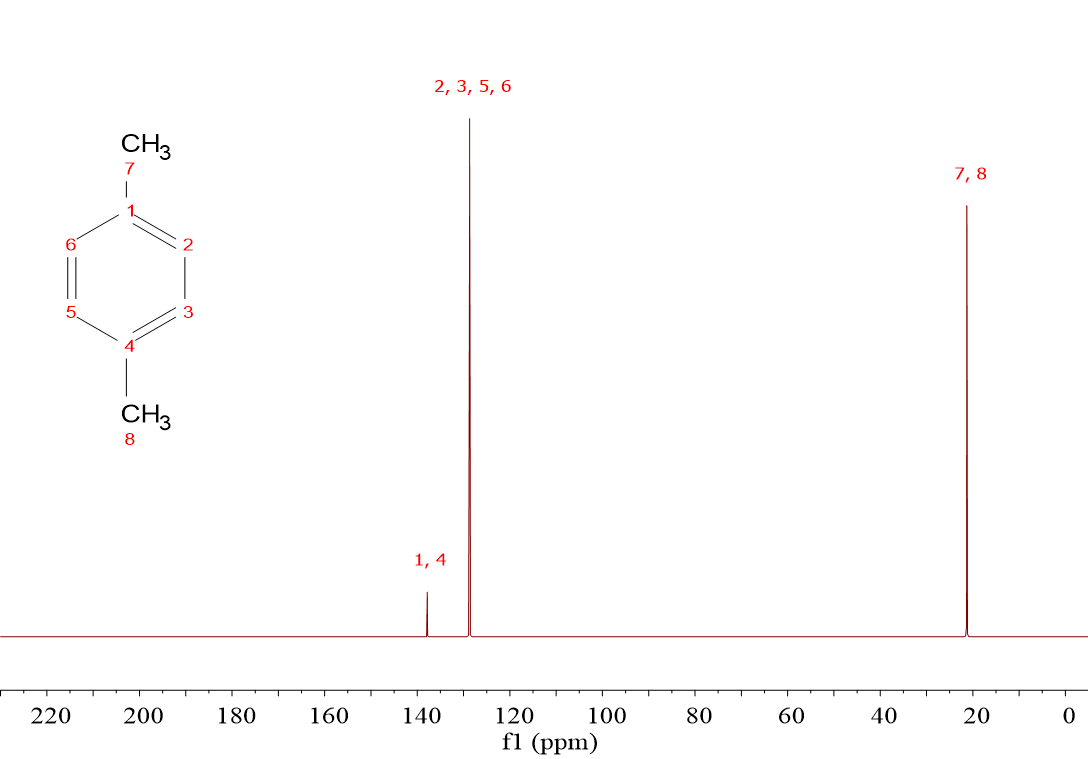
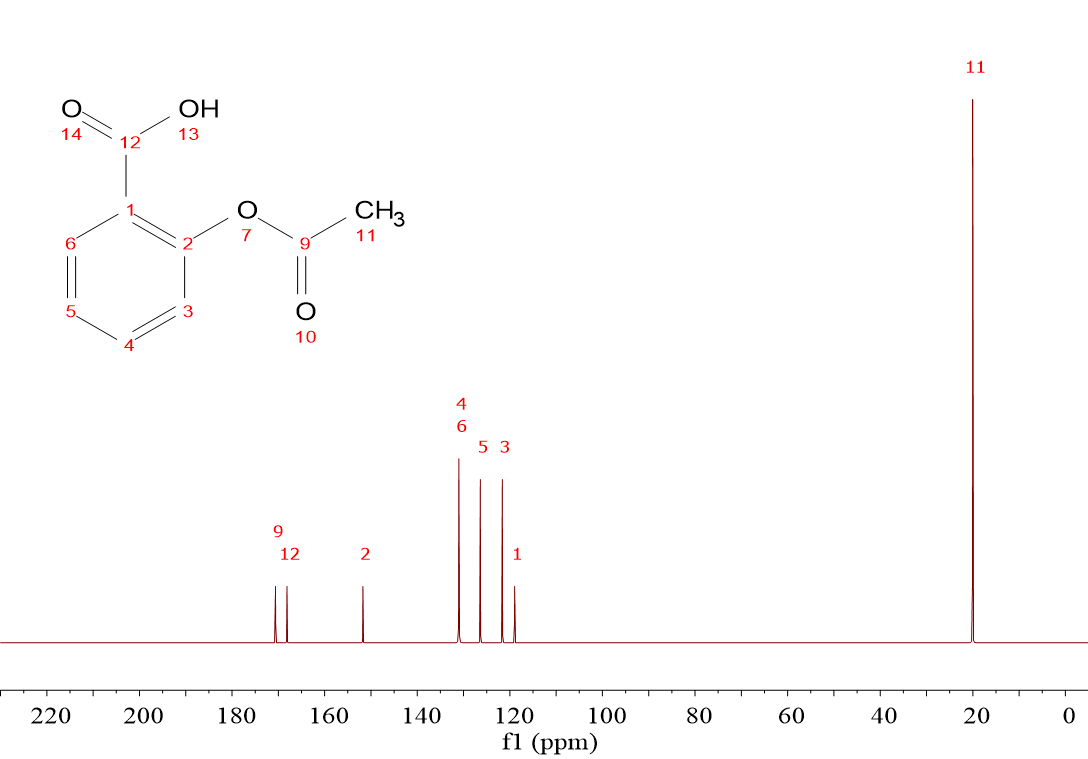
It is obvious that non-protonated carbons generally give particularly small signals. This is the case for carbons 1 and 4 of p-xylene and for carbons 1, 2, 9 and 12 of aspirin (the two substituted ring carbons and the two carbonyls). There are two reasons.
First reason: relaxation
After each pulse, the nuclei take some time to return to equilibrium, the relaxation time (see the response of the nuclei). To accumulate many FIDs in a short time, the pulse is repeated every few seconds, before the slowest nuclei have fully recovered. Those nuclei give ever weaker signals.
What makes some carbons slow? Relaxation is mainly due to interaction with other nearby magnetic nuclei (dipolar coupling). A 1H always has other hydrogens nearby. A 13C, on the other hand, is almost always surrounded by 12C, which is not magnetic, and its main “escape route” is the hydrogens bonded directly to it. If it has none, it relaxes very slowly, sometimes over tens of seconds, and its signal stays small.
Second reason: the NOE
When the 13C spectrum is recorded, all the hydrogens are irradiated to decouple them. That irradiation saturates the 1H and, through cross-relaxation, increases the signal of the nearby 13C: it is the same nuclear Overhauser effect we saw between hydrogens, but between different nuclei.
The maximum enhancement depends on the ratio of the gyromagnetic ratios: the signal can be multiplied by up to 1 + γH/2γC ≈ 2.99, that is, almost tripled. Only carbons with attached hydrogens, whose relaxation is almost entirely due to them, reach that maximum. Carbons without hydrogens hardly benefit.
In a normal 13C spectrum, carbons without hydrogens (quaternary carbons, carbonyls, substituted aromatic carbons, nitriles) usually give the smallest signals. This is a useful clue for recognizing them, but not a rule: the only reliable way to know how many hydrogens each carbon has is to record a DEPT spectrum.
Even so, intensity gives some information. Two carbons equivalent by symmetry usually give a taller signal than a single one of the same kind, as with the pairs of aromatic CH in ibuprofen.
Quantitative 13C spectra
Sometimes a 13C spectrum is needed in which the areas are proportional to the number of carbons, for example to analyse mixtures or polymers. It is achieved as follows:
- Inverse gated decoupling is used: the hydrogens are irradiated only while the FID is being recorded, not between pulses. The spectrum comes out decoupled, with singlets, but the NOE has no time to build up.
- Enough time is allowed between pulses for all the carbons to relax, about five times the relaxation time of the slowest one. Sometimes a paramagnetic reagent, such as chromium(III) acetylacetonate, is added to shorten the relaxation times.
The price is a much longer and less sensitive spectrum. That is why, in everyday work, 13C spectra are not integrated.