First ¹H and ¹³C spectra
Before studying each tool separately, it is worth looking at two real spectra, the 1H and 13C spectra of ibuprofen, and understanding a good part of them already. One idea is enough: nuclei that have the same environment in the molecule (the same “address”) give a single signal.
The 1H spectrum of ibuprofen
Here is the 1H spectrum of ibuprofen, the painkiller you have probably taken many times, with molecular formula C13H18O2. It was recorded on a 60 MHz benchtop instrument.
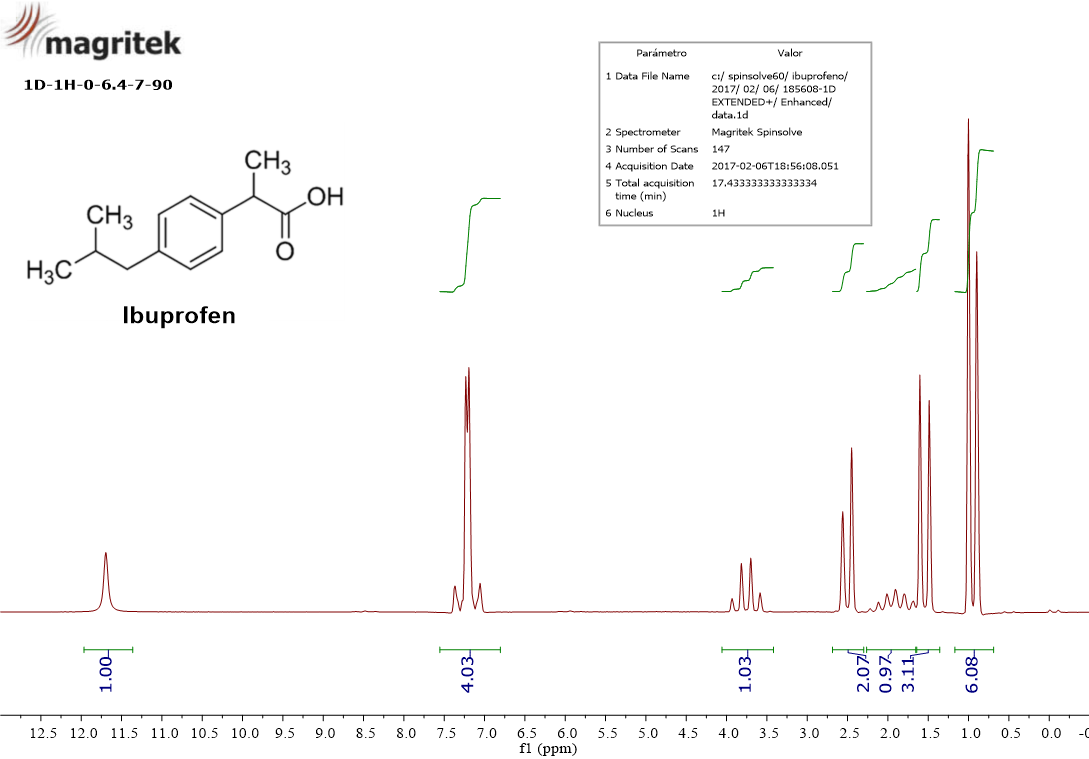
1H spectra have a horizontal scale, the chemical shift scale, which usually runs from 0 to 12-15 ppm (parts per million; we will see what that means in the topic on 1H NMR). The signals of the different hydrogens of the compound appear on it. Fortunately they do not all come out together: if they did, NMR would be useless for determining structures.
Counting addresses
Let us count and tell apart the hydrogens of the structure. To do so we will use symmetry and the idea that single C-C bonds rotate freely, like a pinwheel. Read what follows carefully, even if there are things you do not fully understand yet.
- In each methyl group (CH3) the three hydrogens swap places when the C-C bond rotates, so they give a single signal: it is as if they lived at the same address.
- Are all the methyls equivalent? The two of the isobutyl group, (CH3)2CH-, are equivalent to each other: if you swapped them, the molecule would not change. Their six hydrogens share an address, different from that of the other methyl, the one next to the carboxyl group.
- There is a single CH2 group, whose two hydrogens are equivalent: another address.
- There are two CH groups outside the ring, each with its own address.
- The four ring CHs are equivalent in pairs (the two next to the CH2 and the two next to the CH of the acid): two addresses with two hydrogens each, very similar to each other.
- That leaves the OH hydrogen, very different from the rest.
In total, eight addresses, with different numbers of “residents”: 6, 3, 2, 1, 1, 2, 2 and 1 hydrogens. Now look at the spectrum. You should find seven signals, at 0.9, 1.5, 1.8, 2.5, 3.7, 7.2 and 11.7 ppm. Can you see them?
The integral
Above each signal there is a green trace, the integral, which measures its area; the value is given below the spectrum.
| δ (ppm) | Appearance | Integral | Address |
|---|---|---|---|
| 11.7 | a single line (singlet) | 1 | COOH |
| 7.2 | a group of lines (multiplet) | 4 | the four ring CHs (two pairs, at 7.1 and 7.3) |
| 3.7 | four lines (quartet) | 1 | CH next to the COOH |
| 2.5 | two lines (doublet) | 2 | CH2 |
| 1.8 | multiplet | 1 | CH of the isobutyl group |
| 1.5 | doublet | 3 | CH3 next to the COOH |
| 0.9 | doublet | 6 | the two CH3 of the isobutyl group |
Can you see where this is going? Each signal is an address, which appears at a different chemical shift, and its area (the integral) tells us how many residents, how many hydrogens, it has.
- We expected an address with six hydrogens, those of the two equivalent CH3 groups. Is there a signal integrating for 6? Yes, the doublet at 0.9 ppm.
- The signal at 1.5 ppm, integrating for 3, must be the other CH3.
- The doublet at 2.5 ppm, integrating for 2, is the CH2.
- The two CHs outside the ring, with one hydrogen each, must be the signals at 1.8 and 3.7 ppm.
- The odd-looking signal at 7.2 ppm integrates for 4: these are the two very close ring addresses, one at 7.1 and the other at 7.3 ppm.
- The “odd one out”, the OH, can only be the signal at 11.7 ppm, very different from the others because the hydrogen is bonded to an oxygen and not to a carbon.
You have now understood your first 1H spectrum, mainly thanks to the integral. What remains is to understand the shape of the signals (their multiplicity: doublets, quartets…), which is studied in the topic on coupling. The art, and the hard part, is doing it the other way round: looking at the spectrum and working out the structure. Step by step…
The 13C spectrum of ibuprofen
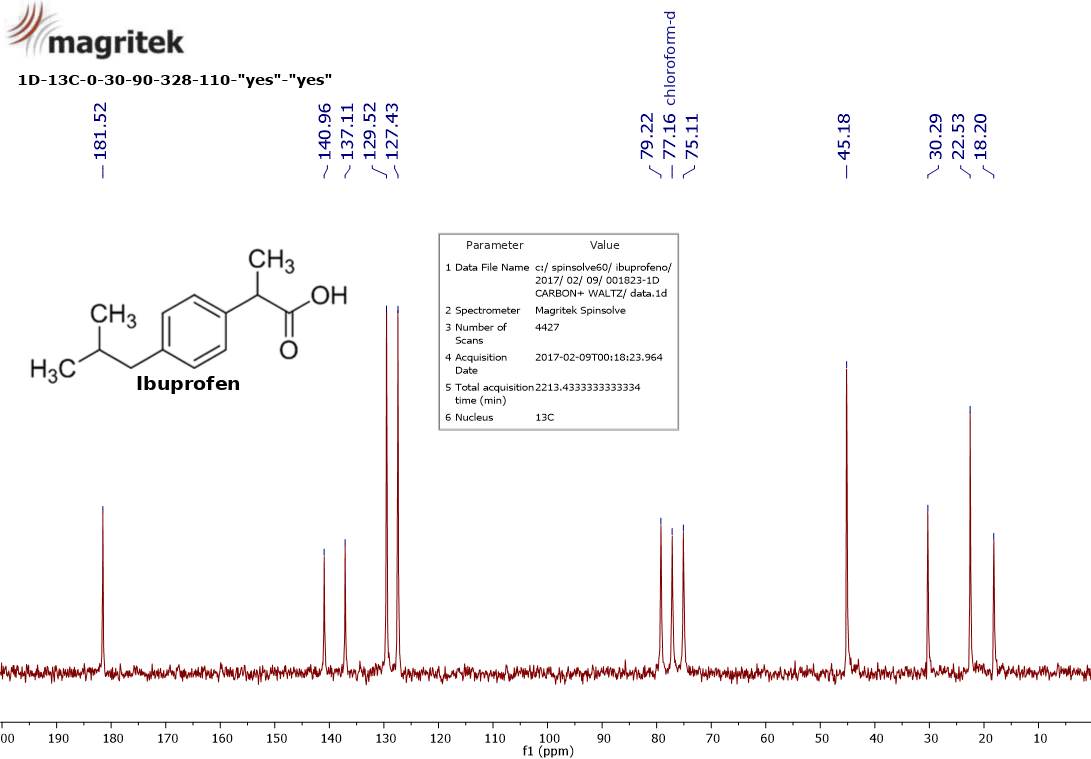
All NMR spectra, whatever the nucleus, have a chemical shift scale. That of 13C runs from 0 to 220-250 ppm: it is much wider than that of 1H, and the signals overlap much less.
Counting carbon addresses
- The two CH3 of the isobutyl group are equivalent: one address with two carbons. The other CH3 has its own.
- The CH2: another address.
- The two CHs outside the ring: two addresses.
- The ring CHs, equivalent in pairs: two addresses with two carbons each.
- The “non-protonated” carbons: the two ring carbons bearing the substituents, different from each other, and the COOH carbon.
In total, ten addresses, with one or two residents each. Look at the spectrum: you should find nine signals, at 18.2, 22.5, 30.3, 45.2, 127.4, 129.5, 137.1, 141.0 and 181.5 ppm. Can you see them?
What is special about 13C spectra
- All the signals are singlets, because the hydrogens are “decoupled” while recording, as we will see in the topic on 13C NMR. The exceptions are the solvent signals, which you must learn to recognize. Here it is deuterated chloroform (CDCl3), which gives a triplet centred at 77.2 ppm.
- There is no integral. The intensity of 13C signals is not proportional to the number of carbons as faithfully as the area of 1H signals is to the number of hydrogens.
- They are insensitive. This spectrum needed 4427 scans and more than 36 hours, compared with 17 minutes for the 1H one. Remember that only 1 % of the carbons are 13C.
An accidental coincidence
Ibuprofen has 13 carbons. Taking into account the two equivalent methyls, we would expect 12 signals; with the two pairs of ring CHs, 10. But only 9 are seen. There must be an additional equivalence that symmetry does not explain: an accidental coincidence. It is one of the drawbacks of NMR, and we will see many examples throughout the course.
Look at the spectrum again. The signals at 22.5, 45.2, 127.4 and 129.5 ppm are, on average, twice as intense as the others. In 13C spectra this suggests, though not always, that those signals correspond to two carbons. Three of them are the equivalent pairs we already knew (the two CH3 groups and the two pairs of ring CHs); the fourth, at 45.2 ppm, brings together by chance the CH2 and the CH next to the COOH. That accounts for the ten expected addresses, two of which coincide and give only nine signals.
You have now understood your first 13C spectrum while knowing almost nothing yet. There is a lot still to learn, but do not despair: step by step…