
C–H couplings, decoupling and DEPT
13C couples with its hydrogens with large constants, 1JCH of 125 to 250 Hz, depending on the hybridization of the carbon and on the substituents. To simplify, the spectra are decoupled, and so the information on how many hydrogens each carbon bears is lost. The DEPT technique recovers it: in “DEPT-90” only CH carbons appear, in “DEPT-135” CH and CH3 appear in antiphase to CH2, and carbons without hydrogens appear in neither.
C-H coupling
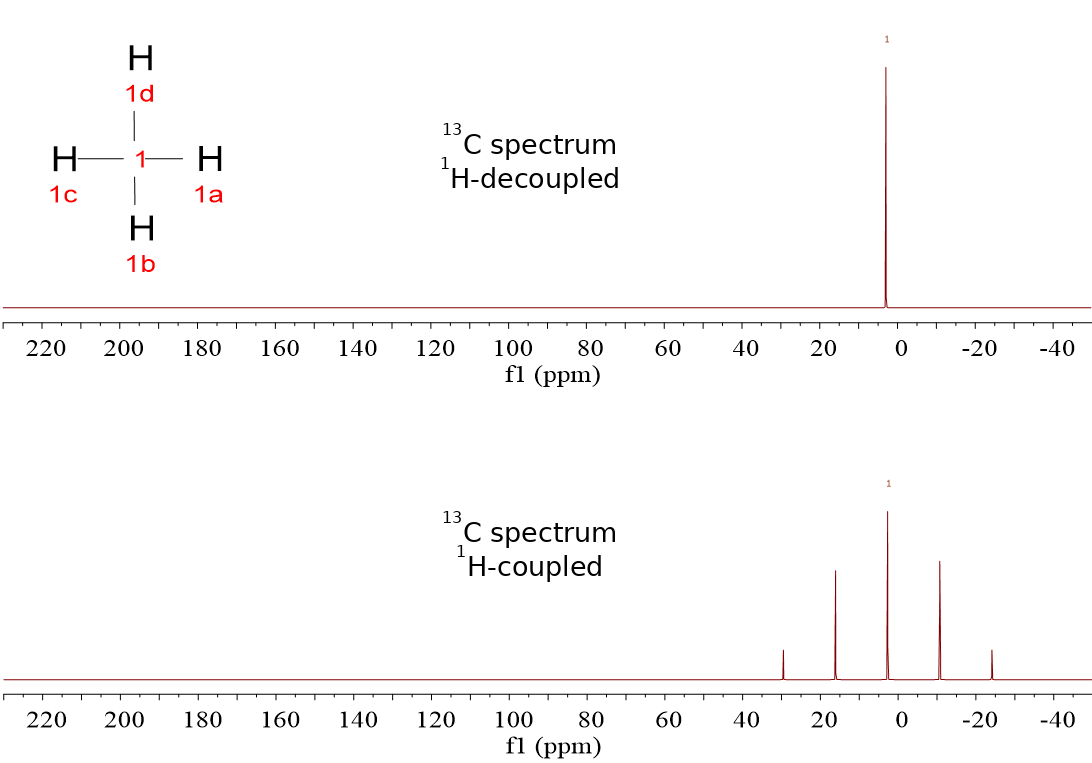
At the start of the topic we saw that, without decoupling, the 13C of methane appears as a quintet, from its four hydrogens. The one-bond coupling constant, 1JCH, is large and depends on the hybridization of the carbon, because it increases with the s character of the C-H bond:
| Type of carbon | Example | 1JCH (Hz) |
|---|---|---|
| sp3 | CH4, CH3CH3 | ≈ 125 |
| sp2 | CH2=CH2, benzene | ≈ 160 |
| sp | HC≡CH | ≈ 250 |
| sp3 with electronegative substituents | CHCl3 | ≈ 210 |
Does 1JCH reflect the strength or length of the C-H bond? Only partly. 1JCH depends mainly on the density of the bonding electrons at the nuclei themselves, and only s orbitals have it; that is why it grows with the s character of the carbon orbital, roughly as 1JCH ≈ 500 × (s fraction): 125 Hz for sp3 (25 %), about 167 for sp2 (33 %) and 250 for sp (50 %). More s character also makes the bond shorter and stronger, so in simple hydrocarbons everything goes in the same direction: from methane to ethylene and acetylene, 1JCH goes from 125 to 156 and 249 Hz, the C-H distance falls from 1.09 to 1.08 and 1.06 Å, and the bond energy rises from about 105 to 111 and 133 kcal/mol. But 1JCH does not measure the strength or length of the bond: all three depend on the s character, and that is why they go together. Chloroform proves it: its 1JCH (209 Hz) is much larger than that of methane and yet its C-H bond is weaker (about 95 kcal/mol). The highly electronegative chlorines concentrate p character in the C-Cl bonds and leave more s character in the C-H bond, and they also increase the effective nuclear charge of the carbon; both raise the constant without strengthening the bond. Notice also the scales: from methane to acetylene the constant doubles, while the distance changes by barely 0.03 Å.
There are also smaller couplings over two and three bonds (2JCH and 3JCH, 0 to 10 Hz), which complicate coupled spectra even further. The HMBC experiment will take advantage of them.
On decoupling, each carbon gives a singlet and the spectrum is simplified. But we lose valuable information: the number of hydrogens attached to each carbon.
DEPT
Fortunately, there are techniques that recover it. The most widely used is DEPT (Distortionless Enhancement by Polarization Transfer). Its basis is complex, but the result is easy to interpret. It uses a sequence of pulses on 1H and 13C that transfers the polarization of the hydrogens to their carbons; depending on the duration of the last 1H pulse and the angle through which it rotates the magnetization (45°, 90° or 135°), the 13C signals appear or not, or appear with different signs, depending on whether they are CH, CH2 or CH3. Since it takes advantage of the larger polarization of 1H along the way, it is also more sensitive than the normal spectrum.
Look at the 13C spectra of 2-(propanoyloxy)benzoic acid (propionylsalicylic acid), an analogue of aspirin.
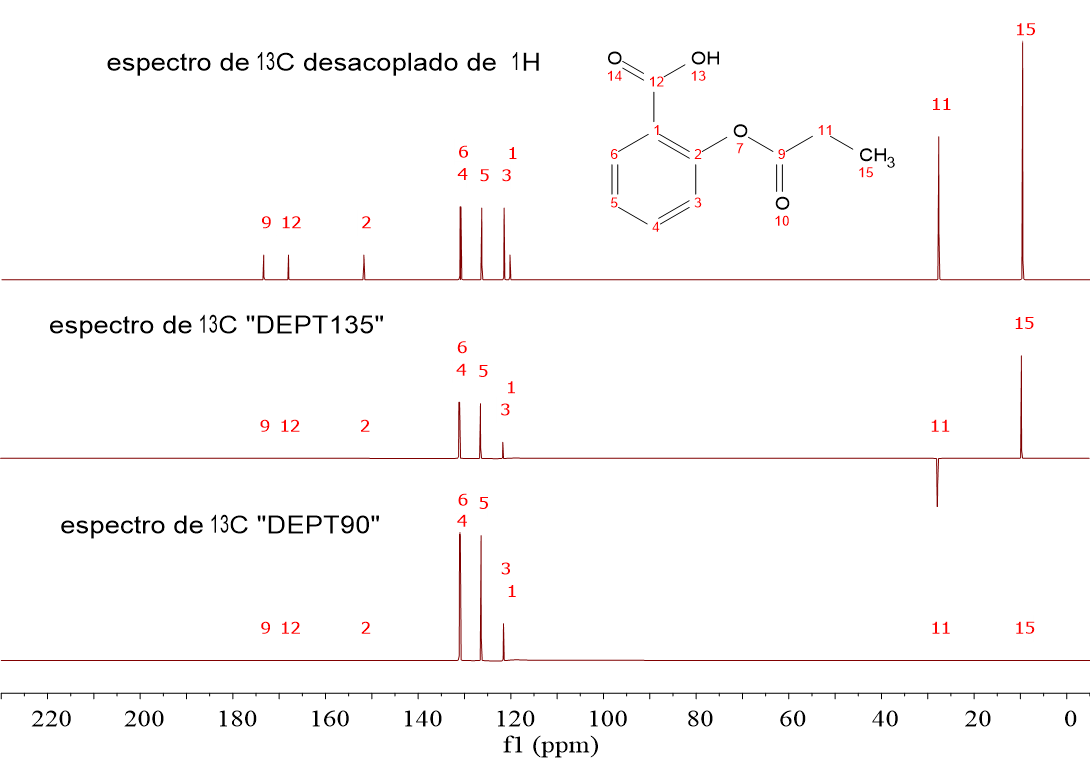
- Normal spectrum (top): all the carbons, as singlets. The non-protonated ones (1, 2, 9 and 12) give small signals.
- DEPT-135 (middle): the signals are still singlets, but the non-protonated carbons disappear. The CH and CH3 (3, 4, 5, 6 and 15) point up, and the CH2 (11) points down, out of phase.
- DEPT-90 (bottom): only the CH carbons (3, 4, 5 and 6) appear.
- DEPT-45 (not shown): it is like DEPT-135, but all the signals appear in phase. It is of little interest and is not normally recorded.
How they are combined
- DEPT-90 tells us which signals are CH.
- In DEPT-135, the upward signals that are not in DEPT-90 are CH3, and the downward ones are CH2. Caution: putting CH2 downwards is a convention. The spectrum can also be recorded with CH2 upwards and CH and CH3 downwards.
- The signals in the normal spectrum that do not appear in DEPT-135 are carbons without hydrogens: C.
With the normal spectrum, DEPT-135 and DEPT-90, all the carbons are classified as C, CH, CH2 and CH3. Adding up the hydrogens of each gives the number of hydrogens bonded to carbon, which, compared with the molecular formula, reveals how many are on OH or NH. It is extraordinarily valuable information for solving an unknown structure.
Today the same information is often obtained, together with the correlation between each carbon and its hydrogens, from the edited HSQC, an even more sensitive and informative two-dimensional experiment.