
Edited HSQC and hybrid experiments
Edited HSQC adds one more piece of information to HSQC: the number of hydrogens on each carbon, read from the sign (the colour) of each spot. HSQC can also be combined with other pulse blocks to build hybrid experiments, such as HSQC-TOCSY, which bring together the information of two experiments in a single map.
Edited HSQC
In HSQC each spot joins a carbon with the hydrogens directly bonded to it. DEPT-135, on the other hand, gives the number of hydrogens on each carbon: CH and CH3 come out positive and CH2 negative. Edited HSQC combines both pieces of information.
To achieve this, an extra period lasting 1/1JCH (about 7 ms) is inserted into the HSQC sequence, during which the magnetization of each carbon evolves under the coupling to its hydrogens. At the end of that period, the signal of CH and CH3 groups keeps its sign and that of CH2 groups is inverted. On the map, each sign is shown in a colour; the choice of colours depends on the software and must be checked in each case.
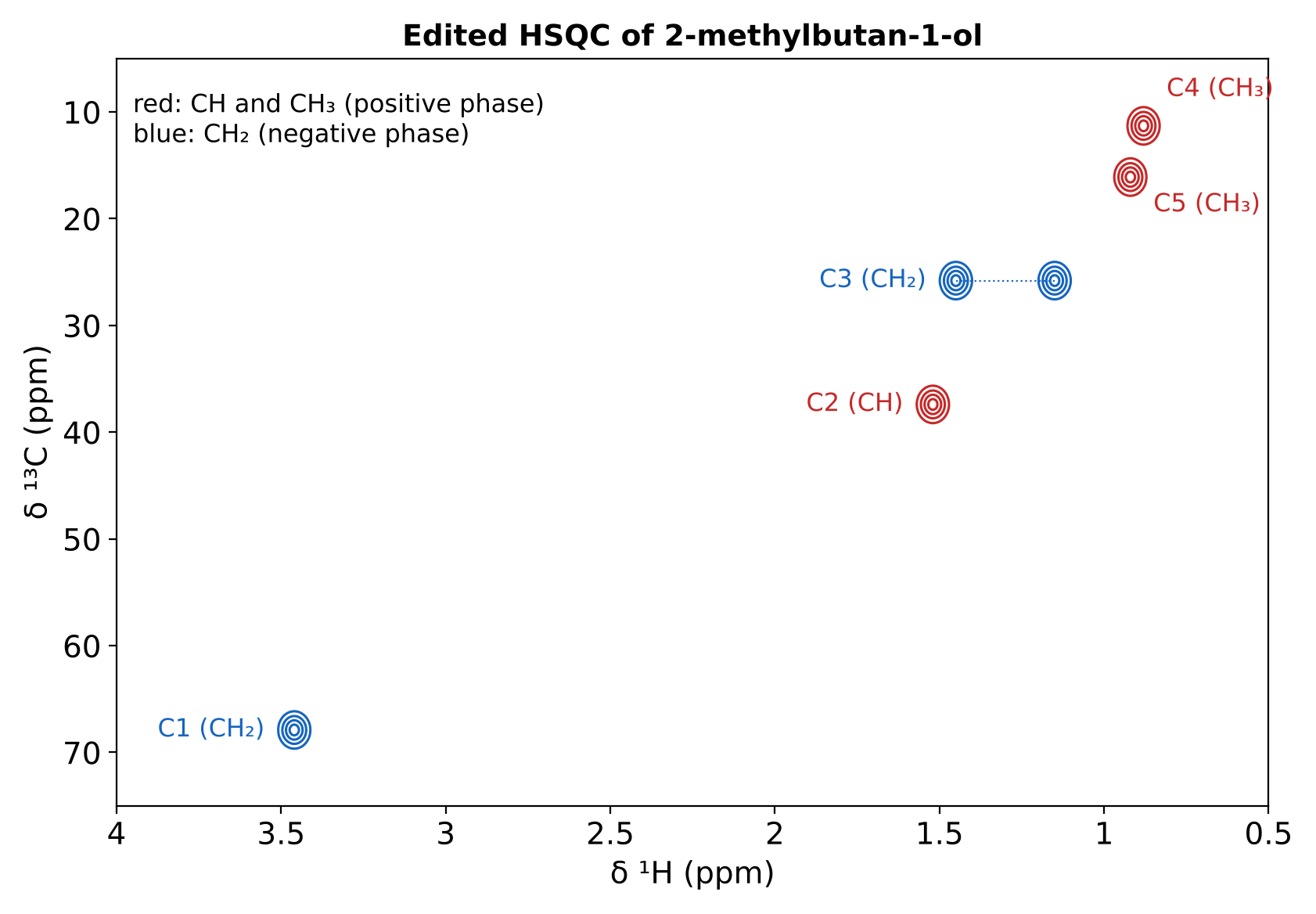
Compared with DEPT, edited HSQC has three advantages:
- It is much more sensitive, because it detects on 1H. With a few milligrams it is obtained in minutes.
- It tells at the same time which hydrogens belong to each carbon and how many there are.
- It shows diastereotopic hydrogens directly: two spots of the same colour on the same horizontal line (in the example, the two H on C3, at 1.15 and 1.45 ppm) are the two hydrogens of one CH2, not two different carbons. In 2-methylbutan-1-ol, the hydrogens of both CH2 groups are diastereotopic because the molecule has a stereocentre at C2; those of C1 have such similar shifts (3.42 and 3.50 ppm) that on the map they merge into a single spot.
Quaternary carbons do not appear, because they have no hydrogens. For them, the 13C spectrum or HMBC is needed.
Hybrid experiments
Many 2D experiments are built by chaining pulse blocks: one that transfers magnetization from 1H to 13C and back (that of HSQC), another that spreads it among the hydrogens of one spin system (that of TOCSY), another that passes it through space (that of NOESY)… Combining them gives hybrid experiments.
The most useful is HSQC-TOCSY. Each carbon shows in its row not only its own hydrogen, as in HSQC, but also all the hydrogens of its spin system, as in TOCSY. The advantage over TOCSY is resolution: even if the hydrogens overlap in the 1H spectrum, the carbons are almost always resolved, and each spin system can be read separately.
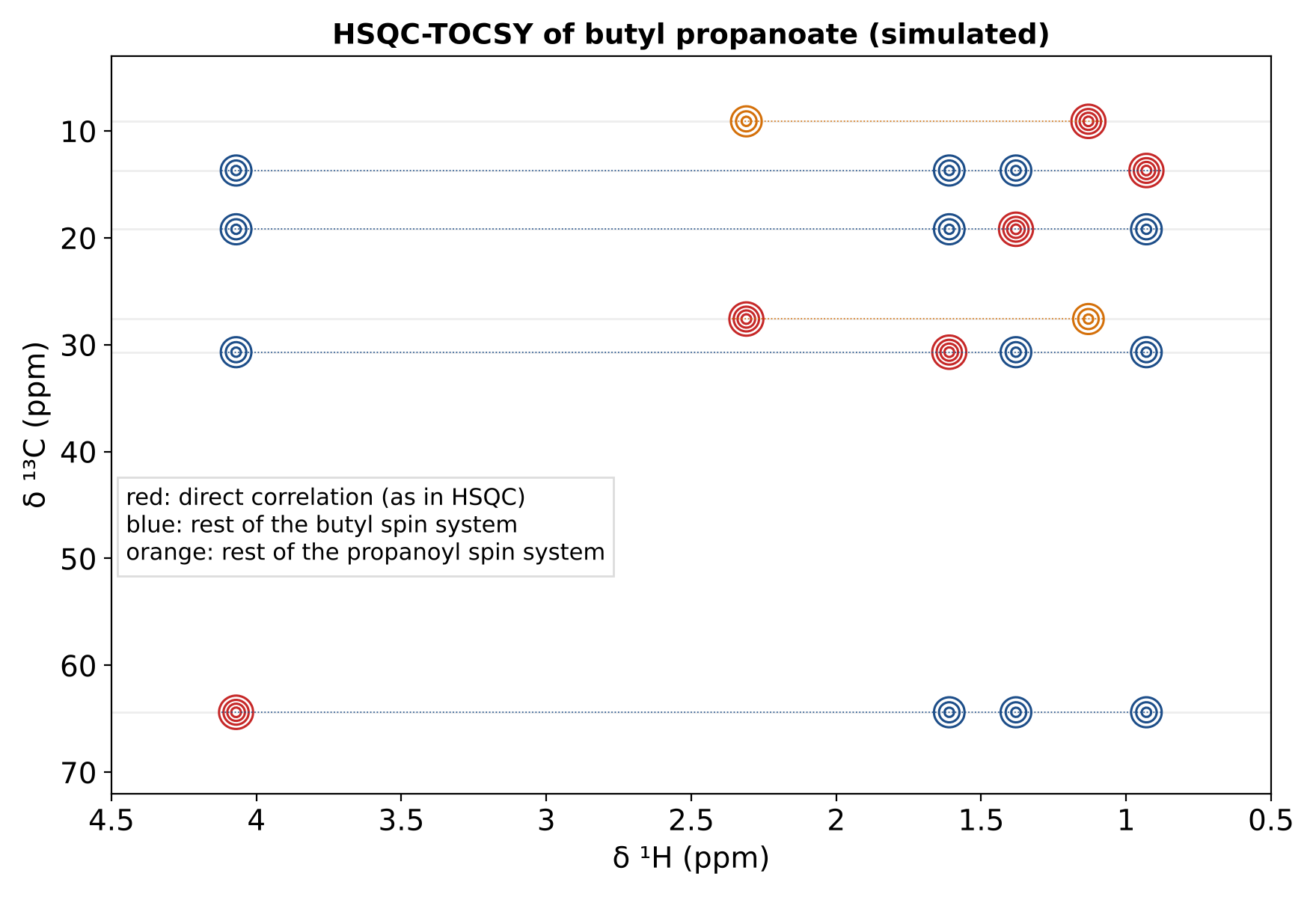
Other experiments in the same family:
- HSQC-NOESY: NOE correlations spread out by the carbon shift, useful for large molecules.
- H2BC: shows only two-bond H–C correlations, which allows them to be told apart from the three-bond correlations of HMBC.
- HSQMBC and variants: allow the long-range nJCH coupling constants to be measured, which give information on conformation.
Many of these experiments are now acquired with non-uniform sampling (NUS): instead of recording every t1 increment, a randomly chosen fraction is recorded and the spectrum is reconstructed by computation. The measurement time is cut by half or more.