
Correlations with ¹⁵N, ¹⁹F and ³¹P
Correlation experiments are not limited to 1H and 13C. With the same sequences, adapted to other frequencies, 1H can be correlated with 15N, 19F or 31P. This gives the shifts of nuclei that are hard to observe directly and places the nitrogen, fluorine or phosphorus atoms in the molecule.
Nitrogen: detecting without observing
Nitrogen is present in a large proportion of drugs and natural products, but it is hard to observe. 14N, the abundant isotope, has spin 1 and gives very broad signals. 15N has spin ½ and sharp signals, but it is only 0.37 % of natural nitrogen and its gyromagnetic ratio is small (and negative): at natural abundance, its receptivity is about 250 000 times lower than that of 1H (see deuterium and nitrogen). A direct 15N spectrum of an ordinary sample is practically impossible.
The solution is the same as in HSQC and HMBC: inverse detection. Magnetization starts on 1H, passes to 15N, picks up its chemical shift and returns to 1H to be detected. This gains a factor of several hundred in sensitivity.
- 1H–15N HSQC uses the direct coupling 1JNH (about 90 Hz) and only sees nitrogens carrying hydrogen: NH of amides, amines, pyrroles and indoles. The hydrogens must exchange slowly with the solvent; DMSO-d6 usually works better than CD3OD.
- 1H–15N HMBC uses two- and three-bond couplings and also sees nitrogens without hydrogen: tertiary amines, nitriles, pyridines, nitro compounds. It is the most widely used, because there is almost always some CH near each nitrogen in a molecule.
The 15N chemical shift
15N chemical shifts span about 900 ppm. They are quoted relative to liquid ammonia (the most common scale in organic chemistry) or to nitromethane; the two scales differ by 380 ppm, and it is important to check which one each source uses.
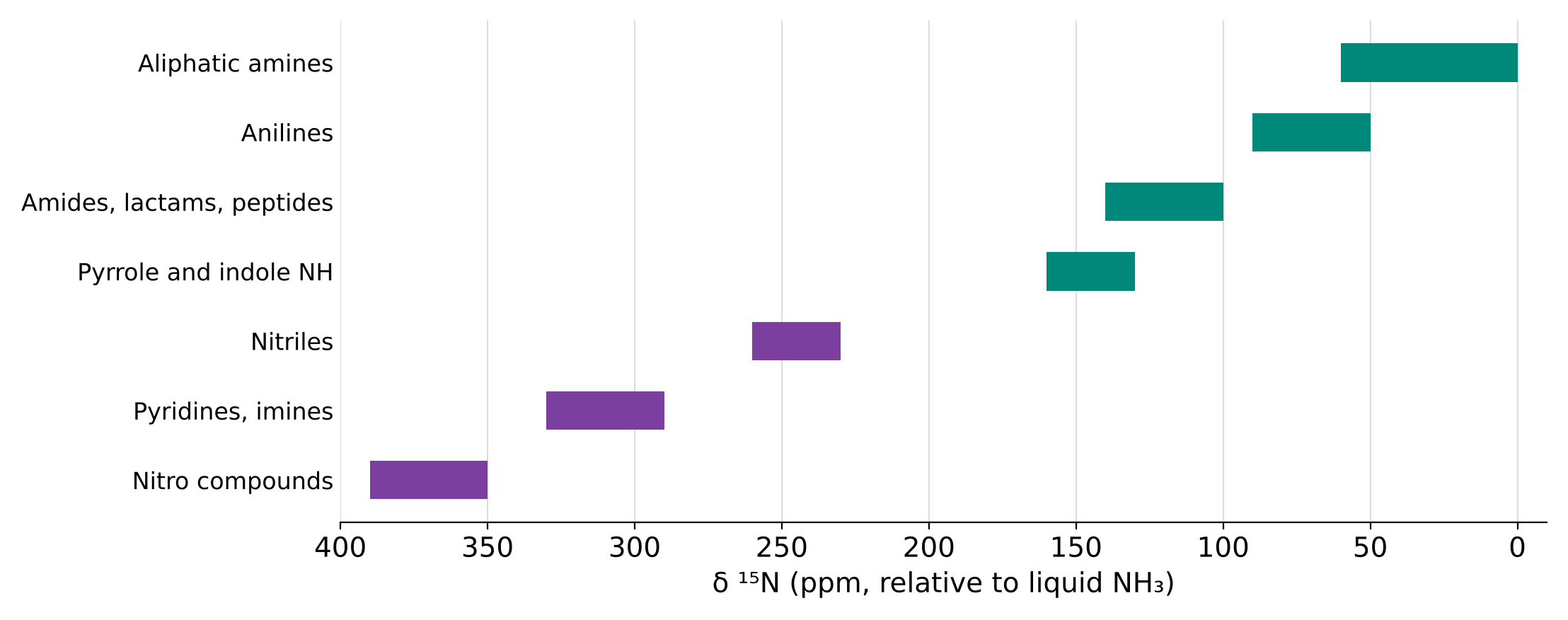
Nitrogens with a lone pair in an sp2 orbital that does not take part in aromaticity (“pyridine-type”) appear at much higher shifts than those that donate it to the ring (“pyrrole-type”). This difference, of 100–150 ppm, is very useful in heterocyclic chemistry:
- It decides which nitrogen of a pyrazole, imidazole or triazole has been alkylated: the alkylated nitrogen becomes pyrrole-type and its shift drops sharply.
- It shows the site of protonation: on protonation, a pyridine-type nitrogen lowers its shift by about 100 ppm.
- It distinguishes tautomers, such as those of pyrazoles or purines.
Fluorine
19F is almost as easy to observe as 1H: 100 % abundance and a high gyromagnetic ratio (see fluorine and phosphorus). Since about a quarter of drugs contain fluorine, experiments that correlate it with the other nuclei are very useful:
- 1H–19F HOESY: the heteronuclear equivalent of NOESY. It shows which hydrogens are close in space to each fluorine, and is used to assign the position of the fluorine and the conformation.
- 19F–13C HSQC and HMBC: they correlate fluorine with its carbon (1JCF ≈ 245 Hz) and with nearby carbons. They are very useful because C–F couplings split the 13C signals and complicate the one-dimensional spectrum.
Phosphorus
31P also has 100 % abundance and spin ½. 1H–31P HMBC correlates phosphorus with hydrogens two or three bonds away (for example, the OCH2 groups of a phosphate ester) and is the usual way to locate phosphate groups in nucleotides, phospholipids and phosphine ligands.