INADEQUATE: carbon–carbon connectivity
INADEQUATE shows directly which carbons are bonded to each other, through the 1JCC coupling. It is the most unambiguous way to trace the carbon skeleton of a molecule, but also one of the least sensitive NMR experiments.
Seeing C–C bonds
With COSY, HSQC and HMBC the skeleton is rebuilt indirectly: COSY joins neighbouring hydrogens, HSQC places them on their carbons and HMBC jumps two or three bonds. But HMBC does not reliably tell two-bond from three-bond correlations, and quaternary carbons surrounded by other quaternary carbons are poorly connected.
Two bonded carbons are coupled with a constant 1JCC that depends on hybridization: about 35 Hz between sp3 carbons, about 55 Hz in aromatic rings, about 70 Hz in a C=C double bond and about 170 Hz in a triple bond. If that coupling could be seen, each C–C bond would be identified directly.
The abundance problem
13C is only 1.1 % of natural carbon. The probability that two neighbouring carbons are both 13C is 0.011 × 0.011 ≈ 1.2·10−4, one molecule in 8000. In a normal 13C spectrum, the C–C coupling appears as two tiny satellites on either side of each signal, about 200 times weaker than it and almost always lost in the noise.
INADEQUATE (Incredible Natural Abundance DoublE QUAntum Transfer Experiment, Freeman, 1980) uses a double-quantum filter: a combination of pulses that only lets through the signal from coupled pairs of 13C and removes that of isolated 13C nuclei. The result contains only the satellites, each in the form of a doublet.
The two-dimensional spectrum
In the 2D version, the F2 axis is the 13C chemical shift and the F1 axis is the double-quantum frequency of each pair, which is the sum of the shifts of the two carbons, δA + δB. Each C–C bond thus produces two doublets in the same horizontal row, at δA and at δB, placed symmetrically about the line F1 = 2δ.
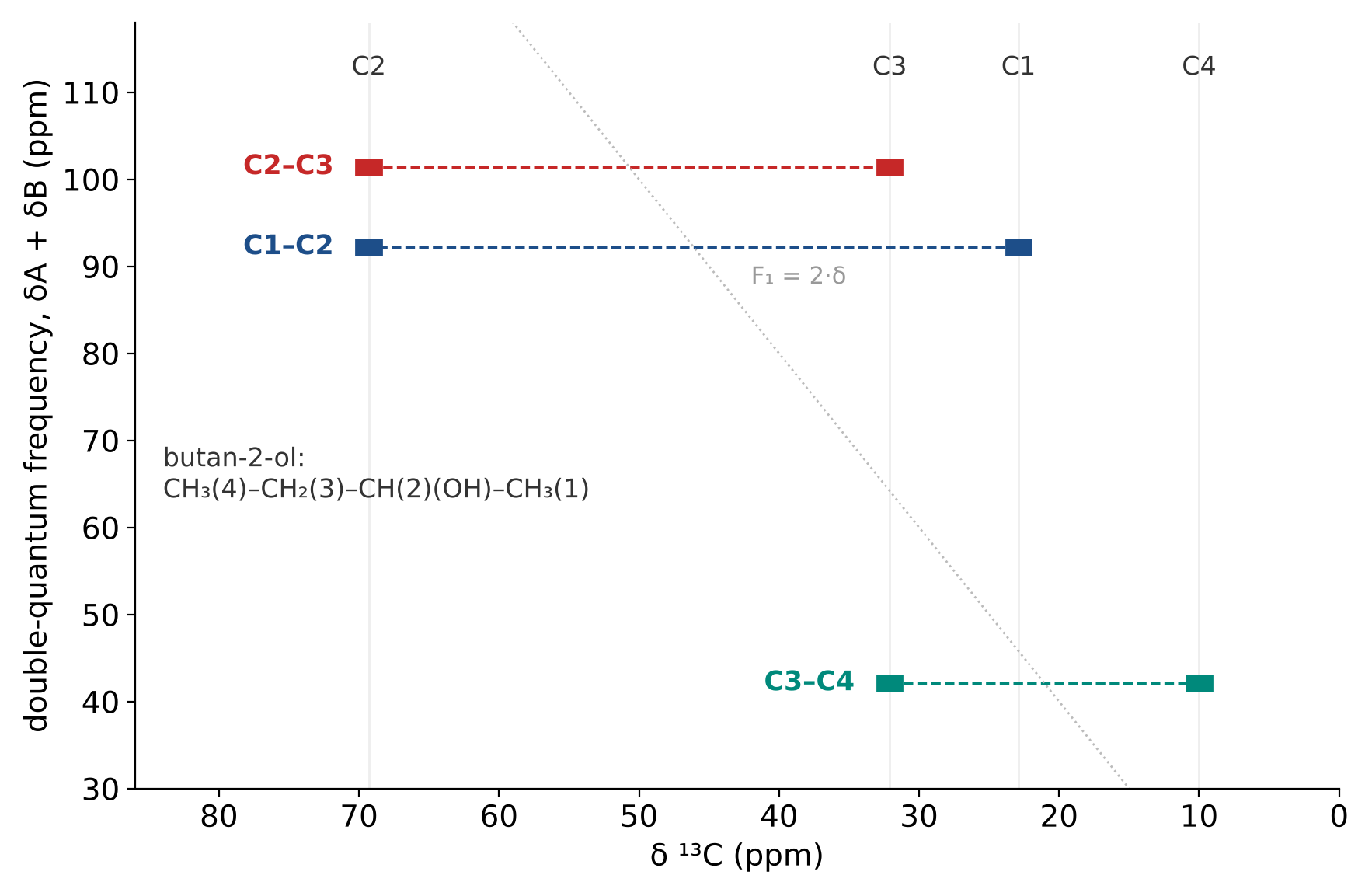
Interpretation is a game of connections: start from one carbon, find the rows it appears in, follow each row to the carbon it is bonded to, and so on. In butan-2-ol, C2 (69.3 ppm) appears in two rows, bonded to C1 (22.9 ppm) and to C3 (32.1 ppm); C3 also appears in a third row, bonded to C4 (10.0 ppm). The chain C1–C2–C3–C4 is established without any assumption.
Two equivalent carbons bonded to each other, such as those of ethane or C1 and C1′ of biphenyl, give no double-quantum signal: their coupling does not show up in the spectrum, just as the coupling between equivalent hydrogens is not seen.
Sensitivity and alternatives
Sensitivity is the big drawback: INADEQUATE usually needs tens or hundreds of milligrams of sample and many hours or days of measurement, although cryogenic probes have made it more accessible. With 13C-enriched compounds, such as those obtained by biosynthesis from labelled precursors, the problem disappears.
A more sensitive alternative is 1,1-ADEQUATE, which detects on 1H, like HSQC, and shows each hydrogen correlated with the carbons bonded to its carbon: unlike HMBC, it only gives two-bond correlations, without ambiguity.