The ¹³C chemical shift
The 13C chemical shift is defined in the same way as for 1H, in ppm relative to TMS, but its scale is about fifteen times wider: from 0 to 220 ppm. It is influenced by the electronegativity of the neighbours and, above all, by hybridization: sp3 carbons appear between 0 and 90 ppm, sp carbons between 65 and 90, and sp2 carbons (alkenes, aromatics and carbonyls) between 100 and 220 ppm.
Parts per million, for carbon too
Everything we saw about the 1H chemical shift applies to 13C. In a field of 1.88 T, 13C resonates at about 20 MHz, a quarter of the 1H frequency. 2-Chloropropane gives two 13C signals, 1082 and 542 Hz above that of TMS. On an 11.7 T instrument (500 MHz for 1H and 125 MHz for 13C), at 6763 and 3388 Hz. Dividing by the spectrometer frequency, in both cases:
1082/20 = 6763/125 = 54.1 ppm (CHCl) 542/20 = 3388/125 = 27.1 ppm (CH3)
To go from ppm to hertz, multiply by the 13C frequency of the spectrometer, not by the 1H one. On a “600 MHz” instrument (14.1 T), 13C resonates at 150.9 MHz, and the two signals of 2-chloropropane are 54.1 × 150.9 = 8164 Hz and 27.1 × 150.9 = 4089 Hz from TMS.
Shielding and electronegativity
As with 1H, the electrons around the nucleus shield it, and anything that withdraws electron density from a carbon deshields it. The effects are, in ppm, about fifteen or twenty times larger.
- The series CH4 (−2.3 ppm), CH3Cl (25.6), CH2Cl2 (54), CHCl3 (77.7) and CCl4 (96 ppm) shows that each chlorine moves the signal by about 25 ppm.
- An electronegative substituent mainly affects the carbon it is bonded to (α effect) and somewhat less the next one (β effect). In 1-chloropropane: CH2Cl at about 47 ppm, central CH2 at about 26 and CH3 at about 11.5 ppm.
- There are curious exceptions. Iodine, a large atom with many electrons, shields the carbon it is bonded to: CH3I appears below 0 ppm, at about −20 ppm (the “heavy atom” effect).
- A substituent three bonds away that is close in space (in a gauche relationship) shields the carbon by a few ppm: this is the γ effect, very useful for distinguishing axial and equatorial substituents on rings.
Hybridization
Look at the spectra of benzene and chloroform. Why does the benzene carbon appear at 128.4 ppm, much further left than that of chloroform (77.7 ppm), when it has no electronegative atoms?
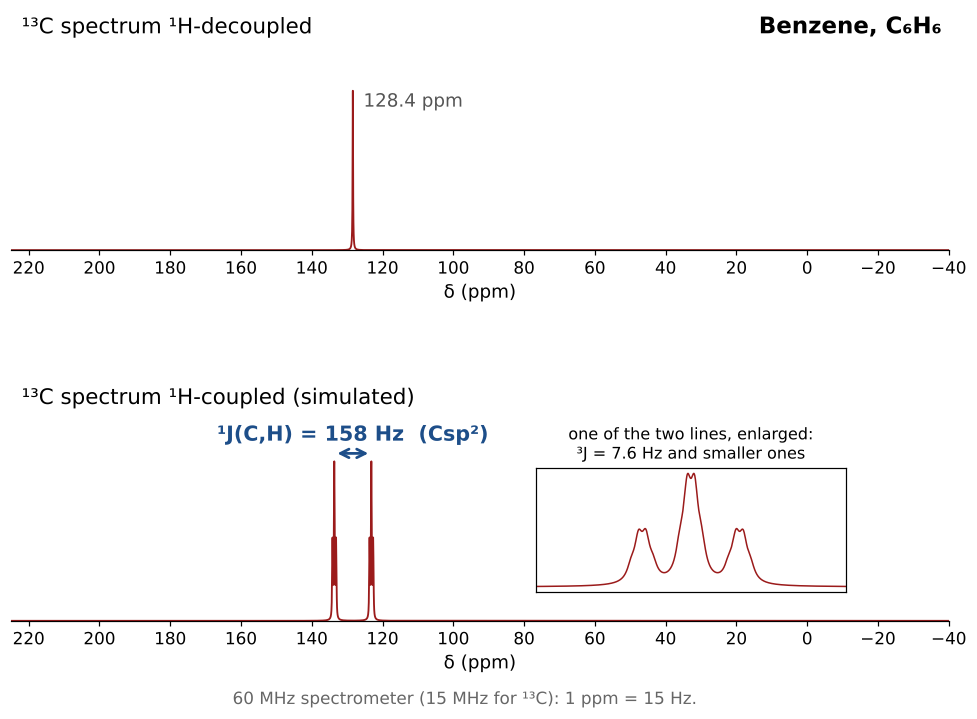
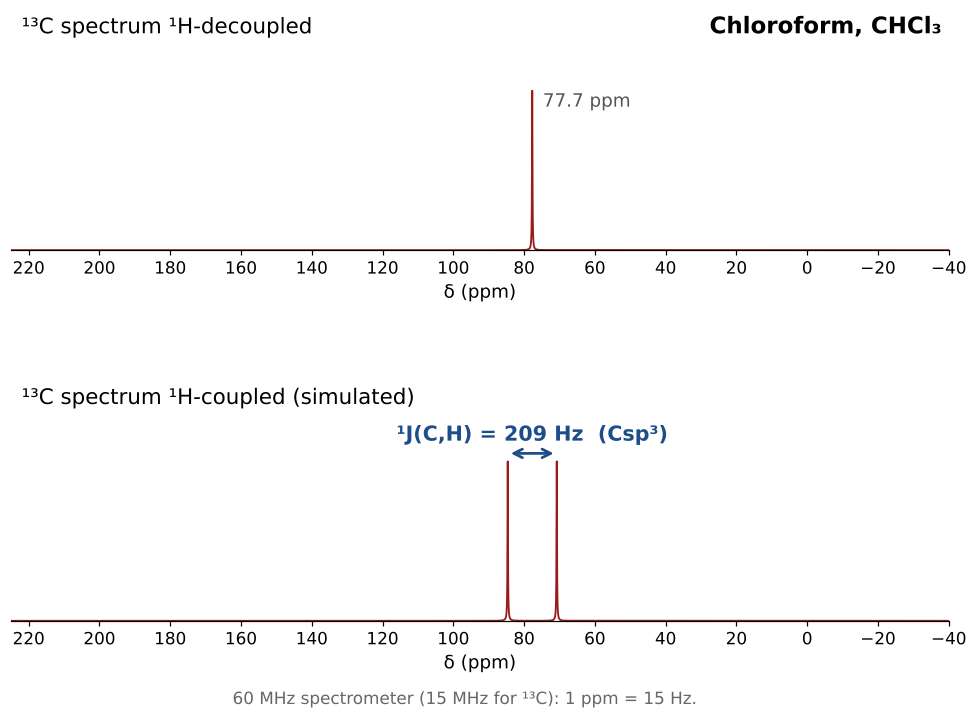
Look also at the coupled spectra. The 1JCH of benzene, an sp2 C, is 158 Hz, larger than that of an ordinary sp3 C such as that of methane (about 125 Hz), because the C-H bond has more s character. That of chloroform, 209 Hz, is larger still even though its carbon is sp3: the three highly electronegative chlorines also increase the s character of the C-H bond. You will see this in more detail in C-H couplings.
For 1H we explained the benzene hydrogens by the ring current. For 13C that current also exists, but it only moves the signals by one or two ppm, little on a 220 ppm scale. What dominates for carbon is hybridization. In an sp2 carbon, the electrons of the π orbitals and the nearby excited levels create, in the magnetic field, a contribution that strongly deshields the nucleus. That is why the sp2 carbons of alkenes, aromatic rings and, even more, carbonyl groups, where the effect of the oxygen is added, appear on the left of the spectrum. The sp carbons of alkynes lie in an intermediate region, between 65 and 90 ppm.
Why do sp carbons not follow the sp3-sp2 series and appear even further left? The contribution that deshields sp2 carbons so strongly arises because the field mixes occupied orbitals with empty orbitals close in energy (for example, σ and π* in a C=C, or n and π* in a C=O). It is larger the smaller that energy gap and the more asymmetric the distribution of electrons around the nucleus. In the triple bond, the two perpendicular π clouds form a cylinder of electrons that is symmetric about the axis, and the empty orbitals lie further away in energy: that contribution is much smaller. In addition, when the bond axis is aligned with the field, the cylindrical cloud circulates around it and creates an induced field that shields the nuclei lying on the axis; it is the same anisotropic effect that makes acetylenic hydrogens appear at only 2-3 ppm in 1H. For both reasons, sp carbons lie between sp3 and sp2 carbons.
The regions of the 13C spectrum
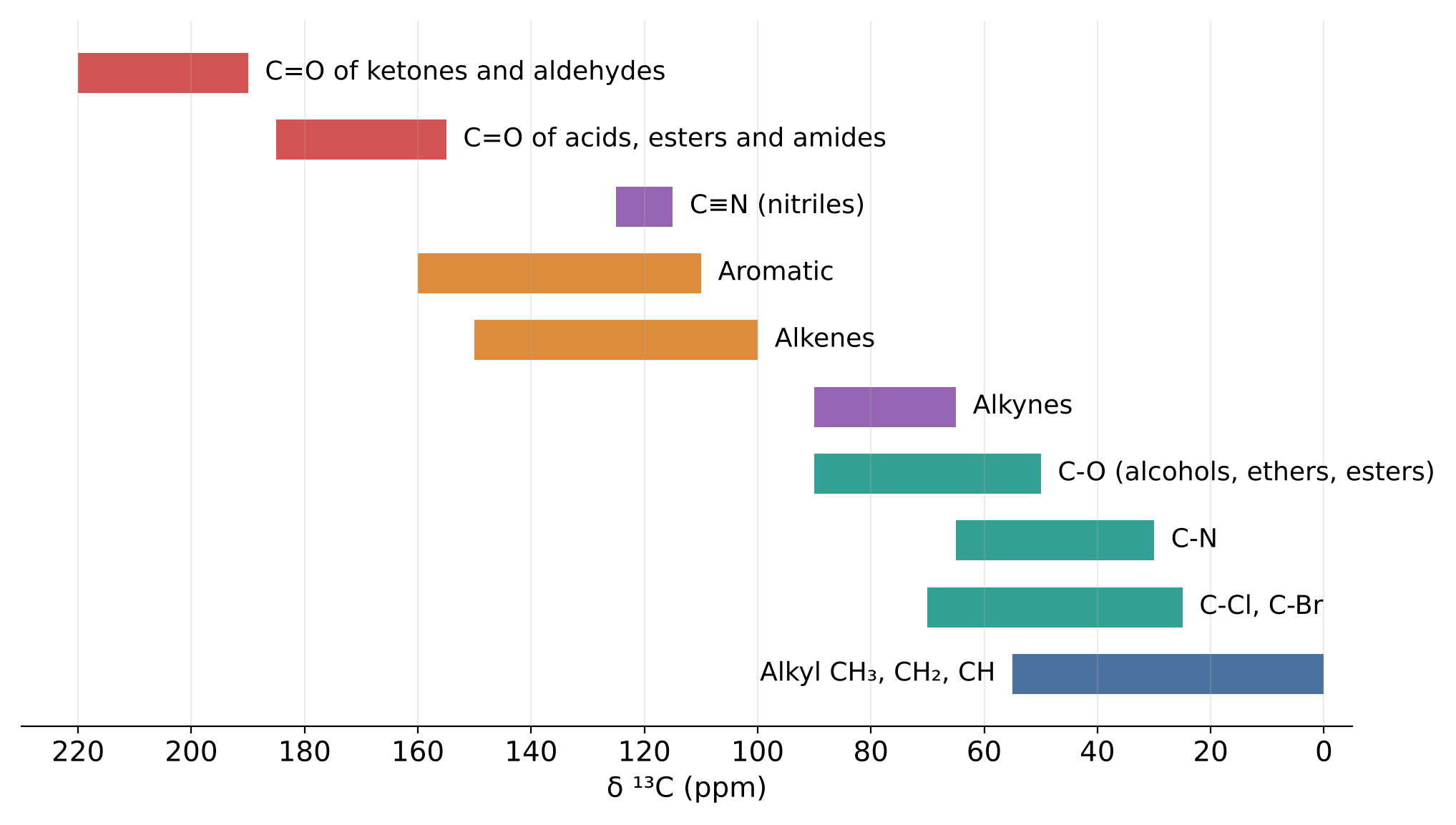
A useful trick: the 13C regions are in the same order as the 1H ones, each on its own scale. For a carbon bearing hydrogens, its δC is roughly fifteen to twenty times the δH of its hydrogens: a CH3 at 1 ppm in 1H appears at about 15-30 ppm in 13C; an OCH3 at 3.7 ppm, at about 50-60; an aromatic CH at 7.3 ppm, at about 128; and a CHO at 9.8 ppm, at about 200 ppm. 1H-13C correlation spectra will take advantage of this.
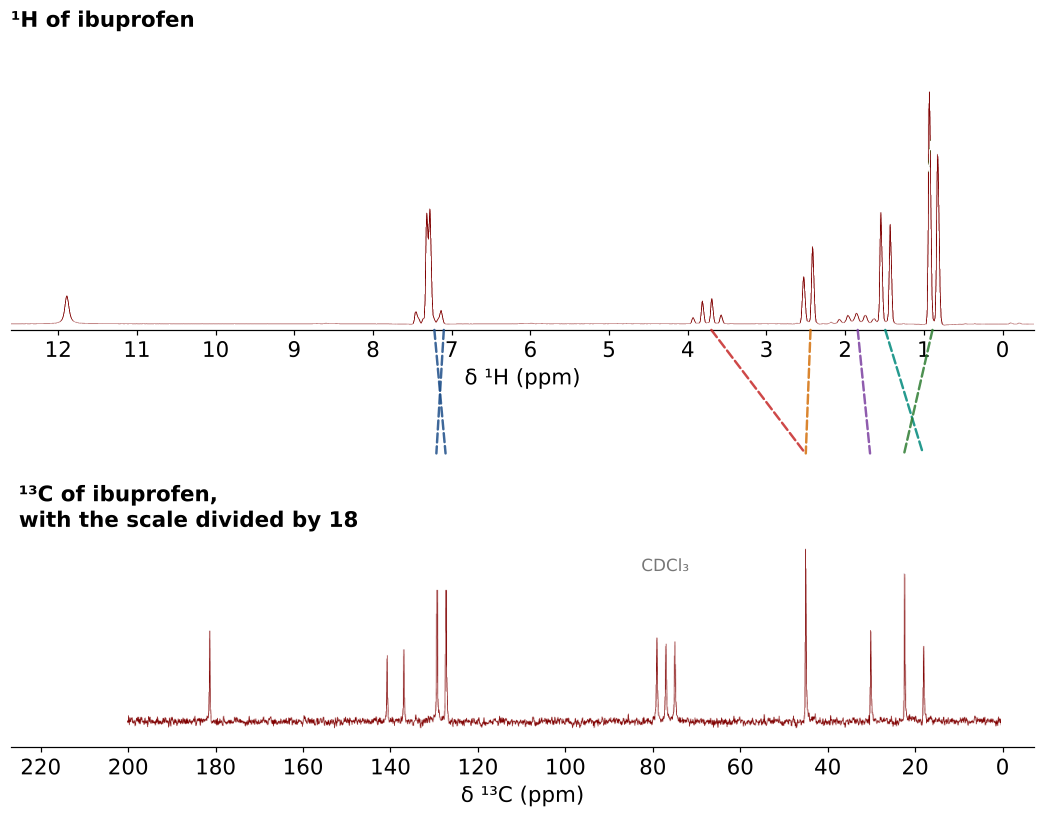
Carbons without hydrogens have no counterpart in 1H, and that is exactly where 13C contributes most: the carbonyl of a ketone (200-220 ppm) is easily told from that of an ester or amide (165-175 ppm), and a quaternary sp3 carbon bonded to an oxygen (70-90 ppm) is seen even though it has no hydrogen to give it away.