
Factors that affect the chemical shift
The electrons around each nucleus create a small magnetic field that opposes the external one: they shield it. Anything that withdraws electron density from a hydrogen (electronegative atoms) deshields it and raises its δ. In addition, the electrons of multiple bonds and aromatic rings create local fields (anisotropy), and hydrogen bonds and the solvent move the signals of OH and NH groups.
Each hydrogen feels a different field
If the 1H of a molecule resonate at different frequencies and the magnet's field is the same for all of them, then they do not all “feel” the same field. Why? Because of the electron density around them, which is not the same for all.
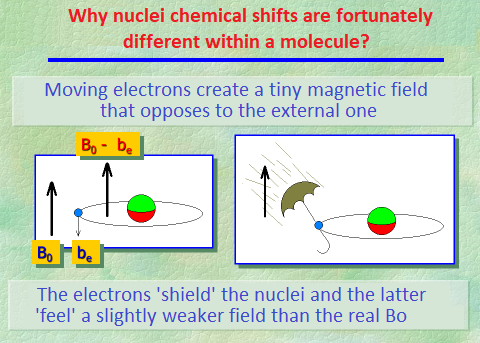
Electrons are charged particles moving around the nucleus. The external field B0 induces in them a circulation that creates a small field, be, opposed to B0. The nucleus feels an effective field somewhat smaller than the real one, as if the electrons were an umbrella:
Beffective = B0 − be = B0(1 − σ)
where σ is the shielding constant. The lower the electron density around a hydrogen, the larger the field it feels, the larger the separation between its levels and the higher the frequency at which it resonates: it appears at higher δ.
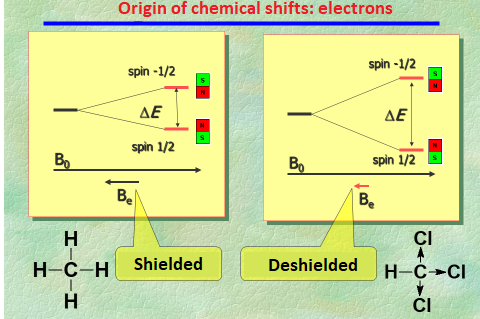
The nuclei are the main actors in the NMR “film”, but it is their “electronic clothing” that makes them shine on the left or on the right of the stage. Light clothing means less shielding and a higher δ (on the left); “winter” clothing means more shielding and a lower δ (on the right).
Electronegativity
The electron density around a hydrogen depends on the neighbouring atoms and, above all, on their electronegativity, the ability of an atom to attract the electrons of its bonds. In 2-chloropropane, CH3CHClCH3, the chlorine attracts the electrons of the C-Cl bond and depletes the CH group, whose hydrogen appears at 3.97 ppm; the CH3 groups, further away, are depleted less and appear at 1.55 ppm. This is the electron-withdrawing inductive effect.
| Compound | Pauling electronegativity (X) | δ of the CH3 (ppm) |
|---|---|---|
| CH3F | 3.98 (F) | 4.26 |
| CH3OH | 3.44 (O) | 3.39 |
| CH3Cl | 3.16 (Cl) | 3.05 |
| CH3Br | 2.96 (Br) | 2.68 |
| CH3I | 2.66 (I) | 2.16 |
| CH4 | 2.20 (H) | 0.23 |
| Si(CH3)4 | 1.90 (Si) | 0.00 |
The effect has two features that we already saw in the preliminary examples:
- It is additive. Each extra chlorine moves the signal by about 2 ppm: CH4 0.23; CH3Cl 3.05; CH2Cl2 5.30; CHCl3 7.26 ppm.
- It fades with distance. In 1-chloropropane, ClCH2CH2CH3, the CH2Cl (H and Cl two bonds apart) appears at 3.5 ppm, the central CH2 (H and Cl three bonds apart) at 1.8 and the CH3 (H and Cl four bonds apart) at 1.0 ppm. Beyond three bonds the effect is already very small.
The anisotropy of π electrons
Look at the spectra of benzene and chloroform. Why do the hydrogens of benzene appear at practically the same chemical shift as that of chloroform, when benzene contains no electronegative atom?
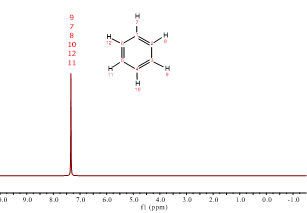
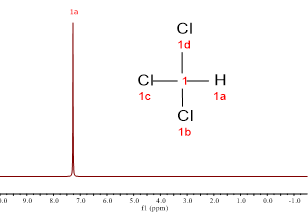
The electrons are again responsible, but now they act together. The six π electrons of benzene move freely around the ring. In the field B0, they circulate like an electric current in a loop (the ring current, one of the manifestations of aromaticity), which creates a local magnetic field. That field opposes B0 above and below the ring, but reinforces it at the periphery, exactly where the hydrogens are. They feel a somewhat larger field and resonate at higher frequencies: 7.3 ppm.
Is this not a contradiction? If the field felt by the hydrogens of benzene is larger, why do their signals appear on the left, “downfield”? Because “downfield” does not refer to the field the nucleus feels, but to the field that had to be applied in the old continuous-wave instruments, which worked at a fixed frequency and swept the field. A deshielded hydrogen, or one reinforced by a local field like these, reaches resonance sooner, while the applied field is still low. In today's instruments, with a fixed field, the same hydrogen resonates at a higher frequency. Both descriptions say the same thing: left, high δ, high frequency, “downfield” and deshielded are synonyms.
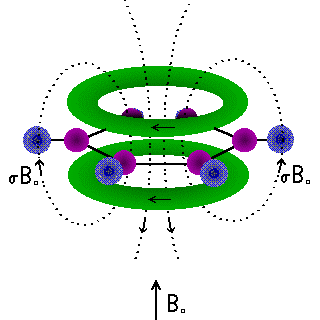
The effect depends on the orientation relative to the π group, which is why it is called magnetic anisotropy. It divides space into shielding (+) and deshielding (−) cones:
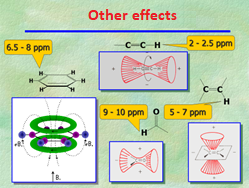
- Alkenes (4.5-6.5 ppm): the hydrogen lies in the plane of the double bond, in the deshielded region.
- Aldehydes (9-10 ppm): two effects add up, the electronegativity of the oxygen and the anisotropy of the C=O.
- Terminal alkynes (1.8-3.1 ppm): the exception. The circulation of the π electrons around the axis of the triple bond places the hydrogen, which lies on that axis, in the shielded region. Acetylene appears at 1.9 ppm, much further right than ethylene (5.3 ppm).
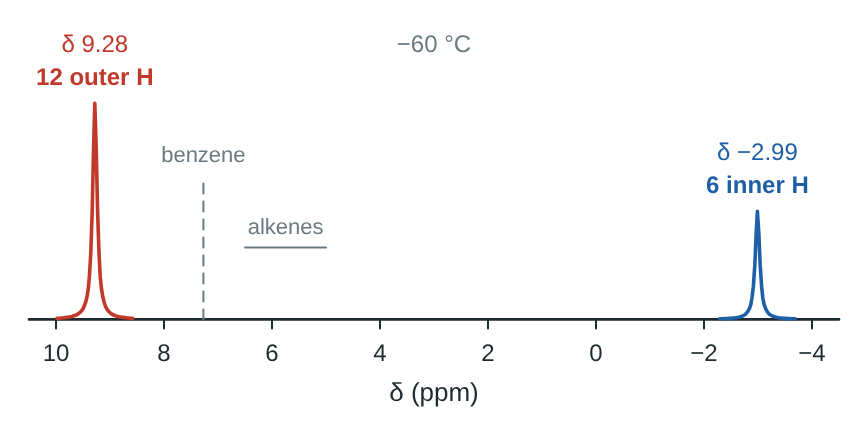
The most spectacular proof of the ring current is [18]annulene, an 18-carbon aromatic ring: its twelve outer hydrogens appear at 9.3 ppm and the six pointing into the ring, in the shielded region, at −3.0 ppm, to the right of TMS. NMR is an experimental criterion of aromaticity; review aromaticity in La Química Orgánica Transparente. Its spectrum and 3D model are studied in detail in Advanced Organic Chemistry.
Hydrogen bonds
Hydrogens bonded to oxygen or nitrogen (OH, NH) form hydrogen bonds, which deshield them. Since the extent of hydrogen bonding depends on concentration, temperature and solvent, their signals are variable:
- The OH of an alcohol can appear anywhere between 1 and 5 ppm; in dilute solution, with less hydrogen bonding, it moves to the right.
- These hydrogens exchange with other molecules, and their signals are usually broad and show no couplings.
- If a drop of D2O is added to the tube and shaken, the OH or NH is exchanged for OD or ND and its signal disappears from the spectrum. It is a simple test to recognize them.
- Strong hydrogen bonds move them far to the left: the COOH of carboxylic acids, which form dimers, appears between 10 and 13 ppm; the OH of salicylaldehyde, with an intramolecular hydrogen bond to the C=O, at about 11 ppm, and the enolic OH of acetylacetone at about 15.5 ppm.
The models are built with typical bond lengths and angles; they are not calculated geometries. Rotate them with the mouse: the three molecules are planar and the hydrogen bond closes an eight-membered ring (dimer) or a six-membered ring (salicylaldehyde and acetylacetone). The effect of these hydrogen bonds on the IR spectrum is shown in topic 3.
The solvent
The solvent also affects the chemical shift, especially for groups that form hydrogen bonds.
- In CDCl3, the most common solvent, the OH groups of alcohols usually give broad signals whose position varies with concentration. The higher the concentration, the greater the chance of intermolecular hydrogen bonding and the further the shift to the left. In many cases the signal becomes so broad that it cannot be seen.
- DMSO-d6 is an excellent hydrogen-bond acceptor through its oxygen. That is why the signals of alcohols appear further left (at about 4-5.5 ppm). In addition, because the OH binds strongly to the solvent, exchange slows down and the hydrogens of the OH groups stay in place. As a result, the signals are sharper and split by the neighbouring hydrogens, because the OH hydrogens bonded to DMSO-d6 have time to “see” their molecular surroundings.
- Aromatic solvents, such as C6D6, shift some signals by up to half a ppm through their own anisotropy. This is sometimes used to separate signals that coincide in CDCl3.
That is why, when comparing a spectrum with a published one, it is essential to check the solvent in which both were recorded.