Some preliminary examples
13C spectra are like 1H spectra in the essentials: each different carbon gives a signal, and its chemical shift depends on its environment. But there are three differences: the scale runs from 0 to about 220 ppm, they are always recorded decoupled from the hydrogens (all the signals are singlets) and they are not integrated.
A scarce nucleus
Remember that the NMR-active isotope of carbon is 13C, with a natural abundance of 1.1 %. That is a big difference from hydrogen: we “lose” 98.9 % of the carbons, which are 12C. In addition, the gyromagnetic ratio of 13C is a quarter of that of 1H, which makes it intrinsically less sensitive. Altogether, for the same number of nuclei, the 13C signal is about 5700 times weaker than that of 1H. That is why more sample or more time is needed; even so, 13C spectra are routine today.
| Nucleus | I | Natural abundance (%) | γ (106 rad s−1 T−1) | Frequency at 9.4 T (MHz) | Receptivity relative to 1H |
|---|---|---|---|---|---|
| 1H | ½ | 99.99 | 267.5 | 400.0 | 1 |
| 13C | ½ | 1.07 | 67.3 | 100.6 | 1.7·10−4 |
The full table, with other nuclei, is in topic 9.
The chloromethanes, coupled and decoupled
Look at the 13C spectra of the same four molecules we studied in 1H NMR: CH4, CH3Cl, CH2Cl2 and CHCl3. There are two spectra of each. What do you notice?
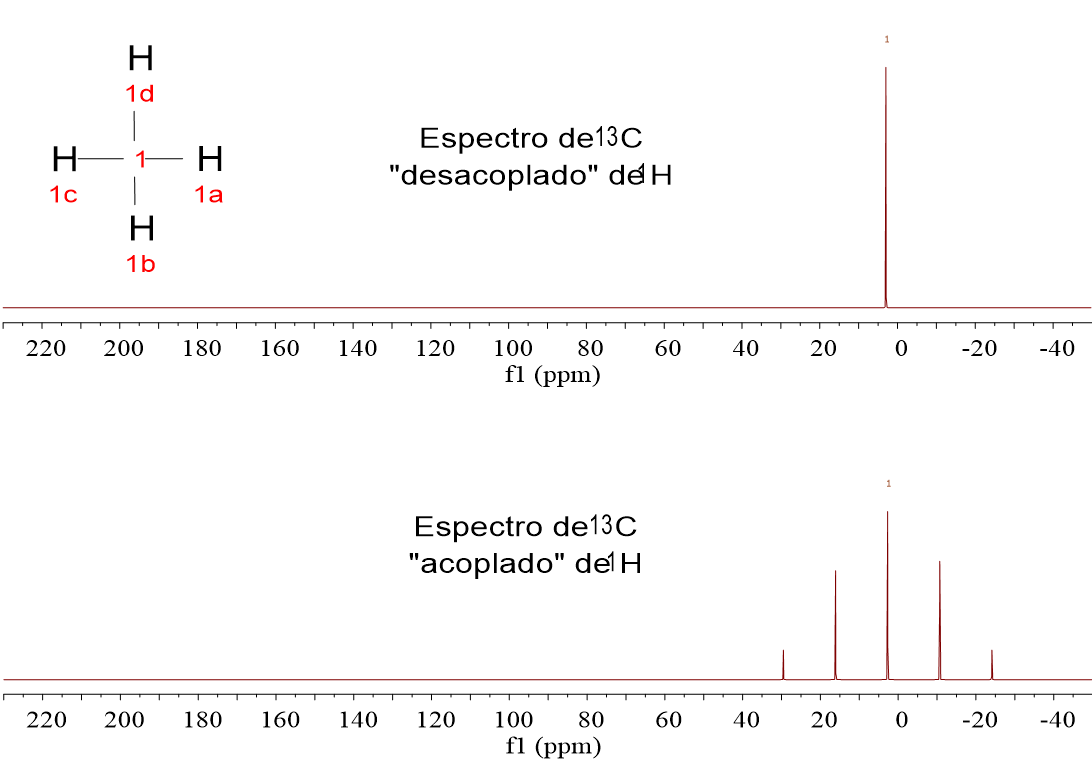
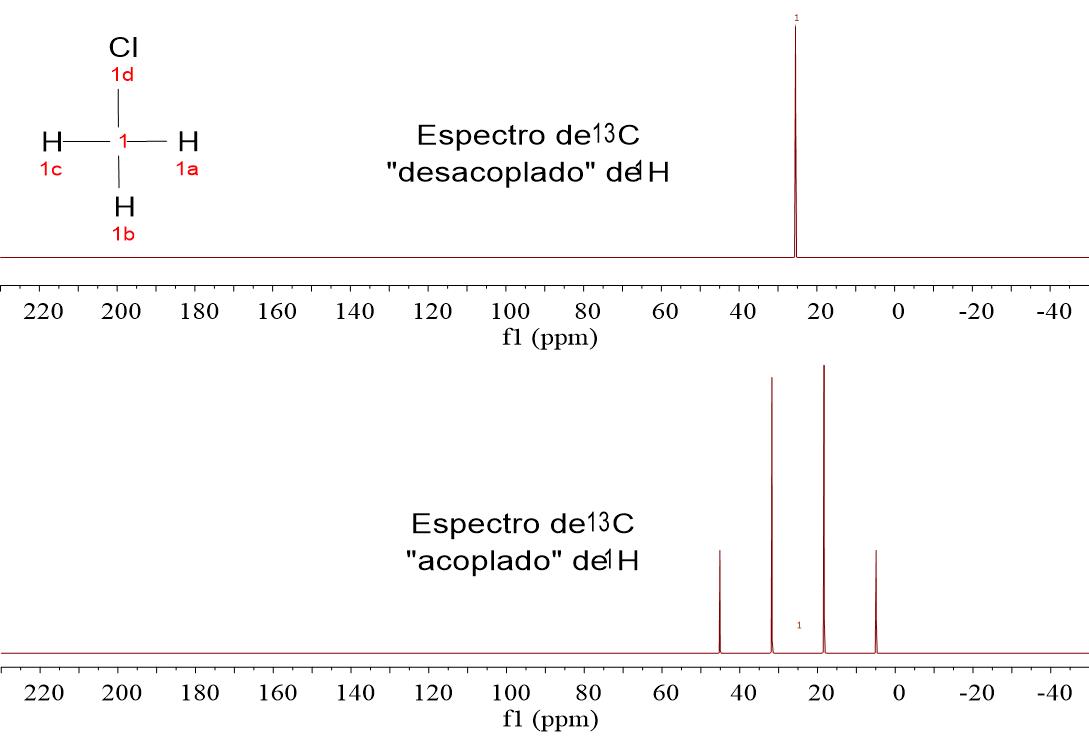
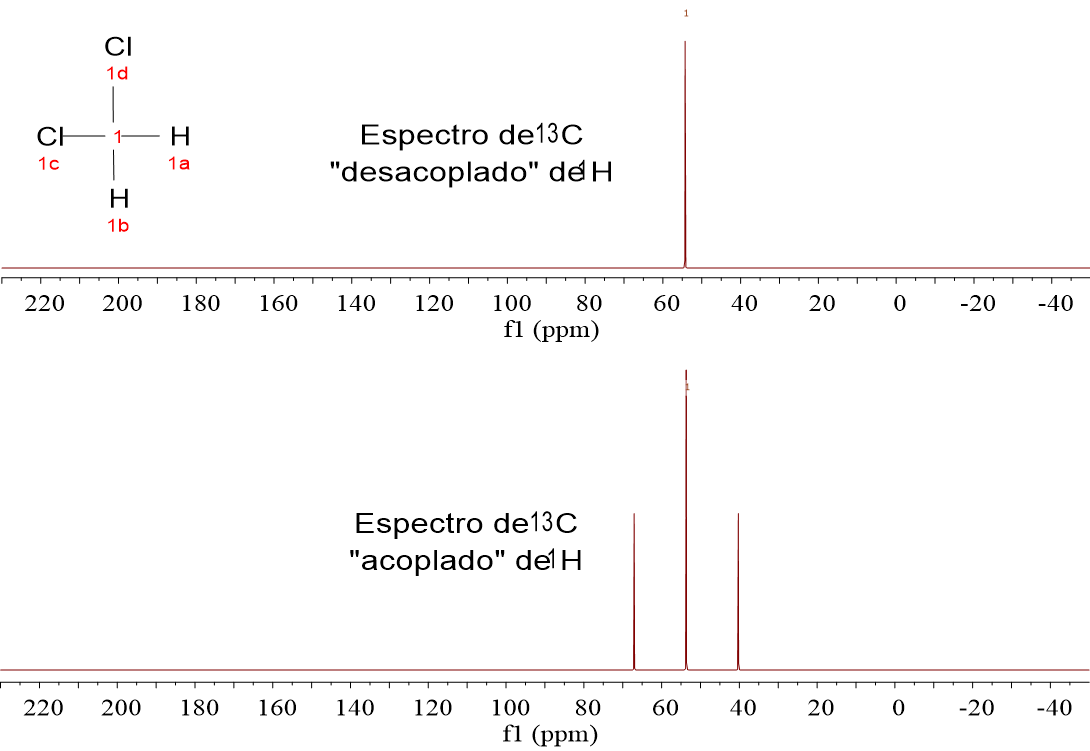
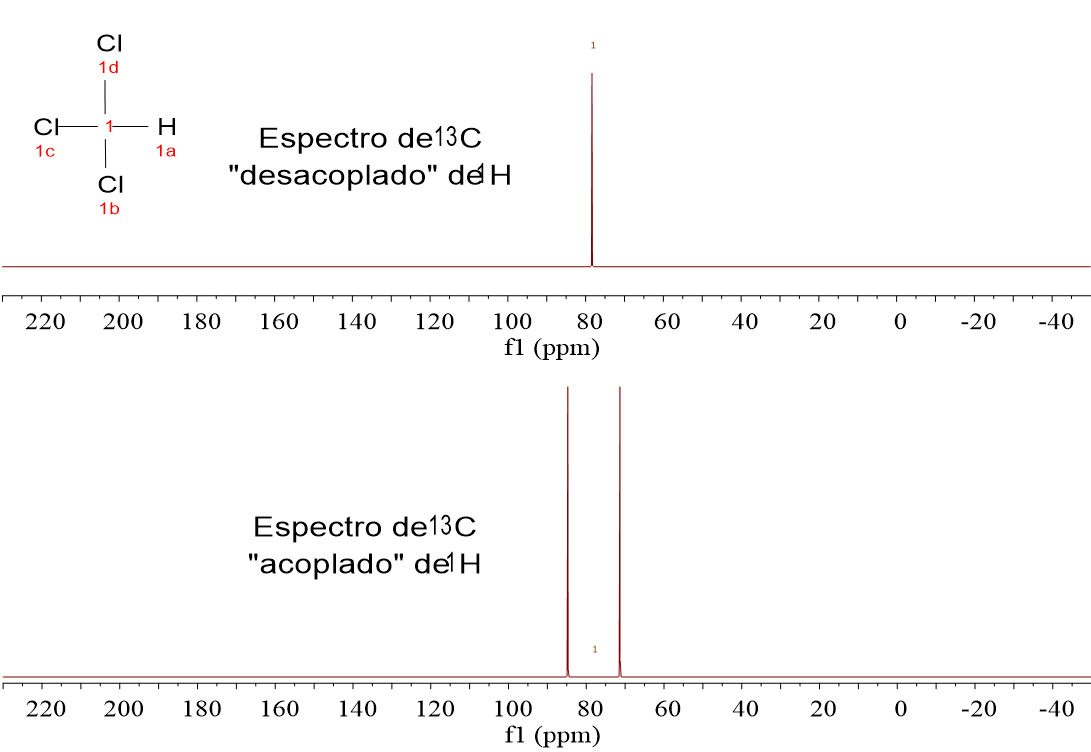
The lower spectra were recorded “without doing anything”: the 13C appears as a quintet for CH4, a quartet for CH3Cl, a triplet for CH2Cl2 and a doublet for CHCl3. Doesn't that remind you of the N + 1 rule? Who supplies the N? The 1H. In the 1.1 % of molecules that contain 13C, that carbon is surrounded by hydrogens, which are 100 % 1H, and magnets interact with each other even when they are different nuclei. The one-bond 13C-1H coupling, 1JCH, is large: about 125 Hz in methane.
The upper spectra are recorded while irradiating all the hydrogens at the same time, so that the carbon no longer “sees” them: this is decoupling. Each carbon gives a single singlet.
13C spectra are always recorded decoupled from 1H. This simplifies them, and the signal of each carbon, instead of being shared among several lines, is concentrated in one, which is very welcome with such a scarce nucleus. Decoupling also increases it through the NOE, as we will see in the intensity of the signals.
The complete series
We add CCl4 to the series. Look at the decoupled spectra.
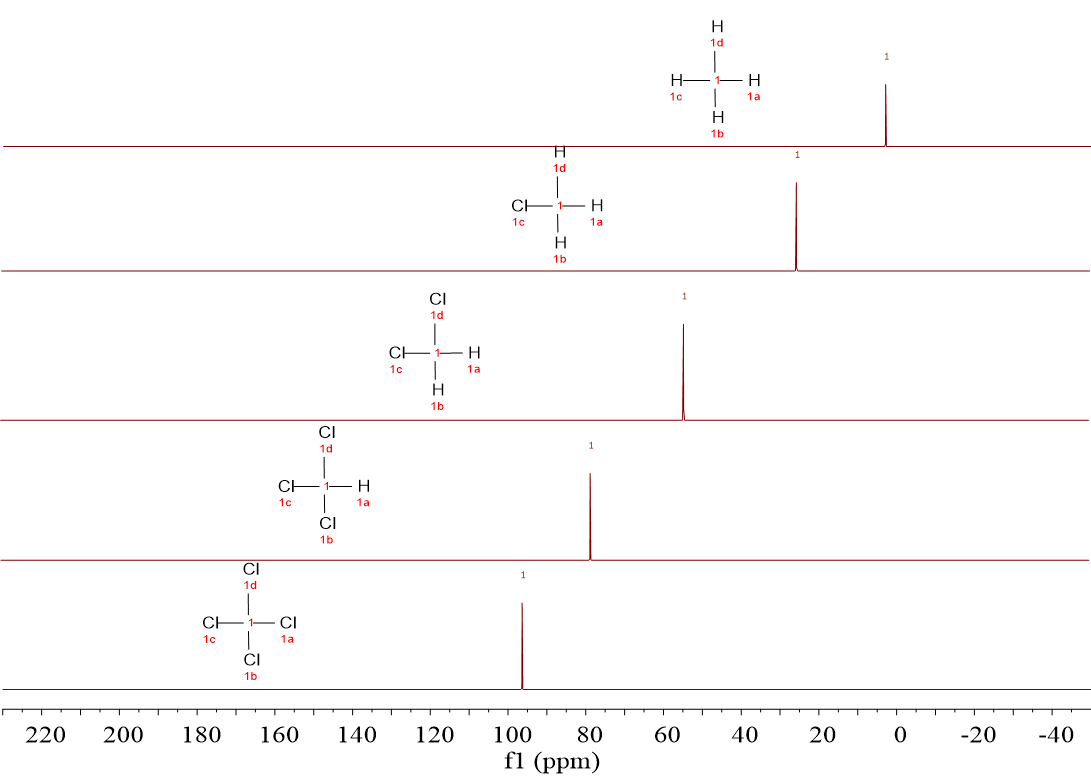
The first thing that stands out is the scale: instead of tens of ppm, it spans hundreds. The signals go from −2.3 ppm (CH4) to 96 ppm (CCl4), through 25.6 (CH3Cl), 54 (CH2Cl2) and 77.7 ppm (CHCl3). As the number of chlorines increases, the signal moves to the left, just as in 1H. On average, each Cl shifts the 1H by about 2.3 ppm, whereas it moves the 13C by about 25 ppm, almost ten times more. This makes sense, because the chlorines are bonded directly to the 13C and so have a more direct effect on its electron density.
You have just rediscovered the first criterion: 13C nuclei resonate at different chemical shifts depending on the nature of the atoms around them.
1- and 2-chloropropane
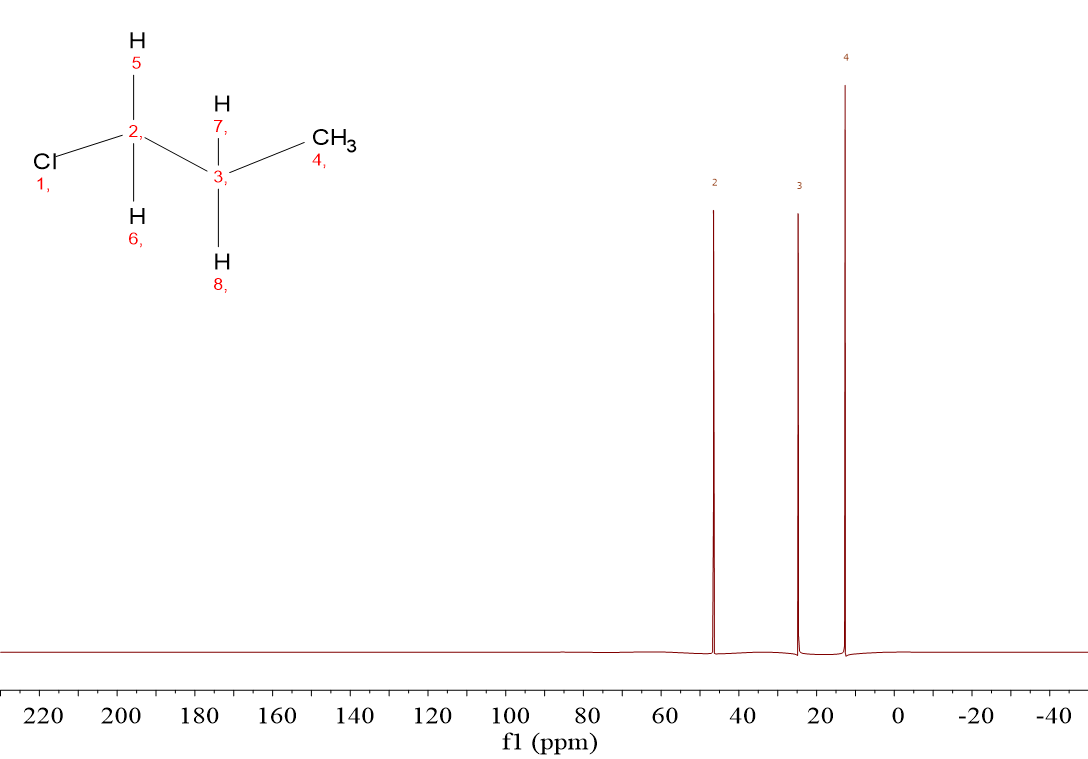
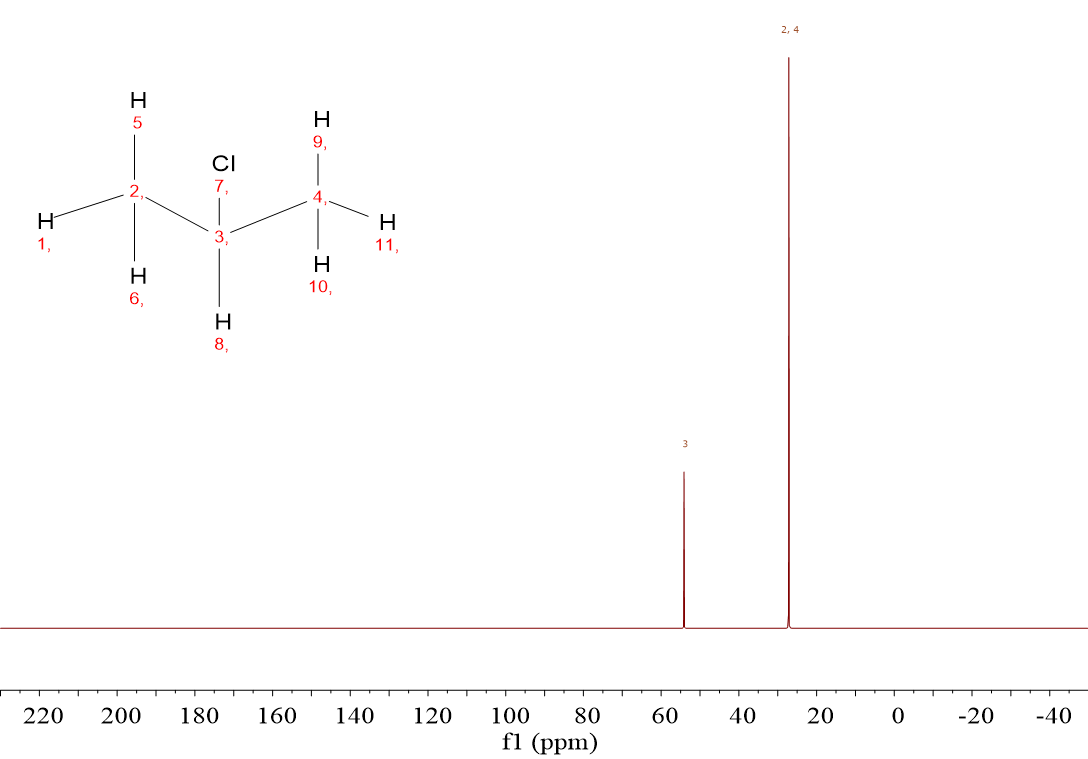
What strikes you? Make a list before reading on.
- Each spectrum has more than one signal: three in 1-chloropropane, with its three different carbons, and two in 2-chloropropane, whose two CH3 are equivalent.
- The integrals have not been measured.
- The chemical shifts depend on the closeness to the chlorine.
- All the signals are singlets.
In 1-chloropropane, the signals appear at about 47, 26 and 11.5 ppm: the CH2Cl, bonded to the chlorine, the central CH2 and the CH3, the furthest away. In 2-chloropropane, the CHCl appears at about 54 ppm and the two CH3 at about 27 ppm. As in 1H, closeness to the chlorine raises the chemical shift, although on a much wider scale.
No integrals and no shape
Why are they not integrated? Because in 13C the intensity of a signal is not proportional to the number of carbons producing it. In 2-chloropropane, the signal of the two equivalent CH3 is more intense than that of the CHCl, but not exactly twice as much. This is explained on the page on intensity.
And the shape of the signals tells us nothing, because they are all singlets. That is a drawback: if each carbon showed its multiplet, we would know whether it is a CH3 (quartet), a CH2 (triplet), a CH (doublet) or a carbon without hydrogens (singlet). But in complex molecules the multiplets would overlap and the sensitivity would be even lower. There are better ways of obtaining that information, such as the DEPT experiment.