
Isotopes and their magnetic properties
Almost every element has an NMR-active isotope, but they are not all equally easy to observe. What matters is the spin quantum number I, the natural abundance and the gyromagnetic ratio γ. The ratio sets the frequency at which each isotope resonates. The sensitivity depends on γ3 and on the abundance.
Which isotopes are active
A nucleus is NMR-active if its spin quantum number I is not zero. The practical rule is simple:
- If the numbers of protons and neutrons are both even, I = 0 and the nucleus is not active. This is the case for 12C, 16O and 32S, the main isotopes of those elements. That is why "ordinary" carbon and oxygen give no signal.
- If either number is odd, I ≠ 0 and the nucleus is active. It may have I = ½ (1H, 13C, 15N, 19F, 29Si, 31P) or more (2H and 14N with I = 1, 11B with 3/2, 17O with 5/2).
Nuclei with I = ½ are the convenient ones: their signals are sharp and their couplings follow the n + 1 rule we saw in topic 7. Those with I > ½ also have a quadrupole moment, discussed below.
Each isotope, a radio station
In a magnetic field B0, each nucleus resonates at a frequency proportional to its gyromagnetic ratio:
ν = γ B0 / 2π
As each isotope has its own γ, in the same magnet each one resonates at a different frequency, far from the others. It works like a radio: the spectrometer "tunes in" to the station of the nucleus we want to observe and does not hear the others. That is why we can record a 13C spectrum without 1H getting in the way, and vice versa.
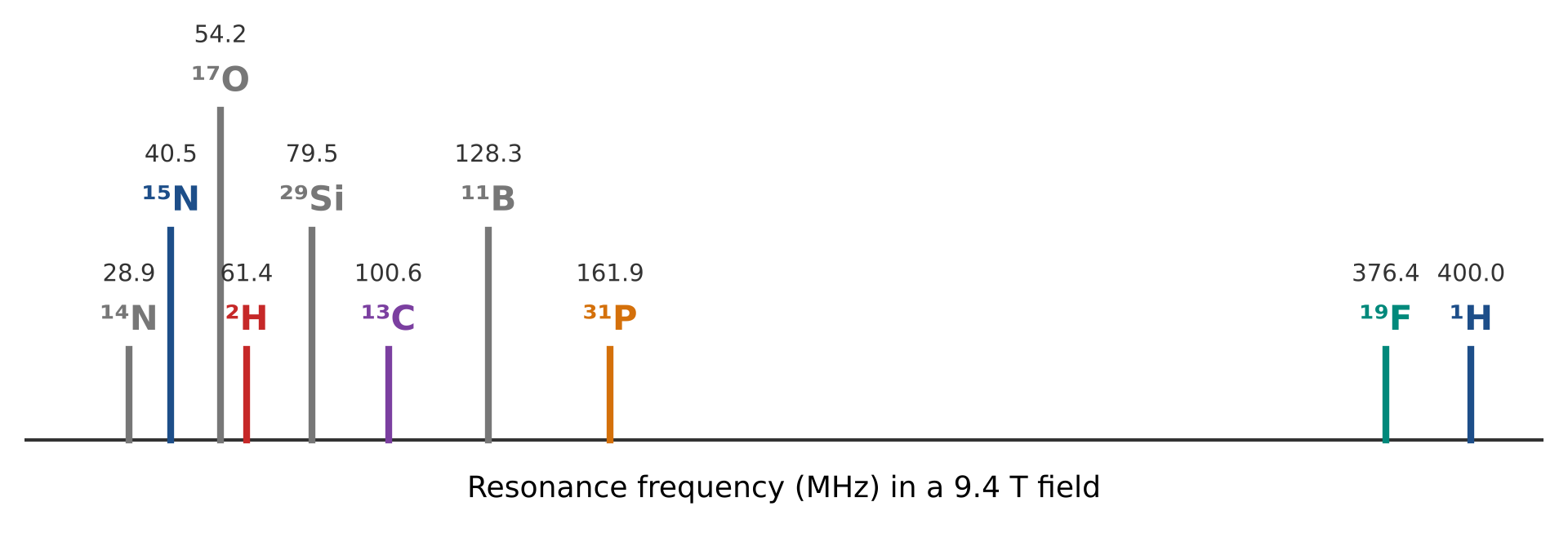
Tuning in to each station has a cost. The coils of the probe, which surround the tube, are the antennas that send the pulses and pick up the signal. Each one forms a circuit that must be tuned and matched to the frequency of the nucleus, and a coil adjusted to 400 MHz is useless at 100 MHz. That is why probes have several channels: one for 1H, a broadband one that can be tuned to any nucleus between 15N and 31P, and another for the 2H of the lock; every time the nucleus is changed the probe must be retuned, which modern instruments do automatically. Each channel also needs its own frequency synthesizer, power amplifier and preamplifier, and observing 13C while decoupling 1H requires two channels working at once. 19F is a special case: its frequency is so close to that of 1H (376 versus 400 MHz) that observing one while decoupling the other requires special probes and filters. At the other end, nuclei with a small γ, such as 15N, resonate at low frequencies: they need longer pulses, induce a weaker signal in the coil and suffer from problems such as acoustic ringing of the probe, which distorts the start of the FID. And cryoprobes, which cool the coil and preamplifier to reduce noise, are usually optimized for 1H and 13C.
To work out the frequency of a nucleus, just multiply the 1H frequency by the ratio of their gyromagnetic ratios. For example, in a 1.88 T magnet, where 1H resonates at 80 MHz:
ν(13C) = 80 MHz × (67.28 / 267.52) = 80 × 0.2515 ≈ 20.1 MHz
The sign of γ gives the direction of precession. It is negative, for example, for 15N and 29Si, and this has consequences for the NOE, as we will see in the nitrogen section.
Properties of the most useful nuclei
| Nucleus | I | Natural abundance (%) | γ (106 rad s−1 T−1) | Frequency at 9.4 T (MHz) | Receptivity relative to 1H |
|---|---|---|---|---|---|
| 1H | ½ | 99.99 | 267.5 | 400.0 | 1 |
| 2H | 1 | 0.012 | 41.1 | 61.4 | 1.1·10−6 |
| 11B | 3/2 | 80.1 | 85.8 | 128.3 | 0.13 |
| 13C | ½ | 1.07 | 67.3 | 100.6 | 1.7·10−4 |
| 14N | 1 | 99.6 | 19.3 | 28.9 | 1.0·10−3 |
| 15N | ½ | 0.37 | −27.1 | 40.5 | 3.8·10−6 |
| 17O | 5/2 | 0.038 | −36.3 | 54.2 | 1.1·10−5 |
| 19F | ½ | 100 | 251.8 | 376.4 | 0.83 |
| 29Si | ½ | 4.7 | −53.2 | 79.5 | 3.7·10−4 |
| 31P | ½ | 100 | 108.4 | 161.9 | 0.066 |
Not all nuclei are heard equally well
Suppose we have a mole of hydrogen and a mole of carbon. Will they give equally intense signals? No, for two reasons that multiply:
- Natural abundance. Almost all hydrogen is 1H, but only 1.07 % of carbon is 13C. For this reason alone the 13C signal is about 93 times weaker.
- Gyromagnetic ratio. The signal intensity grows roughly as γ3. Since (267.5 / 67.3)3 ≈ 63, 13C is another 63 times less sensitive.
Altogether, 93 × 63 ≈ 5900: for the same number of atoms, 13C is about 6000 times harder to detect than 1H. This is the receptivity in the last column of the table (1.7·10−4). That is why a 13C spectrum needs more sample or more time, and why all the sensitivity tricks we saw in topic 8 are used.
The table makes the situation clear. 19F and 31P, with 100 % abundance and I = ½, are almost as easy as 1H. 15N, with a receptivity of 4·10−6, is almost impossible to observe directly at natural abundance.
That is why, when 15N (or 13C) is needed at a specific position, isotopic labelling is used: the molecule is prepared enriched in that isotope, often above 98 %. For proteins this is relatively simple, because it is enough to grow the bacteria that produce them in a medium whose only nitrogen source is 15NH4Cl. For small molecules it is much harder. A synthesis must be designed that introduces the labelled atom at the right step, starting from a few commercial precursors (15NH4Cl, K15NO3, 15N-phthalimide…) that are expensive; every step with an incomplete yield makes the product more expensive, and sometimes the usual route is no good because it introduces the nitrogen too early, so another one has to be devised. That is why labelling is reserved for studies of biosynthesis, reaction mechanisms or drug metabolism, where the information justifies the effort. Something similar happens with deuterium, as we will see in the deuterium section.
Quadrupolar nuclei
Nuclei with I > ½ do not have a spherical charge distribution. This quadrupole moment interacts with the electric field gradients in the molecule and makes the nucleus relax very quickly. There are two consequences:
- The signals of the nucleus itself are broad, sometimes so broad that they cannot be told apart from the baseline. The larger the quadrupole moment, the worse.
- Couplings to its neighbours are usually averaged out or only broaden their signals. That is why amide NH protons, bonded to 14N, often appear as broad signals in the 1H spectrum. It is also why we hardly ever see couplings to chlorine or bromine, which are quadrupolar too.
2H is a welcome exception: its quadrupole moment is very small and it gives reasonable spectra. When it couples to other nuclei, the number of lines does not follow the n + 1 rule but the more general 2nI + 1 rule. We will see it in the deuterium section.
To choose which nucleus to observe, look at I (½ is ideal), the abundance and γ. These three numbers tell you the frequency at which it resonates and whether its spectrum will be easy, hard or nearly impossible.