
Interaction with radio frequency
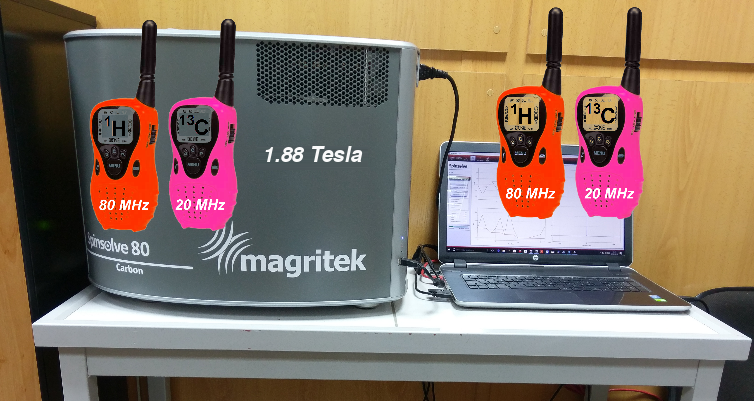
To make the nuclei “resonate”, they are irradiated with a radio wave of the same frequency as that corresponding to the separation between their two energy levels: 80 MHz for 1H and 20 MHz for 13C in a field of 1.88 T. The radio frequency sets the nuclei spinning in phase and tips their magnetization away from the direction of the field.
Perturbing in order to observe
We had left the methane molecules inside a strong magnetic field (B0). The 1H nuclei, all indistinguishable, had split into two groups separated by a minute energy. The 1 % of the carbons that is 13C had also split into two groups, separated by a quarter of that energy.
All spectroscopies are the result of perturbing the system. In infrared, the radiation changes the vibrations of the bonds; in mass spectrometry, the molecule is ionized and breaks up; in X-ray diffraction, the electrons diffract the radiation. How is a nucleus perturbed in NMR?
Conceptually it is not difficult: it is irradiated with an electromagnetic wave of the frequency that corresponds to the separation between the levels. In a field of 1.88 T that is 80 MHz for 1H and 20 MHz for 13C, that is, radio waves, close to those of an FM station (review the previous page). Hence the name: the nuclei are placed in a magnetic field and are brought into resonance with a radio wave.
The population difference
Let us consider a large number of methane molecules, for example one mole (6.022·1023). The nuclei are not split exactly 50:50 between the two levels: the energy difference, tiny as it is, makes the lower level (n½) slightly more populated than the upper one (n−½). The ratio is given by the Boltzmann distribution.
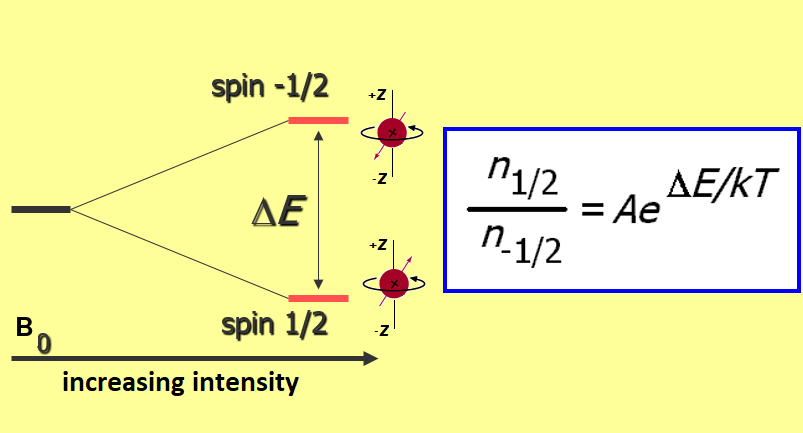
In a field of 1.88 T and at 25 °C, for every million 1H nuclei in the upper level there are only a million and thirteen in the lower one. In a 400 MHz instrument the excess rises to 64 per million, which is why strong fields give more sensitivity. The whole NMR signal comes from that tiny excess.
The macroscopic magnetization
It is simpler to think of the sum of all the nuclear magnets, a vector called the macroscopic magnetization (M0). The magnetic moments of the nuclei cannot line up completely with the field and make an angle with it. According to the laws of physics, a magnet at an angle to a magnetic field rotates around it, like a tilted spinning top around the vertical. That motion is called precession, and its frequency (the Larmor frequency) is precisely the one corresponding to ΔE: 80 MHz for 1H and 20 MHz for 13C in our field of 1.88 T.
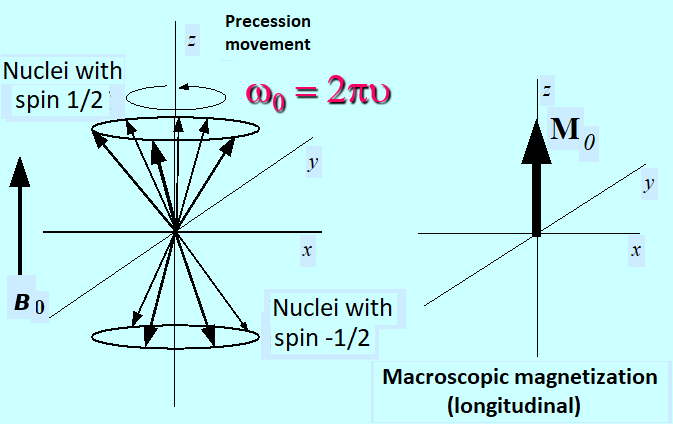
There are a few more vectors rotating around the +z axis than around −z. Since the nuclei rotate out of phase, their components in the xy plane cancel, but the z components do not: the sum of all the vectors is a small vector M0 parallel to the field, the longitudinal magnetization.
The effect of the radio frequency
What happens if the system is irradiated with a radio wave (B1) of the same frequency as the precession of the nuclei and perpendicular to B0? Two things happen at once:
- The nuclei begin to rotate in phase, synchronized.
- The nuclei in the lower level absorb energy and move to the upper level, which evens out the populations.
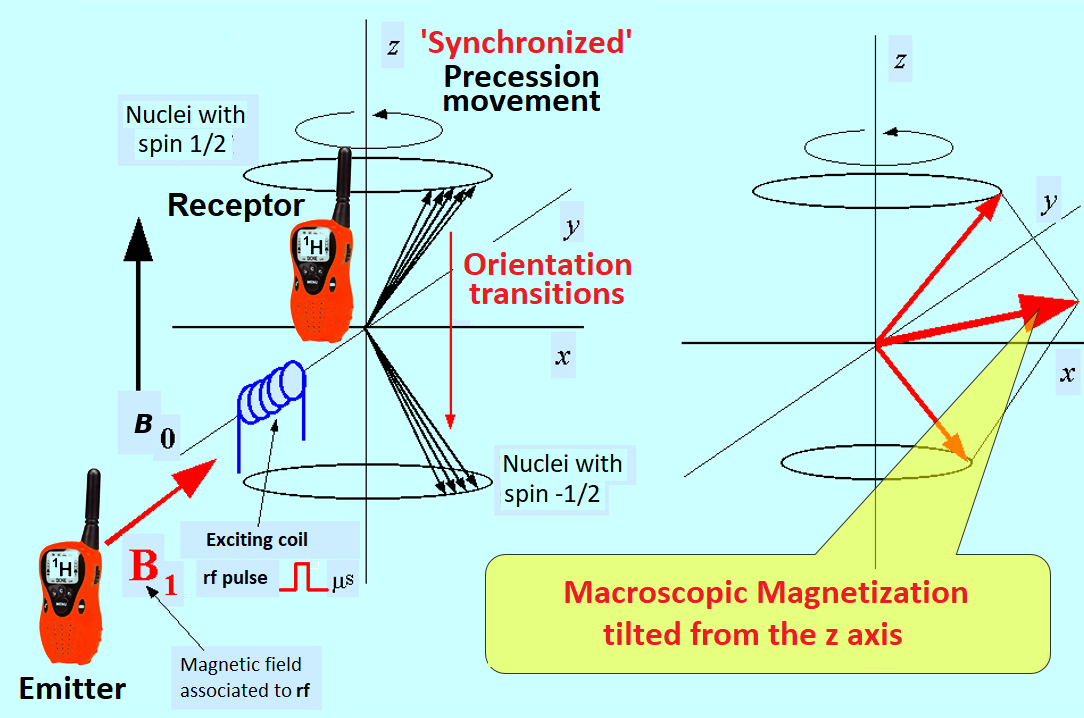
The result is that the magnetization tilts away from the z axis. If B1 is kept on long enough, M0 ends up in the xy plane, perpendicular to the field, and becomes transverse magnetization (Mxy). In today's instruments, B1 is applied as a very short pulse, a few microseconds long, called a “90° pulse” because it tips the magnetization through 90°.
A channel for each nucleus
In a field of 1.88 T, 80 MHz radiation affects only the 1H. To perturb the 1 % of 13C, 20 MHz radiation must be used, which leaves the 1H alone. Each nucleus has its own “channel”, as if it were a walkie-talkie.
One more channel: the electron and electron paramagnetic resonance (EPR)
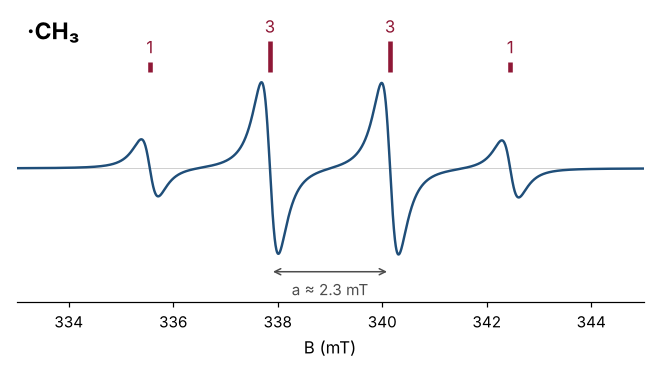
The electron also has spin ½ and behaves like a tiny magnet, about 660 times stronger than the proton. In the same 1.88 T magnet it would resonate at about 53 GHz, in the microwave region. That is why EPR (also called ESR) uses weaker fields, of about 0.34 T, which an electromagnet can provide, and microwaves of about 9.5 GHz. By tradition, the spectrum is recorded by sweeping the field and is drawn as the derivative of the absorption.
Only species with unpaired electrons give a signal: free radicals, many transition-metal ions and defects in solids. In an ordinary organic molecule all the electrons are paired and EPR sees nothing, so it is the ideal technique for detecting radicals and following radical reactions. The unpaired electron interacts with nearby magnetic nuclei and the signal splits (hyperfine structure): n equivalent hydrogens give n + 1 lines, with the same intensities as the NMR multiplets.

Once the magnetization is in the xy plane, the irradiation is stopped and we “listen” to how the system returns to equilibrium: the walkie-talkie switches from transmitter to receiver. That is explained on the next page.