
Nuclei in a magnetic field
In a strong magnetic field (B0), spin-½ nuclei orient themselves in two ways, with or against the field, which have slightly different energies. The separation between the two levels, ΔE, is proportional to the field and to a constant characteristic of each nucleus, the gyromagnetic ratio γ.
Like the needle of a compass
Do you remember how a compass works? It is a magnetized needle that, in the Earth's magnetic field, lines up with the magnetic north pole. The same happens to magnetic nuclei, although noticing it requires a much stronger field than the Earth's: about a hundred thousand times stronger.
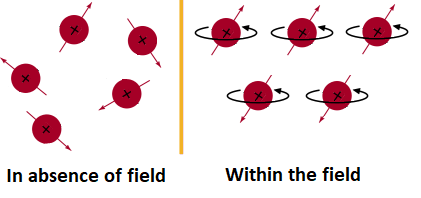
There is an important difference from the compass. Outside the field, all the nuclei have the same energy and no preferred orientation. Inside the field, quantum mechanics allows a spin-½ nucleus only two orientations: roughly half line up, as far as they can, with the field (+z, spin +½) and the other half against it (−z, spin −½).
The two orientations have different energies. The one aligned with the field is a little more stable and very, very slightly more populated. The stronger the field, the larger the separation.
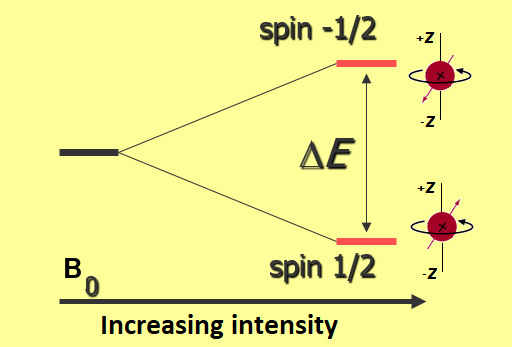
Let us go back to methane. Inside the field, the 99 % of 12C(1H)4 and the 1 % of 13C(1H)4 have their hydrogens split into two groups, some with the field and others against it. The 1 % of 13C(1H)4 also has its carbons split into two groups.
How much energy?
Is the energy that separates the two levels of 1H the same as for 13C? The answer comes from two equations: the Planck-Einstein equation, which relates the energy to the frequency of the radiation that can supply it, and the Larmor equation, which relates that frequency to the field.
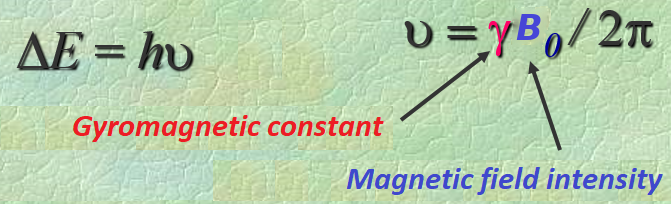
ΔE = hν ν = γB0/2π
- The energy difference is proportional to the field B0. The stronger it is, the further apart the two levels are.
- It also depends on the gyromagnetic ratio (γ), characteristic of each nucleus. That of 1H (26.75·107 rad s−1 T−1) is almost four times that of 13C (6.73·107 rad s−1 T−1).
With actual numbers: in a field of 1.88 T (18,800 gauss), that of an “80 MHz” benchtop spectrometer, the resonance frequency is 80 MHz for 1H and 20 MHz for 13C. That of 1H is four times higher because so is its gyromagnetic ratio.
The energy difference between the two levels is tiny: 5.3·10−26 J for 1H and 1.3·10−26 J for 13C. Per mole of nuclei it is only 0.032 J/mol (7.6·10−3 cal/mol) for 1H, some eighty thousand times less than the thermal energy at room temperature (RT ≈ 2.5 kJ/mol, 0.59 kcal/mol). That is why the population difference between the two levels is so small, as we will see on the next page.
NMR spectroscopy depends on minute energy differences. It is almost miraculous that so much structural information can be obtained from it.
Spectrometers are named after the 1H frequency, not after their field. This table relates the two quantities:
| Field B0 (T) | ν(1H) (MHz) | ν(13C) (MHz) |
|---|---|---|
| 1.41 | 60 | 15 |
| 1.88 | 80 | 20 |
| 7.05 | 300 | 75 |
| 9.40 | 400 | 100 |
| 11.7 | 500 | 125 |
| 14.1 | 600 | 150 |
| 28.2 | 1200 | 300 |