
Nuclear magnetism
Some nuclei, such as 1H and 13C, have spin and behave like tiny magnets. 12C, the main isotope of carbon, does not. That is why NMR “sees” all the hydrogens of an organic molecule, but only 1 % of its carbons.
“Nuclear” does not mean radioactive
The name nuclear magnetic resonance tells us that the technique has to do with atomic nuclei. But there is no need to worry: it has nothing to do with radioactivity, which is what the word “nuclear” always suggests to the general public. The nuclei are not transformed; they only change, very slightly, their orientation.
In NMR the nuclei are the main characters and the electrons take a secondary, though very important, role, as we saw on the previous page.
Nuclear spin
Protons and neutrons have a quantum property called spin. A nucleus is a charged particle, and a “spinning” charge creates a magnetic field. In the nucleus, the spins of the protons and of the neutrons tend to pair up and cancel. Thus:
- If the nucleus has an even number of protons and an even number of neutrons, like 12C (6 + 6) or 16O (8 + 8), its total spin is zero and it has no magnetic moment. It is “invisible” to NMR.
- If it has an odd number of protons, of neutrons or of both, like 1H (1 proton) or 13C (6 protons and 7 neutrons), it has spin and behaves like a tiny magnet.
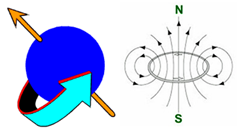
The 1H and 13C nuclei have spin ½, the simplest case. Other nuclei of interest to the organic chemist, such as 19F, 31P or 15N, also have it; they are studied in the topic on other nuclei.
Hydrogen and carbon
Which are the most abundant and important elements in an organic molecule? Hydrogen and carbon. Wouldn't it be extraordinary to receive a signal from each of their nuclei? If we knew how to interpret that information, we would have a map of the molecular structure. That is exactly what is achieved by recording NMR spectra.
- 1H (one proton and no neutrons) has a natural abundance of 99.99 %. Practically all the hydrogens of a molecule are magnets.
- 13C (mass 13.003) has an abundance of 1.1 %. It is small, but enough. The remaining 98.9 % is 12C, with no magnetic moment.
Food for thought: methane
Consider the simplest organic molecule, methane (CH4). It is completely symmetrical and its four hydrogens are equivalent and indistinguishable.
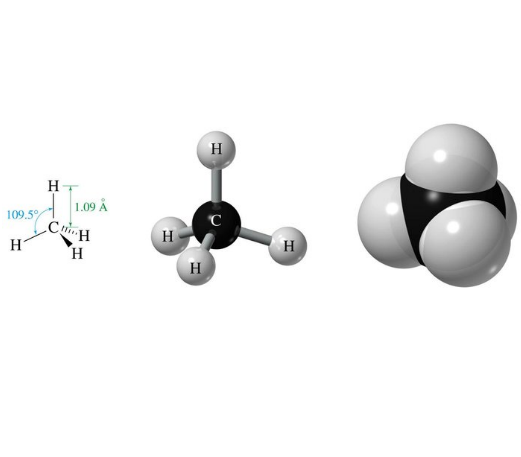
Now think about it differently: natural methane is a mixture of two kinds of molecules.
- 99 % of 12C(1H)4, with only four magnets, the four equivalent 1H.
- 1 % of 13C(1H)4, with five magnets: the four 1H and the 13C.
Keep this in mind. When we record a 13C spectrum, only the molecules that contain 13C “speak”, and they are one in a hundred at each position. And in them, the 13C is almost always surrounded by 12C. The consequences, for sensitivity and for the appearance of the spectra, will be seen in the topic on 13C NMR.