
NMR: from Rabi to today's instruments
Nuclear magnetic resonance (NMR) was born in physics laboratories between 1938 and 1946. Within a few years chemists discovered that it gave a different signal for each type of hydrogen in a molecule, and they turned it into the most powerful technique for determining organic structures.
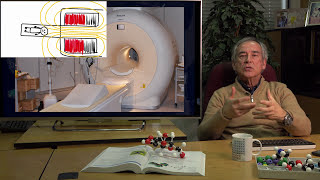
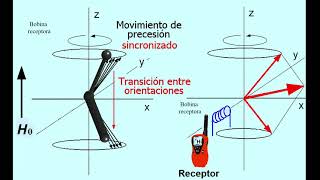
Two videos to begin with
Nuclei, the supporting actors of chemistry
Chemistry studies the transformations that take place when electrons are shuffled between atoms: that is how some substances turn into others. In that shuffling the atomic nuclei go unnoticed. But we should not forget that the nucleus is the centre of every atom and that, tiny as it is, it has properties we can use to “see” molecular structures. One of them is the magnetic moment, which is what NMR uses.
From physics to chemistry
The first magnetic resonance experiments were carried out by Isidor Rabi in 1938 with beams of molecules in a vacuum, and they earned him the 1944 Nobel Prize in Physics. In 1945 and 1946, Edward Mills Purcell (with solid paraffin) and Felix Bloch (with water) independently observed the absorption of radio frequency by the hydrogen nuclei of ordinary matter, and they shared the 1952 Nobel Prize in Physics.
Each type of nucleus, the proton (1H) or phosphorus (31P), for example, absorbed at a different radio frequency, which made it possible to identify it. When a nucleus absorbs the radio frequency, it is said to be in resonance.
As the experiments were refined, something turned up that physicists found a nuisance and chemists found a gift: the same nucleus, such as 1H, did not always resonate at the same frequency, but at slightly different frequencies depending on the compound it was in. In 1951 Arnold, Dharmatti and Packard, at Stanford University, recorded the spectrum of ethanol (CH3CH2OH) and found three signals: one for the three hydrogens of the CH3, another for the two of the CH2 and another for the one of the OH.
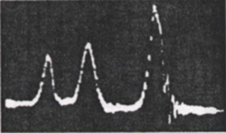
And, to everyone's surprise, the areas of the signals were in a 1 : 2 : 3 ratio, exactly the number of hydrogens in each group. NMR made it possible to “see” the groups of hydrogens, to “count” them and, from the position of their signal, to know what part of the molecule they were in. It is the electrons, now as supporting actors, that make the nuclei resonate at slightly different frequencies.
NMR observes the nuclei, but what it tells us about them depends on the electrons around them. That is why it gives information about structure.
The great advances
The practical discovery of NMR coincided with that of the transistor, and since then it has progressed at the pace of electronics and computing:
- 1952-1961. The company Varian sells the first spectrometers. The Varian A-60 (60 MHz, 1961) brings 1H NMR into organic chemistry laboratories.
- 1966. Richard Ernst and Weston Anderson replace the slow frequency sweep with a radio-frequency pulse followed by the Fourier transform. Ernst received the 1991 Nobel Prize in Chemistry, also for two-dimensional NMR.
- 1970s. Superconducting magnets and routine 13C NMR.
- 1980s. Two-dimensional NMR (COSY, NOESY, 1H-13C correlations) and the structure of proteins in solution, for which Kurt Wüthrich received the 2002 Nobel Prize in Chemistry.
- Medicine. Magnetic resonance imaging (MRI), for which Paul Lauterbur and Peter Mansfield received the 2003 Nobel Prize in Medicine. In hospitals the word “nuclear” was dropped so as not to frighten patients.
- Today. Magnets of up to 28 T (1.2 GHz for 1H) and, at the other end, benchtop instruments without liquid helium that fit in any laboratory (see NMR spectrometers and techniques).
The following pages explain, with no more physics than necessary, why some nuclei behave like magnets, what happens to them in a magnetic field, how they are made to “resonate” and how their response is turned into a spectrum.