NOESY and ROESY
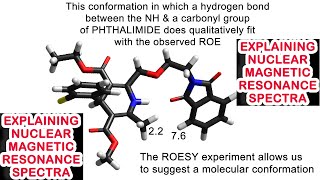
NOESY and ROESY look like COSY, but their cross peaks indicate proximity in space rather than coupling: they link hydrogens less than about 5 Å apart, however many bonds separate them. They are based on the nuclear Overhauser effect and are used to study the configuration and conformation of molecules.
Close in space, not in bonds
Coupled hydrogens are usually close in space, because at most four bonds separate them. But some hydrogens separated by many bonds end up close together because of the configuration or conformation of the molecule. Coupling does not detect them; the nuclear Overhauser effect (NOE) does.
Remember that the NOE is a transfer of magnetisation through space, not through bonds. Its intensity falls with the sixth power of the distance, 1/r6, so it is only observed between hydrogens less than about 5 Å apart. NOESY (Nuclear Overhauser Effect SpectroscopY) shows all the NOEs of the molecule in a single map. It is read like a COSY: each pair of symmetric cross peaks links two hydrogens that are close in space.
Peak sign and molecular size
The NOE depends on how fast the molecule tumbles in solution, measured by its correlation time τc. The larger the molecule, the slower it tumbles.
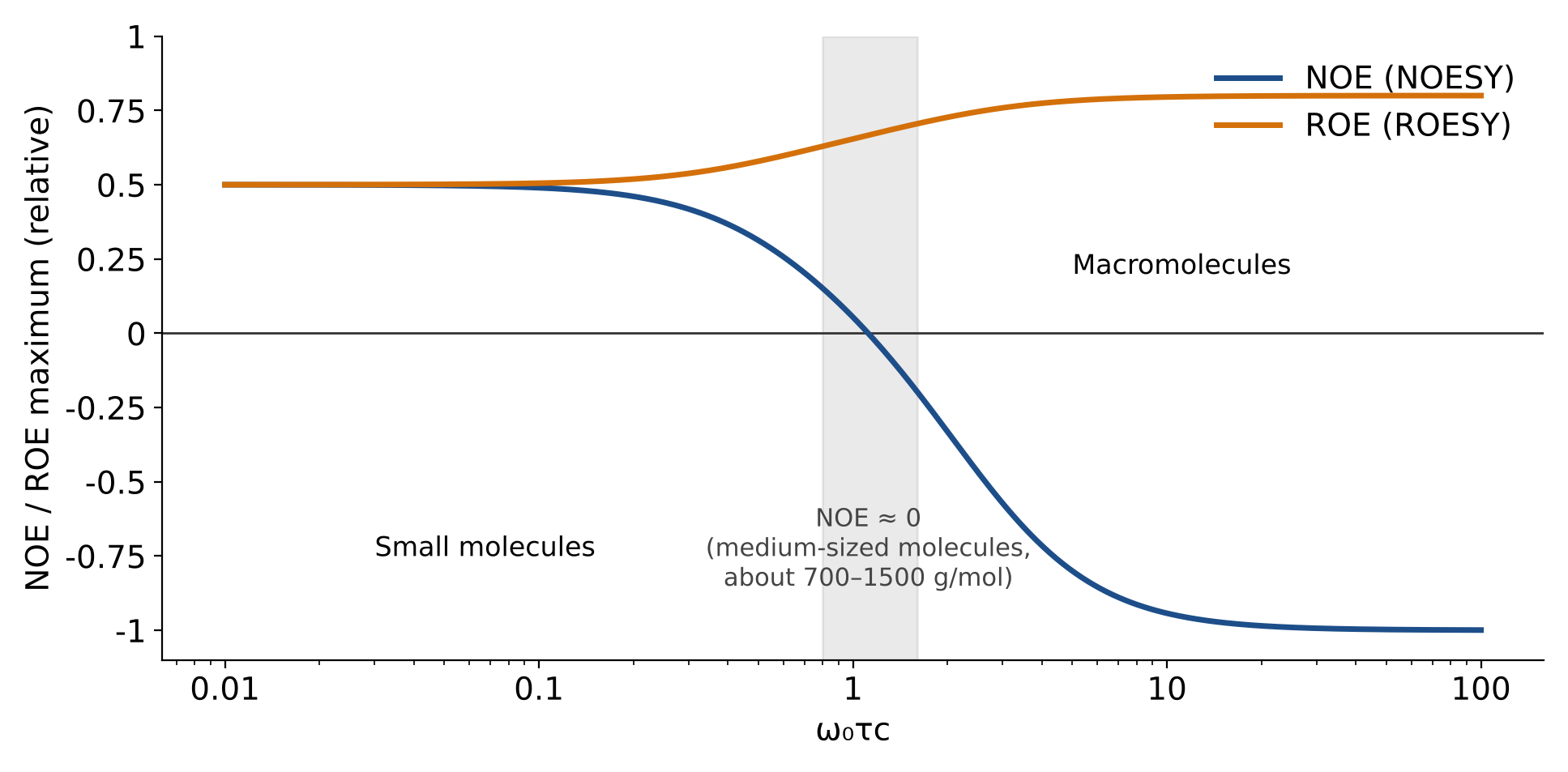
- Small molecules, a few hundred g/mol, tumbling fast: the NOE is positive, and in NOESY the cross peaks have the opposite sign to the diagonal.
- Macromolecules, such as proteins or polymers, tumbling slowly: the NOE is negative and strong, and the cross peaks have the same sign as the diagonal.
- Medium-sized molecules, about 700 to 1500 g/mol depending on the field: the NOE passes through zero and NOESY may show nothing, even when hydrogens are very close.
For the last case ROESY (Rotating-frame Overhauser Effect SpectroscopY) is used. It measures the effect under different conditions, with the magnetisation "locked" by a radiofrequency field, and its effect is always positive, whatever the size of the molecule. In a ROESY, proximity cross peaks always have the opposite sign to the diagonal.
Peaks that are not NOEs
These spectra sometimes show cross peaks that are not due to proximity. It is worth recognising them:
- Chemical exchange peaks. If a hydrogen jumps between two positions (an OH exchanging with water, slow rotation about a bond), a cross peak appears between them with the same sign as the diagonal.
- COSY-type peaks in NOESY, between coupled hydrogens, with a characteristic shape of alternating positive and negative lines.
- TOCSY-type peaks in ROESY: during the spin-lock, magnetisation can also spread along the chain of couplings. They have the same sign as the diagonal, and that is how they are told apart from ROEs.
An example: cis-non-3-en-1-ol
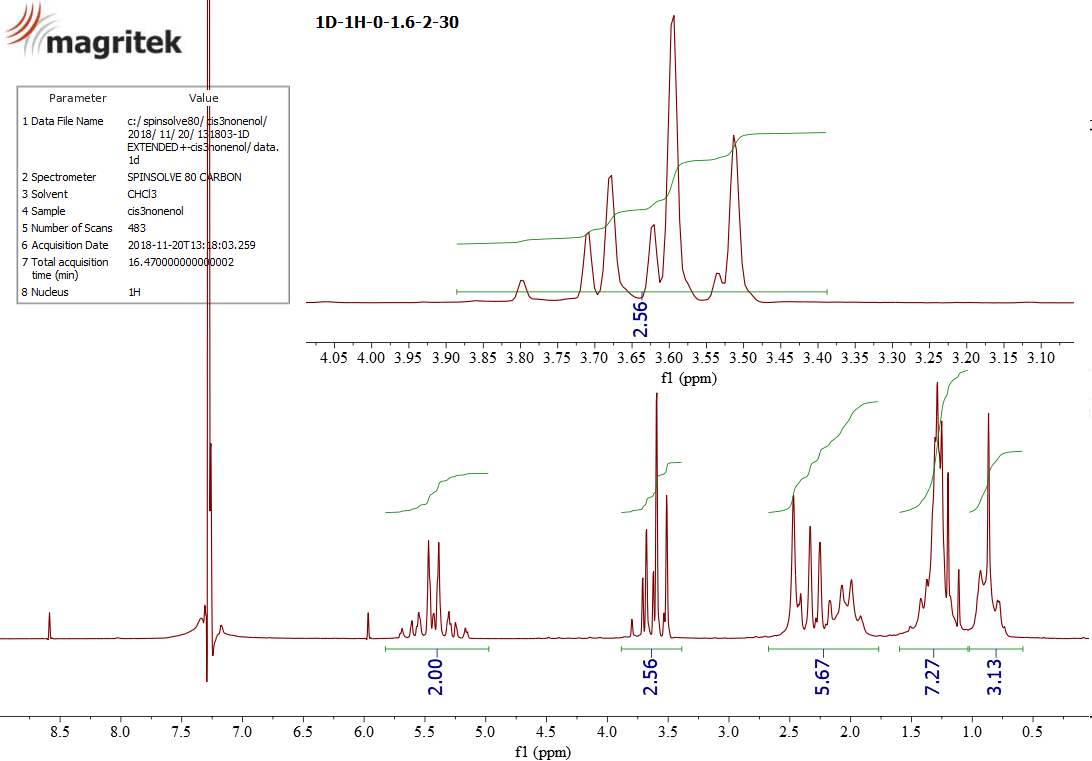
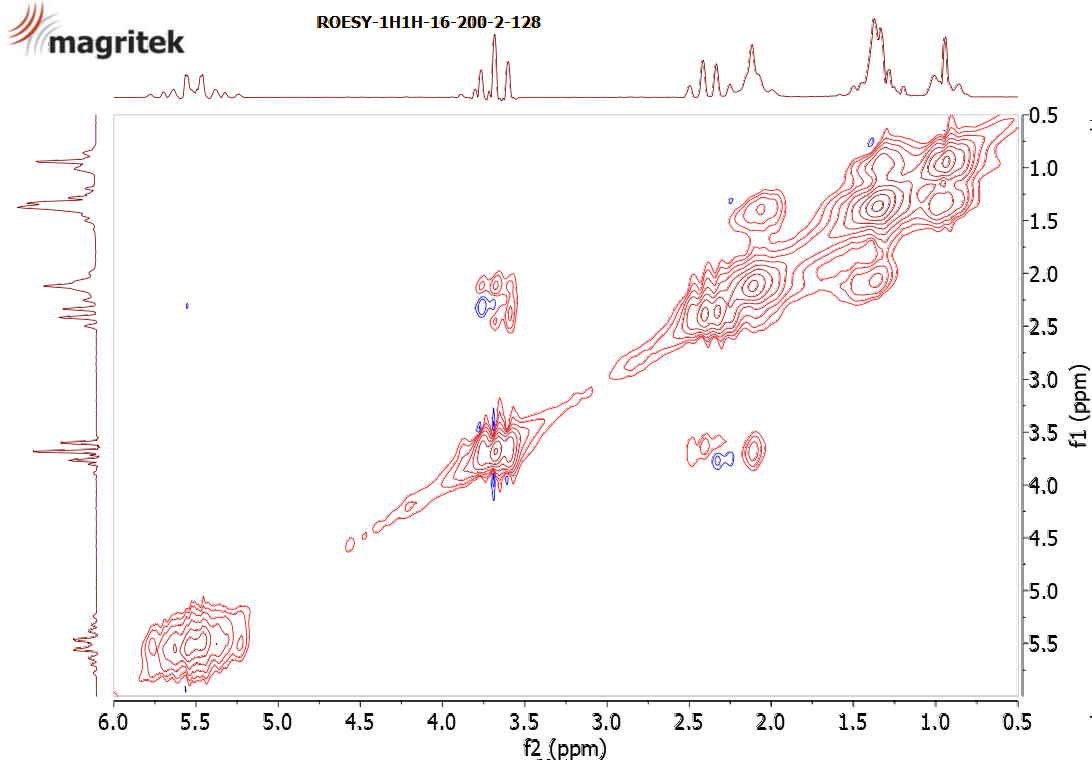
Let us compare the COSY and ROESY of cis-non-3-en-1-ol, HO–CH2–CH2–CH=CH–CH2–(CH2)3–CH3, recorded on an 80 MHz benchtop instrument. The main signals are the olefinic hydrogens (5.3–5.6 ppm), the CH2OH (3.63 ppm), the two allylic CH2 groups (2.33 ppm for C2 and 2.04 ppm for C5), the three chain CH2 groups (around 1.3 ppm) and the CH3 (0.9 ppm).
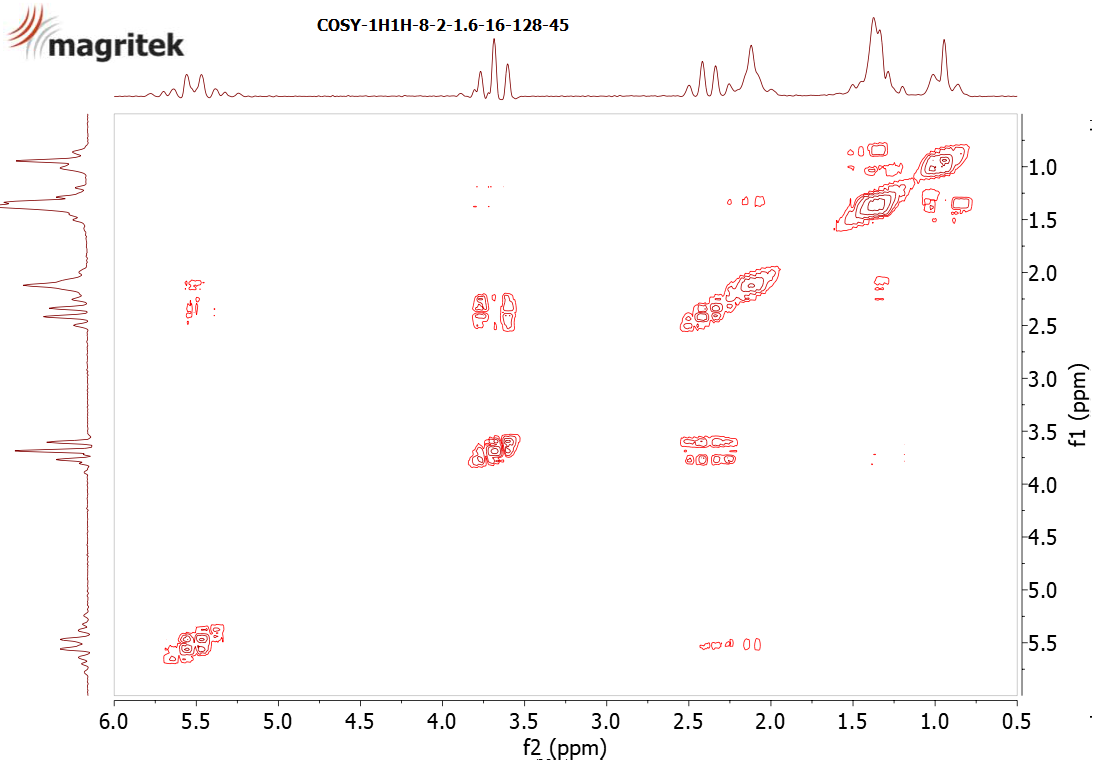
- In the COSY, the CH2OH (3.63 ppm) correlates only with its neighbour, the CH2 at 2.33 ppm. The olefinic hydrogens correlate with both allylic CH2 groups.
- In the ROESY, the diagonal is red, so true ROEs must appear in blue. The peak between 3.63 and 2.33 ppm is blue: the C1 and C2 hydrogens are, naturally, close in space.
- The ROESY also shows a peak between 3.63 ppm and 2.04 ppm (the C5 CH2), which is not in the COSY. But it is red, the same sign as the diagonal: it is not a ROE but a TOCSY-type peak. The magnetisation has travelled along the chain of couplings C1–C2–C3=C4–C5.
The lesson is important: in a ROESY you must check the sign before concluding that two hydrogens are close. The proximity that would reveal the cis configuration, between the two allylic CH2 groups (2.33 and 2.04 ppm), lies too close to the diagonal at 80 MHz to be resolved. The cis configuration is better confirmed in two other ways. One is the coupling constant between the olefinic hydrogens (about 11 Hz for cis and 15 Hz for trans), measured at high field. The other is 13C: the allylic carbons of a cis alkene appear about 5 ppm more shielded than those of the trans isomer.
NOESY and ROESY detect hydrogens close in space (less than 5 Å). NOESY works for small and large molecules; ROESY for medium-sized ones. In both, the sign of the cross peak relative to the diagonal tells you whether it is a proximity effect or an artefact.
Applications to relative configuration and conformation are covered in topic 12.