Blaise Pascal (1623-1662)
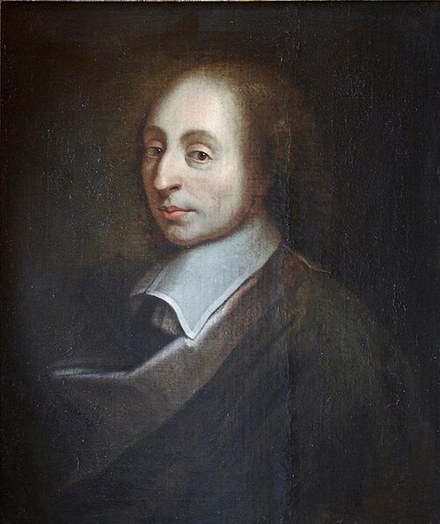
French mathematician, physicist and philosopher born in Clermont (now Clermont-Ferrand). He was a child prodigy: his father educated him at home and at sixteen he wrote an essay on conic sections. At nineteen he built a mechanical calculator, the Pascaline, to help his father with his accounts as a tax collector.
He studied the vacuum and atmospheric pressure: in 1648 he had his brother-in-law carry a barometer up the Puy de Dôme and showed that the mercury fell with altitude. He stated the principle of the transmission of pressure in liquids, the basis of the hydraulic press, and the SI unit of pressure bears his name.
In 1654, in his correspondence with Pierre de Fermat about games of chance, he laid the foundations of probability theory, and wrote the Treatise on the Arithmetical Triangle (published in 1665), in which he studied in depth the properties of the triangle that now bears his name, although Chinese, Persian and Italian mathematicians, such as Tartaglia, had known it centuries earlier. He devoted his last years to religion; from that period come the Provincial Letters and the Pensées.
More information: en.wikipedia.org