
A strategy for solving structures
Solving a structure is like doing a jigsaw puzzle: each technique contributes pieces, and the solution must fit all of them. There is no single method, but following an order helps not to get lost and not to overlook anything. This section proposes a strategy and applies it to a complete example.
A strategy in eight steps
- Review the data. Check that the sample is pure and that the spectra are properly referenced. Identify the signals that do not belong to the compound: the solvent (CHCl3 at 7.26 ppm in 1H and 77.2 ppm in 13C), water, grease from the stopcocks, TMS.
- Molecular formula and degrees of unsaturation. From the exact mass or elemental analysis (T1, T2). The degrees of unsaturation tell how many rings and π bonds have to be found.
- Functional groups. IR (C=O, OH, NH, C≡N…), the mass-spectral fragments and the characteristic 13C shifts (carbonyls above 160 ppm, carbons bonded to oxygen between 50 and 90 ppm).
- Carbon inventory. With 13C and DEPT or edited HSQC, count the carbons and classify them as C, CH, CH2 and CH3. If there are fewer signals than carbons in the formula, there is symmetry. Compare the number of hydrogens bonded to carbon with the formula: the missing ones are in OH, NH or SH groups.
- Fragments. In the 1H spectrum, the integrals give the number of hydrogens in each signal, and the multiplicities and coupling constants, their neighbours. COSY gathers the hydrogens into spin systems; each one is a fragment of the molecule.
- Join the fragments. HMBC connects the fragments through quaternary carbons and heteroatoms, where 1H–1H couplings are interrupted.
- Stereochemistry. Coupling constants and NOE give the relative configuration (T12); the absolute configuration requires other techniques.
- Check. The proposed structure must explain all the signals, their shifts, multiplicities and intensities, and must not predict signals that do not appear. It is worth comparing it with data for known compounds.
Common mistakes: forgetting hydrogens that exchange with the solvent (OH and NH in CD3OD or D2O); missing a symmetry and miscounting the carbons; mistaking rotamers for a mixture of compounds; interpreting a second-order spectrum as first-order; and accepting a structure that explains almost all of the data.
A worked example
A colourless liquid with a fruity smell gives the following data:
| Technique | Data |
|---|---|
| MS (EI) | m/z 176 (M+•, 40 %), 131 (100 %), 103 (60 %), 77 (35 %). Exact mass: 176.0837 |
| IR | 1712 (s), 1637 (m), 1310, 1170 (s), 980 (m), 767 and 711 cm−1 |
| 13C (CDCl3) | 167.0 (C), 144.6 (CH), 134.5 (C), 130.2 (CH), 128.9 (2 CH), 128.0 (2 CH), 118.3 (CH), 60.5 (CH2), 14.3 (CH3) |
| 1H (CDCl3, 400 MHz) | a 7.69 (d, J = 16.0 Hz, 1H); b 7.52 (m, 2H); c 7.38 (m, 3H); d 6.44 (d, J = 16.0 Hz, 1H); e 4.27 (q, J = 7.1 Hz, 2H); f 1.34 (t, J = 7.1 Hz, 3H) |
| HMBC (selection) | Ha → 167.0, 128.0 and 118.3; Hd → 167.0 and 134.5; He → 167.0 and 14.3 |
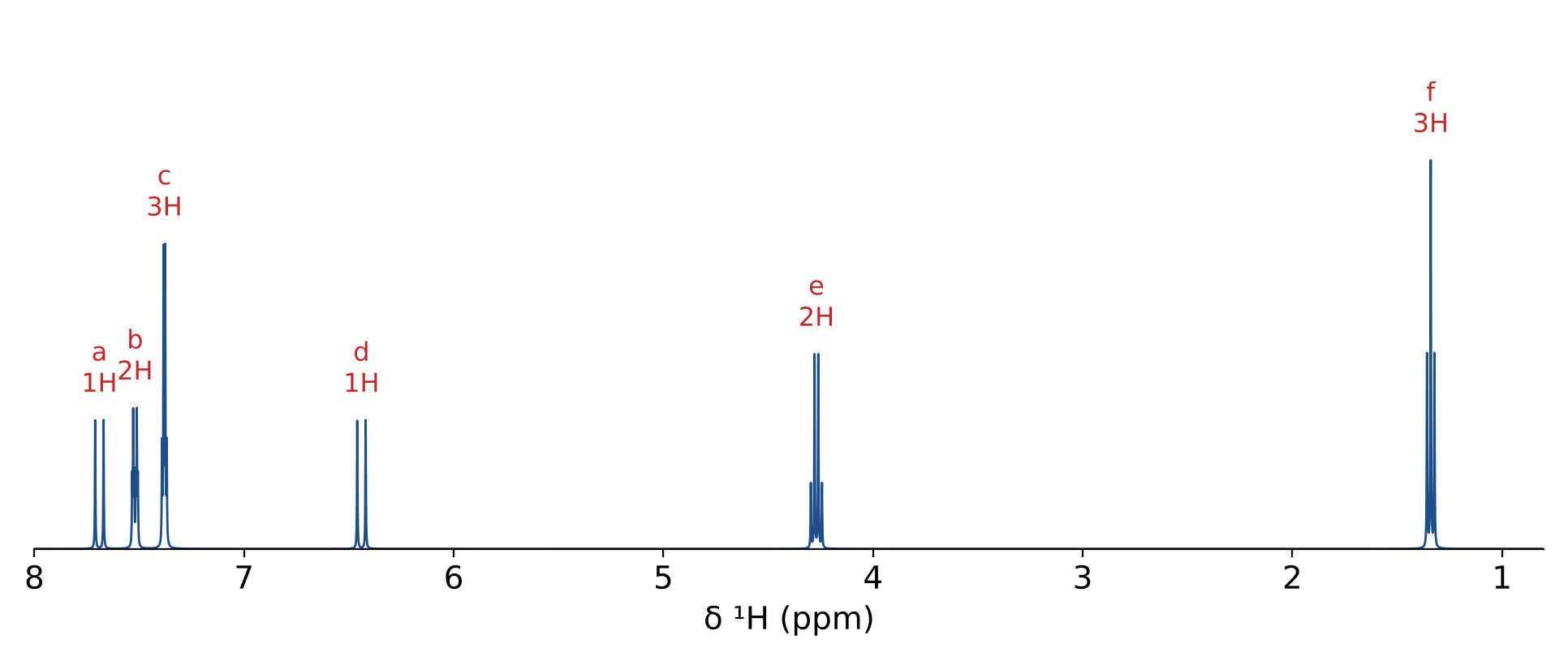
1. Formula. The exact mass 176.0837 corresponds to C11H12O2 (calculated 176.0837). Degrees of unsaturation: (22 + 2 − 12)/2 = 6.
2. Functional groups. The IR band at 1712 cm−1, somewhat low for a saturated ester, and the carbon at 167.0 ppm indicate a conjugated ester. The band at 1637 cm−1 is a C=C, and the one at 980 cm−1 is typical of a trans alkene. The bands at 767 and 711 cm−1 suggest a monosubstituted benzene.
3. Carbons. There are 9 signals for 11 carbons: two of them (128.9 and 128.0 ppm) count double, which is typical of a monosubstituted benzene ring (ortho and meta C). The hydrogens bonded to carbon are 1 + 2 + 3 + 1 + 2 + 3 = 12, all those in the formula: there is no OH.
4. Fragments.
- An ethyl group bonded to oxygen: quartet e (2H, 4.27 ppm, on a 60.5 ppm carbon) and triplet f (3H), with the same constant. It is an ester OCH2CH3.
- A phenyl group: 5 aromatic H (b + c) and the carbons at 134.5, 130.2, 128.9 and 128.0 ppm.
- A trans CH=CH double bond: doublets a and d couple to each other with J = 16.0 Hz, a value only possible for two trans hydrogens.
The unsaturations add up: benzene (4) + C=C (1) + C=O (1) = 6.
5. Joining the fragments. In the HMBC, the OCH2 hydrogens (e) correlate with the carbonyl (167.0): the ethyl group is on the ester oxygen. Hd (6.44 ppm) correlates with the carbonyl and with Cipso (134.5); Ha (7.69 ppm) correlates with the carbonyl and with the ortho C (128.0). The double bond therefore lies between the ring and the carbonyl, with Ha in the β position, next to the phenyl (deshielded by conjugation with the carbonyl), and Hd in the α position.
6. Structure. It is ethyl (E)-3-phenylprop-2-enoate (ethyl cinnamate), C6H5–CH=CH–COOCH2CH3.
7. Check. The mass spectrum also fits: the base peak at m/z 131 is the loss of the ethoxy group (176 − 45), the acylium ion C6H5CH=CHCO+; the one at 103 results from losing CO as well (131 − 28), and the one at 77 is the phenyl cation.
Videos
 ▶ Determinación de tres estructuras hermanas (in Spanish)
 ▶ Averigua la estructura molecular con RMN (in Spanish)
 ▶ Practica RMN: Adivina estructuras (in Spanish)
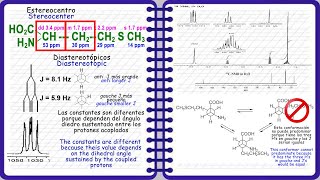 ▶ Practica RMN 2: Adivina estructuras (in Spanish)
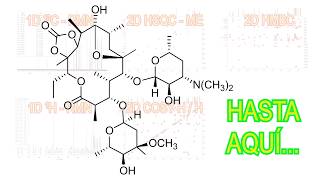 ▶ Rompecabezas (in Spanish)
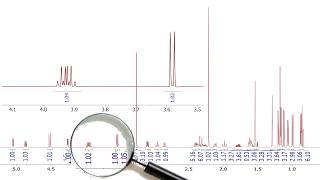 ▶ Más Rompecabezas (in Spanish)
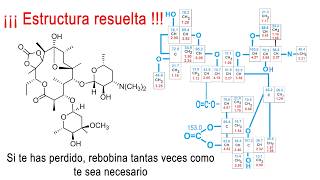 ▶ Se me rompió la cabeza (in Spanish)
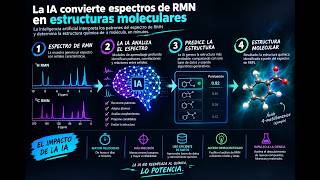 ▶ ¿La IA nos deja sin trabajo? (in Spanish)