
Elemental analysis and molecular formula
The first piece of data in any structure determination is the molecular formula. Traditionally it was obtained in two steps: elemental analysis gave the proportion of the atoms (the empirical formula) and a measurement of the molecular mass showed how many times it had to be multiplied. Today high-resolution mass spectrometry gives the molecular formula directly.
Elemental analysis by combustion
The method is based on completely burning a weighed amount of sample in excess oxygen and measuring the products: all the carbon becomes CO2, all the hydrogen H2O and the nitrogen N2 (and nitrogen oxides, which are then reduced). Justus von Liebig developed it around 1830, absorbing and weighing the water and the CO2, and Fritz Pregl adapted it to a few milligrams of sample (Nobel Prize, 1923).
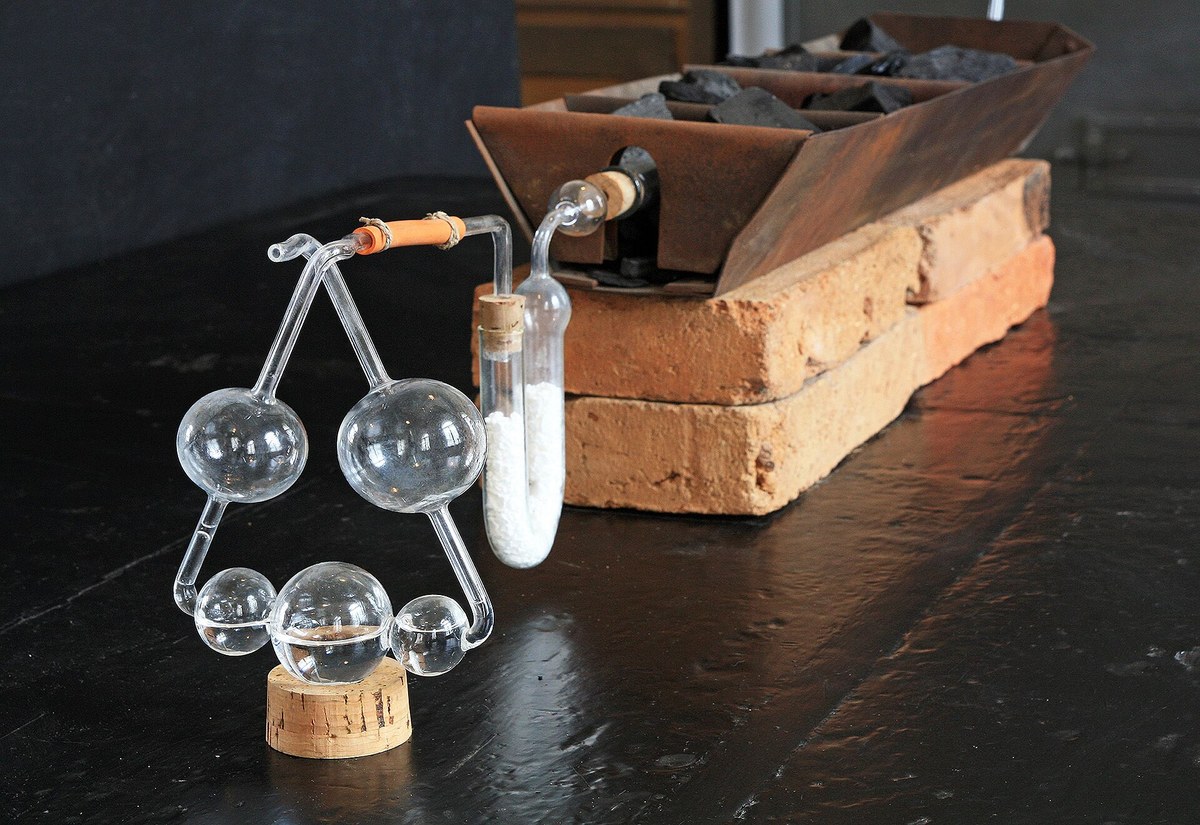
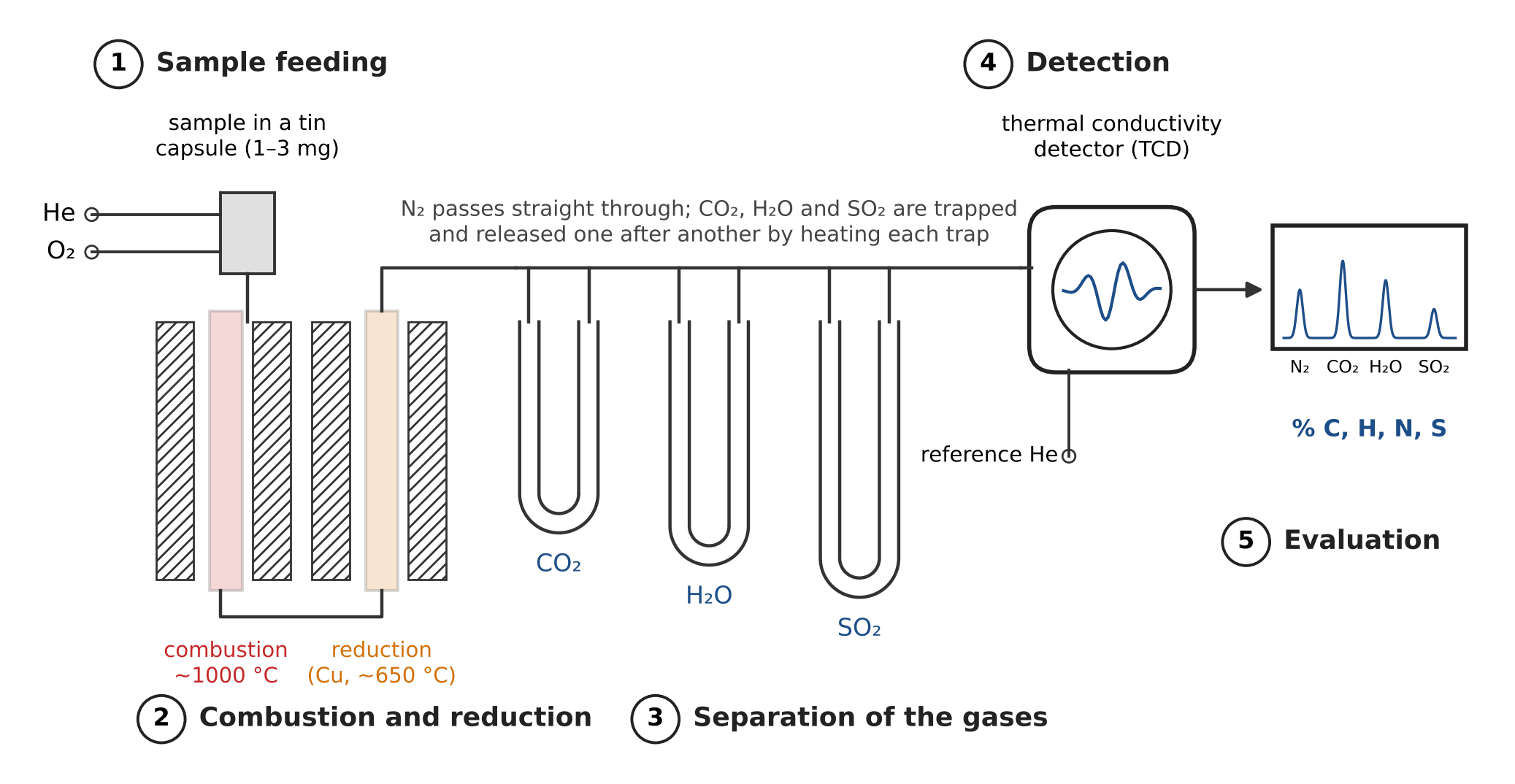
Current analysers do the same automatically: they separate the combustion gases, with traps that retain them and release them one after another or by gas chromatography, and quantify them with a thermal conductivity detector, which compares the conductivity of the outgoing gas with that of pure helium. In a few minutes they give the percentages of C, H, N (and S, if SO2 is measured too). Oxygen is not normally measured; it is calculated by difference up to 100 %, provided it is known that no other elements are present. Halogens, phosphorus or metals need separate analyses.
The precision is a few tenths of a per cent. That is why scientific journals accept elemental analysis as proof of the purity of a new compound when the values found do not deviate by more than ±0.4 % from those calculated.
From percentages to the empirical formula
The empirical formula is the simplest ratio between the numbers of atoms. It is calculated by dividing each percentage by the atomic mass of the element and finding the whole-number ratio between the quotients.
For example, a liquid gives C 64.81 % and H 13.60 %; the remaining 21.59 % is assumed to be oxygen:
| Element | % | % / atomic mass | ÷ the smallest | Atoms |
|---|---|---|---|---|
| C | 64.81 | 64.81 / 12.011 = 5.396 | 4.00 | 4 |
| H | 13.60 | 13.60 / 1.008 = 13.49 | 10.0 | 10 |
| O | 21.59 | 21.59 / 15.999 = 1.349 | 1.00 | 1 |
The empirical formula is C4H10O. If the quotients do not come out as whole numbers (for example, 1 : 1.5), they are all multiplied by the small number that makes them whole (here, 2 : 3).
From the empirical to the molecular formula
The molecular formula is a whole-number multiple of the empirical one: (C4H10O)n. To find n the molecular mass is needed. It used to be measured by freezing-point depression or vapour density; today it is obtained from the molecular ion in the mass spectrum (see The mass spectrometer). If the mass spectrum of the previous example shows the molecular ion at m/z 74, since the empirical formula weighs 74.12, n = 1 and the molecular formula is C4H10O.
In other cases the multiple is not 1. Glucose, for example, gives C 40.00 % and H 6.71 %, which corresponds to the empirical formula CH2O (mass 30.03). With a molecular mass of 180, n = 6 and the molecular formula is C6H12O6.
The molecular formula must obey the nitrogen rule: a compound containing C, H, O, S and halogens has an even nominal molecular mass if it contains an even number of nitrogen atoms (including zero), and an odd one if it contains an odd number. A molecular ion at m/z 59, therefore, indicates one or three nitrogens.
Exact mass
High-resolution mass spectrometry measures the mass of the molecular ion to four or five decimal places. Since isotope masses are not whole numbers (1H = 1.00783; 12C = 12.00000; 14N = 14.00307; 16O = 15.99491), formulas with the same nominal mass have different exact masses: CO weighs 27.9949; N2, 28.0061, and C2H4, 28.0313. With an accuracy of a few ppm, the exact mass usually leaves only one possible formula (see Exact mass, isotopes and molecular formula).
That is why elemental analysis is no longer the main route to the molecular formula, although it remains the most widely used proof of purity. It also has a limitation: in large molecules, formulas that differ by two hydrogens give almost identical percentages. C20H30O2 (C 79.42 %, H 10.00 %) and C20H32O2 (C 78.90 %, H 10.59 %) can barely be told apart within the margin of error; their exact masses, 302.2246 and 304.2402, leave no room for doubt.