
Exact mass, isotopes and molecular formula
With a high-resolution analyser, the mass of the molecular ion is measured to four or five decimal places, and this exact mass fits only one or very few molecular formulas. In addition, isotopes leave their signature in the spectrum: the M+1 peak indicates how many carbons there are, and the M+2 peak reveals chlorine, bromine or sulfur.
Nominal mass, exact mass and molar mass
There are three ways of expressing the mass of a molecule, and they should not be confused:
- Nominal mass is calculated with the integer masses of the most abundant isotope of each element (C = 12, H = 1, O = 16…). It is what a quadrupole measures.
- Exact monoisotopic mass is calculated with the exact masses of those same isotopes (C = 12.0000; H = 1.0078; O = 15.9949…). It is what a high-resolution analyser measures.
- Molar mass (the "molecular weight") uses the average atomic masses of all natural isotopes (C = 12.011…). It is used for weighing in the laboratory, but does not correspond to any peak in the spectrum.
| Isotope | Exact mass (u) | Abundance (%) | Heavy isotope | Abundance (%) |
|---|---|---|---|---|
| 1H | 1.00783 | 99.99 | 2H | 0.01 |
| 12C | 12.00000 | 98.93 | 13C | 1.07 |
| 14N | 14.00307 | 99.64 | 15N | 0.36 |
| 16O | 15.99491 | 99.76 | 18O | 0.20 |
| 19F | 18.99840 | 100 | — | — |
| 31P | 30.97376 | 100 | — | — |
| 32S | 31.97207 | 94.99 | 34S | 4.25 |
| 35Cl | 34.96885 | 75.76 | 37Cl | 24.24 |
| 79Br | 78.91834 | 50.69 | 81Br | 49.31 |
| 127I | 126.90447 | 100 | — | — |
From exact mass to formula
Only 12C has an exactly integer mass, by definition. The other isotopes deviate slightly: hydrogen weighs a little more than 1 and oxygen a little less than 16. That is why formulas with the same nominal mass have different exact masses. Suppose a compound gives its molecular ion at m/z 120.0573:
| Formula | Exact mass | Difference from 120.0573 |
|---|---|---|
| C4H8O4 | 120.0423 | −125 ppm |
| C8H8O | 120.0575 | +2 ppm |
| C7H8N2 | 120.0687 | +95 ppm |
| C9H12 | 120.0939 | +305 ppm |
High-resolution spectrometers measure with an error below 5 ppm (parts per million), so only C8H8O fits, for example acetophenone. At higher masses there are more possible formulas and accuracy alone is not enough: it must be combined with the isotopes and with the rules below. From the formula, the number of unsaturations is calculated.
The nitrogen rule
A molecule containing C, H, O, S and halogens always has an even nominal mass. If it has an odd number of nitrogen atoms, its mass is odd. The reason is that nitrogen is the only common element with an even mass (14) and an odd valence (3). So a molecular ion at m/z 151, like that of paracetamol, C8H9NO2, reveals an odd number of nitrogens. Careful: for the [M+H]+ ions of soft methods the parity is reversed.
The M+1 peak: the number of carbons
1.07 % of carbon atoms are 13C. In a molecule with n carbons, the probability that one of them is 13C is approximately 1.1 % × n. That is why the M+1 peak has an intensity, relative to M, of about 1.1 % per carbon:
no. of C ≈ (intensity of M+1 / intensity of M) × 100 / 1.1
In toluene (7 carbons), M+1 is about 7.7 % of M. Each nitrogen adds another 0.37 %. The estimate is approximate, because small intensities are measured with some error, but it easily tells a 5-carbon molecule from a 15-carbon one.
The M+2 peak: chlorine, bromine and sulfur
Chlorine and bromine have two abundant isotopes two mass units apart, and they leave unmistakable groups of peaks:
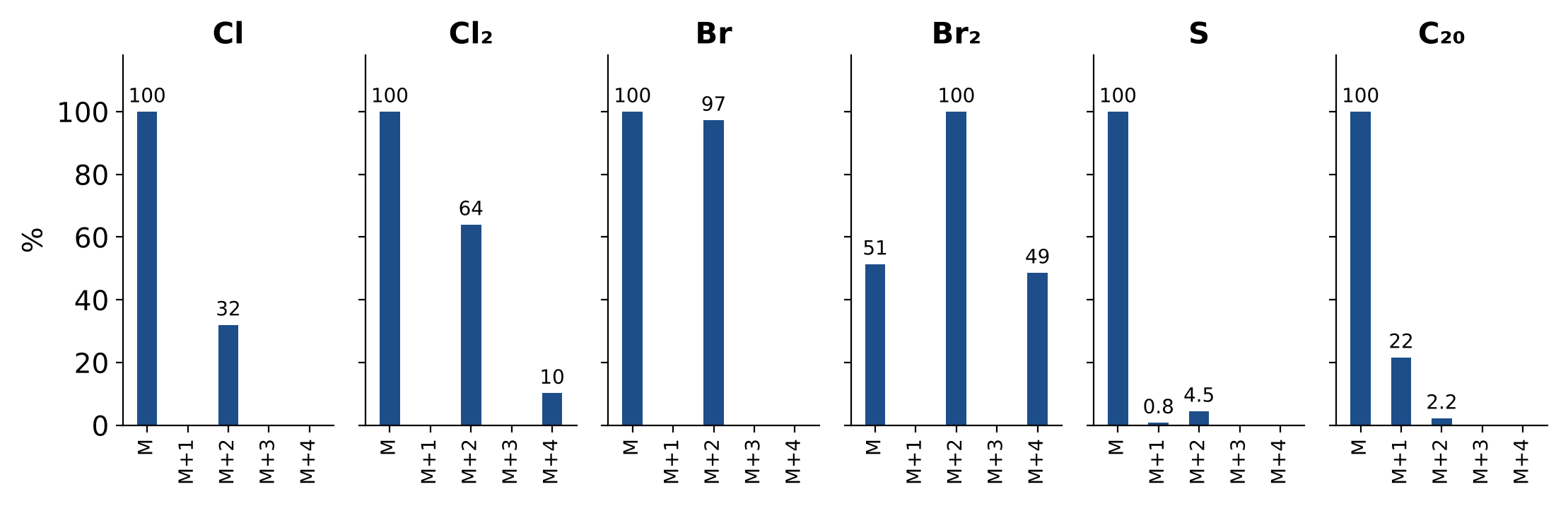
- One chlorine: M and M+2 in a 3 : 1 ratio.
- Two chlorines: M, M+2 and M+4 in a 9 : 6 : 1 ratio.
- One bromine: M and M+2 almost equal, 1 : 1.
- Two bromines: 1 : 2 : 1.
- One sulfur: an M+2 of 4.4 %, small but noticeable.
This is how it looks for dichloromethane, CH2Cl2:
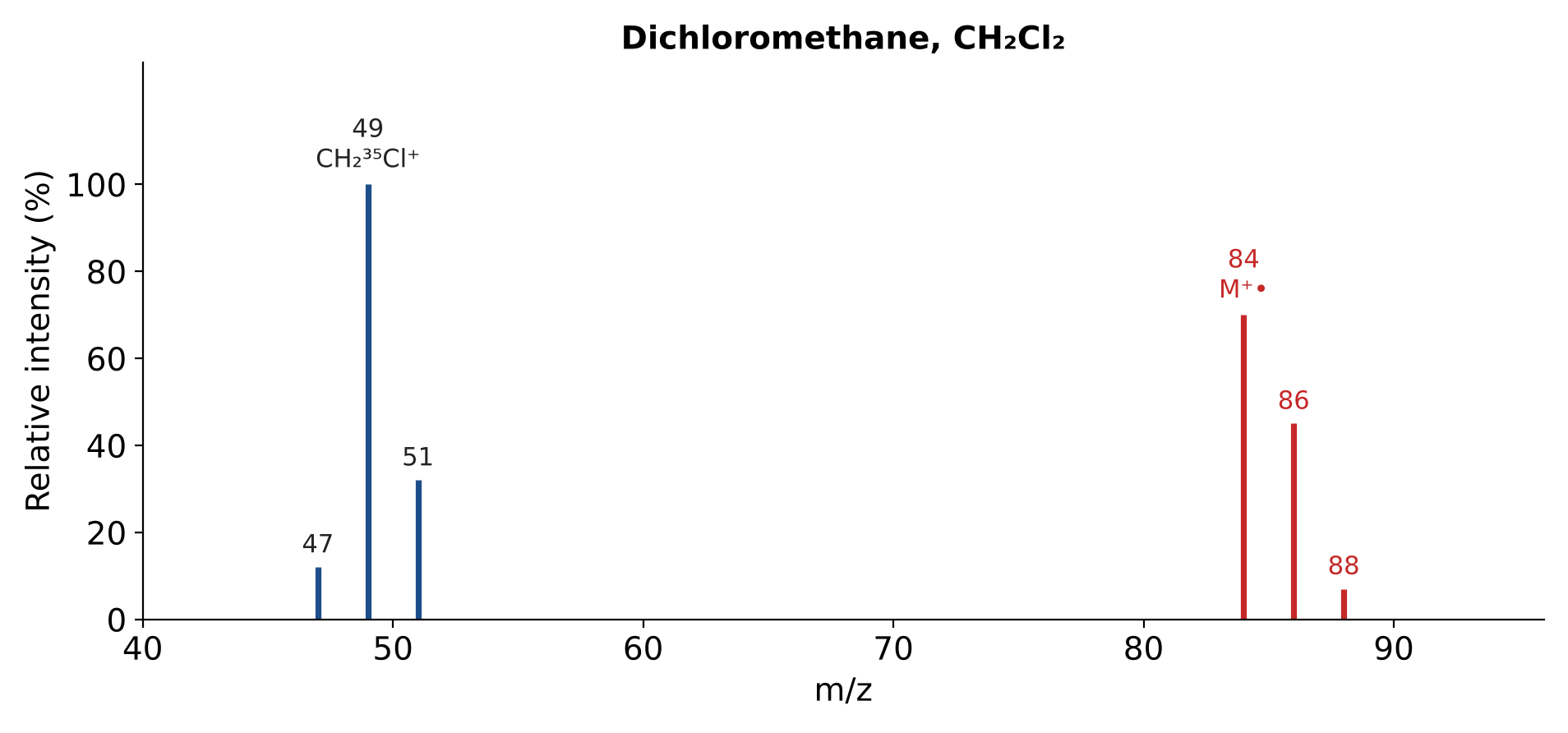
The molecular ion forms the 84/86/88 group, in a 9 : 6 : 1 ratio, as expected for two chlorines. The base peak, at 49, is CH2Cl+, which has lost one chlorine: that is why it comes with a peak at 51 of one third of its intensity, the pattern of a single chlorine. Isotope patterns also tell how many halogens each fragment keeps.
Sulfur leaves a more discreet signature. In dimethyl disulfide, CH3SSCH3, with two sulfurs, the M+2 peak (96) reaches 9 % of the molecular ion, twice as much as with a single sulfur and far more than the carbons and hydrogens would give:
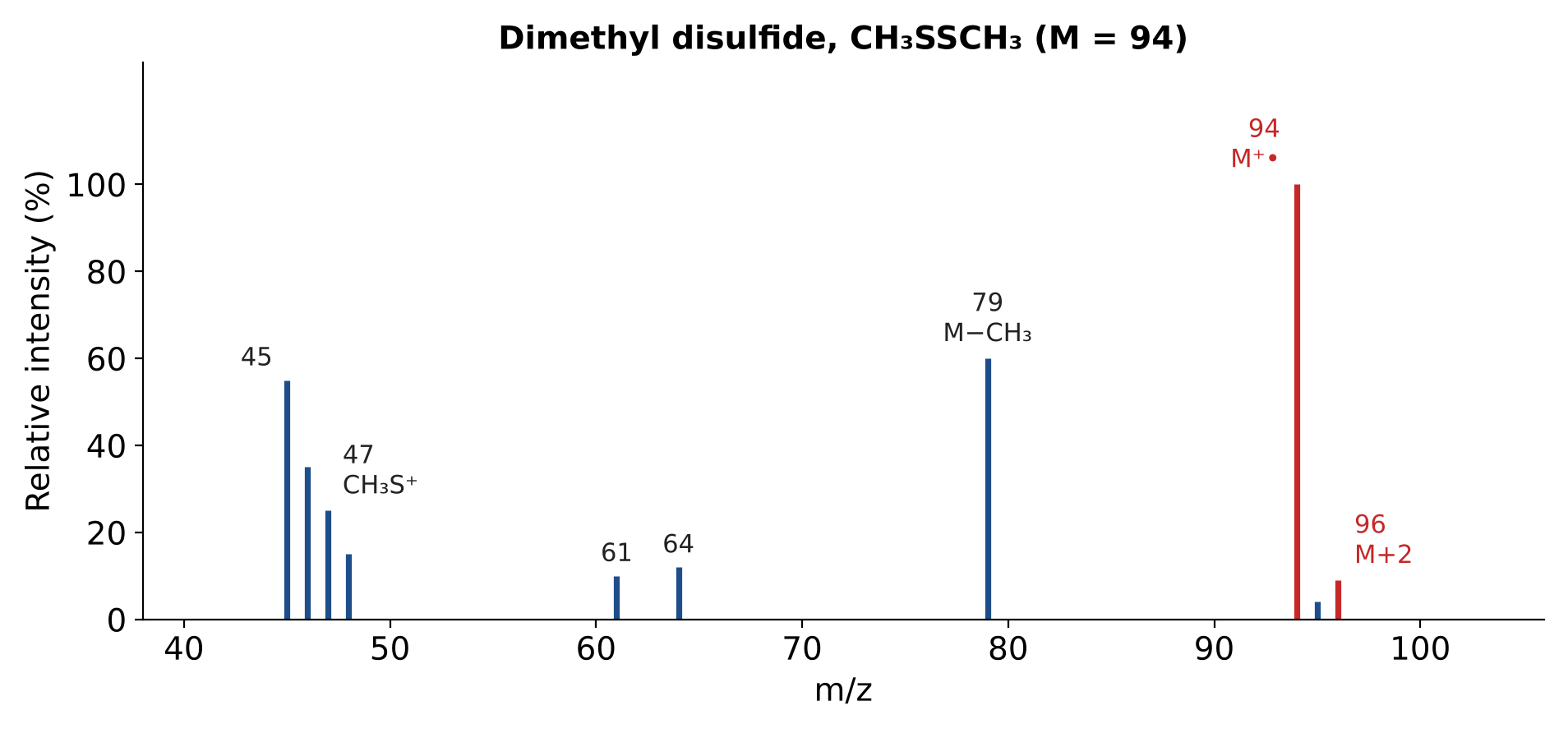
An M+2 of 4–5 % for each sulfur, without the 3 : 1 pattern of chlorine or the 1 : 1 of bromine, is the clue to thiols, sulfides and disulfides. The M+1 (95), on the other hand, is small: only two carbons.
To deduce the formula from the mass spectrum: (1) find the molecular ion, (2) apply the nitrogen rule, (3) estimate the carbons from M+1, (4) look for Cl, Br or S in M+2 and (5), if you have an exact mass, choose the formula that matches within 5 ppm.